This website uses cookies to improve your experience. We\'ll assume you\'re ok with this, but you can opt-out if you wish. Read More
Performance Golf SF2 vs SF1: What Actually Changed and Is the Upgrade Worth It?
Categories :
Article-At-A-Glance
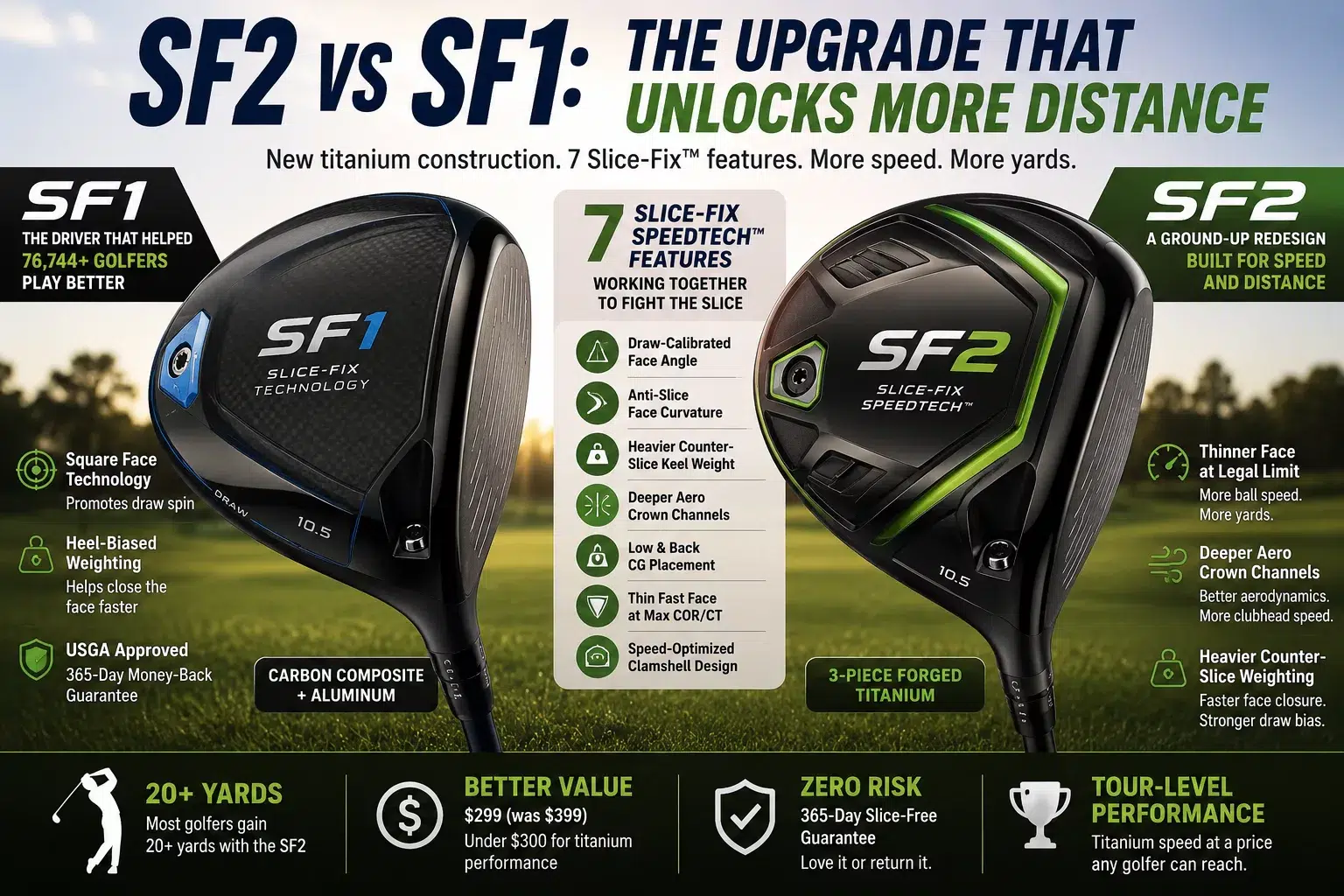
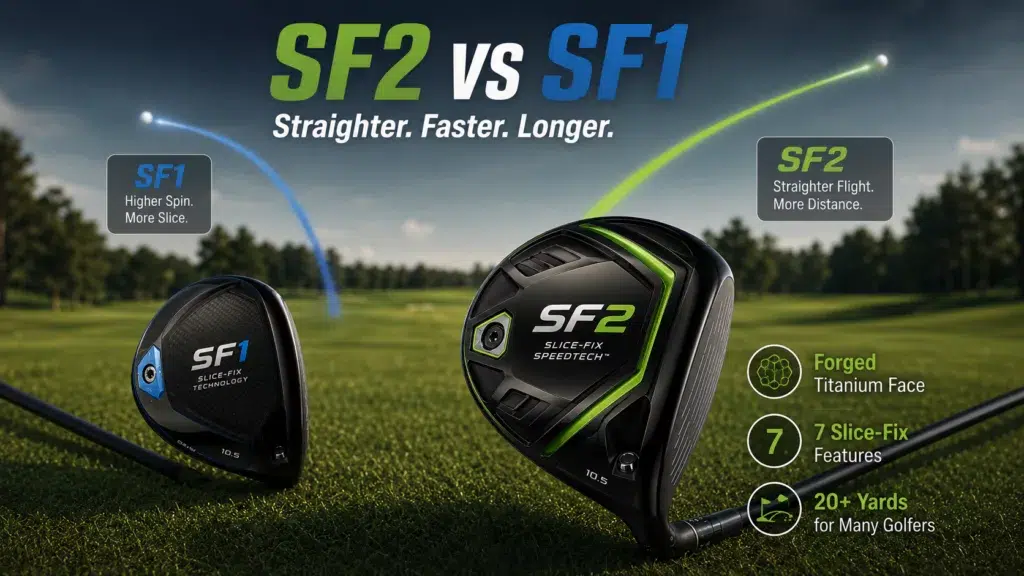
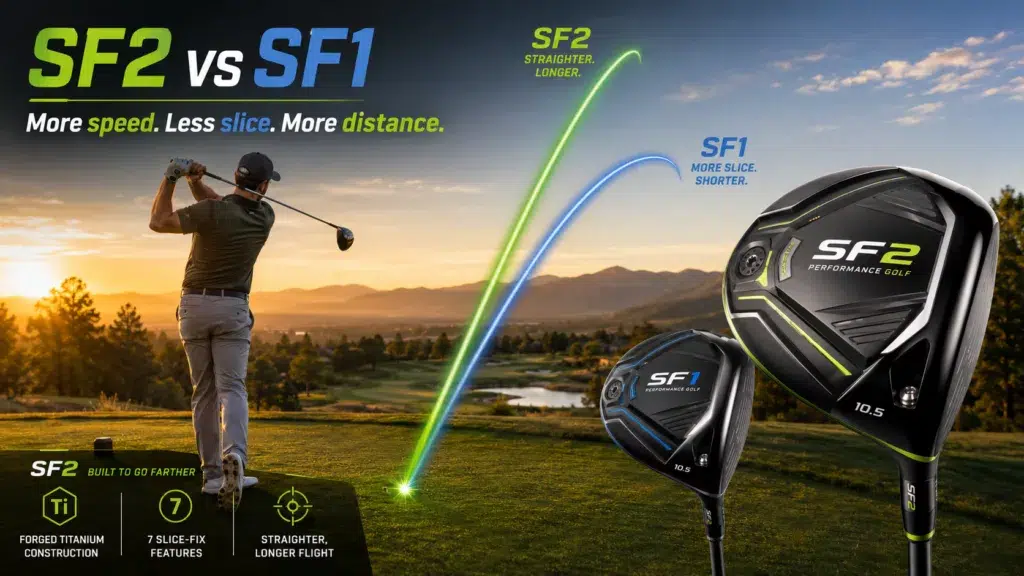
- The SF2 is a full redesign — not just a refresh — featuring 3-piece forged titanium construction versus the SF1’s carbon composite and aluminum build.
- Performance Golf’s SF2 introduces 7 Slice-Fix features working together, including a draw-calibrated face angle, deeper Aero Crown Channels, and heavier Counter-Slice Weighting.
- Most golfers report gaining 20+ yards switching to the SF2, thanks to a thinner face engineered to the legal COR/CT limit — something the SF1 couldn’t match.
- The SF1 still holds its own for casual golfers on a budget, but there’s a specific type of golfer who will see a dramatic difference with the SF2 — keep reading to find out if that’s you.
- Both drivers come with a 365-day money-back guarantee, which changes the risk calculation entirely when deciding whether to upgrade.
If you’ve been playing with the SF1 and wondering whether the SF2 is a real upgrade or just a marketing refresh, the answer is: the construction change alone makes it a completely different driver.
The jump from carbon composite and aluminum to a 3-piece forged titanium build isn’t cosmetic. It directly affects how fast the face flexes at impact, how weight is distributed to fight the slice, and how efficiently the clubhead moves through the air. Performance Golf engineered the SF2 specifically around titanium’s speed-producing properties — something the SF1 simply wasn’t built to do.
This breakdown covers every meaningful difference between the two drivers, who should upgrade, and whether the SF2 holds up against premium drivers from major brands costing $500 or more.
The SF2 Is a Meaningful Upgrade — Here’s the Short Version
The SF1 was a solid slice-fighting driver that helped over 76,744 golfers improve their game. The SF2 takes everything that worked in the SF1 and rebuilds it from scratch around a material that unlocks ball speed the original design couldn’t deliver. Forged titanium allows for a thinner, hotter face — and that translates directly to distance.
Beyond the material upgrade, Performance Golf deepened the Aero Crown Channels, added more heel weighting for faster face closure, and refined the 445cc head into a lower, sleeker clamshell profile. The aerodynamics are legitimately better, which means more clubhead speed without swinging harder.
| Feature | SF1 | SF2 |
|---|---|---|
| Construction | Carbon composite + aluminum | 3-piece forged titanium |
| Face Technology | Standard face | Thin fast face at max COR/CT limit |
| Head Size | 445cc | 445cc Speed Geometry |
| Slice-Fix Features | Multiple | 7 Slice-Fix SpeedTech™ features |
| Counter-Slice Weighting | Standard heel weight | Heavier Counter-Slice Keel Weight |
| Aerodynamics | Crown channels | Deeper Aero Crown Channels |
| Price | Under $300 | $299 (from $399) |
| Guarantee | 365-day money-back | 365-day Slice-Free Guarantee |
What the SF1 Was Built to Do
Before breaking down the SF2’s improvements, it’s worth understanding what made the SF1 worth buying in the first place. It wasn’t just another driver with a slightly closed face — it was built around a specific problem that affects 96% of amateur golfers.
The Slice Problem It Was Designed to Solve
A slice happens when the clubface is open at impact relative to the swing path, sending the ball spinning hard to the right (for right-handed golfers). Most traditional drivers do nothing to correct this — they’re built for tour-level swing mechanics that most recreational golfers simply don’t have. The SF1 addressed this directly with Square Face Technology and Anti-Slice Face Curvature, which automatically works to square the clubface through impact and promote draw-spin, even on off-center hits.
SF1 Construction: Carbon Composite and Aluminum
The SF1 used a carbon composite body with an aluminum component in its construction. This combination kept costs manageable and allowed for strategic weight placement to fight the slice. However, aluminum and carbon composite have physical limitations when it comes to face thickness and energy transfer — the face simply cannot be made as thin or as springy as forged titanium, which directly caps the ball speed potential of the design.
Why the SF1 Still Works for Many Golfers
Despite being the older model, the SF1 is still a genuinely effective anti-slice driver. It features a draw-calibrated face angle, anti-slice face curvature, and heel-biased weighting that helps close the face faster through impact. For golfers with slower swing speeds or those who aren’t chasing maximum distance, the SF1 delivers real, measurable correction. It’s USGA-approved and backed by the same 365-day money-back guarantee, which means the barrier to trying it is low.
The honest answer is that for many weekend golfers, the SF1 still does the job. The upgrade to the SF2 becomes compelling when distance is the missing piece — or when the SF1 fixed the slice but left yards on the table.
What Actually Changed in the SF2
Performance Golf didn’t just update the aesthetics or adjust the loft. The SF2 is a ground-up redesign that addresses the one limitation the SF1 couldn’t overcome: ball speed. Here’s exactly what changed, and why each upgrade matters on the course.
1. Switch From Aluminum to 3-Piece Forged Titanium
This is the single biggest change between the two drivers. Forged titanium is significantly lighter and stronger than aluminum, which allows engineers to redistribute weight more precisely and manufacture a thinner face without sacrificing structural integrity. The result is a clubhead that’s aerodynamically cleaner, more durable, and purpose-built for speed. The SF2’s 3-piece titanium construction also gives the head a lower, sleeker clamshell profile compared to the SF1 — not just for looks, but to reduce drag through the swing.
2. Thinner Face for More Ball Speed at Legal COR/CT Limit
The SF2’s face is engineered to the maximum legal limit for COR (Coefficient of Restitution) and CT (Characteristic Time) — the USGA’s measurements for how much energy a face transfers to the ball. Hitting this limit means the face is as hot as the rules allow. The SF1’s construction didn’t allow for this level of face thinness, which means every swing with the SF2 is transferring more energy to the ball than the SF1 could physically achieve.
This is where the 20+ yard distance gains most golfers report actually come from. It’s not just that straight shots travel farther than slices — the SF2 is genuinely generating more ball speed at impact.
3. Heavier Counter-Slice Keel Weighting in the Heel
The SF2 takes the SF1’s heel weighting concept and amplifies it. By placing more mass deeper in the heel, the center of gravity is positioned to encourage faster face rotation through the impact zone — which is exactly what a slicer needs. This isn’t a subtle tweak; Performance Golf specifically increased the weight to make face closure more automatic, reducing the demand on swing timing and technique.
4. Deeper Aero Crown Channels for Less Air Resistance
The crown channels carved into the top of the SF2 are deeper than those on the SF1. These channels aren’t decorative — they redirect airflow over the clubhead during the downswing to reduce drag. Less air resistance means the clubhead is moving faster when it reaches the ball, adding to the overall speed package without requiring any change in the golfer’s swing.
5. 445cc Speed Geometry Head With Clamshell Profile
The SF2 keeps the same 445cc head size as the SF1 but completely reworks the shape. The lower, flatter clamshell profile isn’t just about looks — it’s designed specifically around how titanium behaves aerodynamically. The result is a head that cuts through the air more efficiently, with less turbulence at the crown, so the speed you generate in your backswing doesn’t bleed off before you reach the ball.
SF2 vs SF1: Side-by-Side Breakdown
Knowing the individual upgrades is useful, but seeing them stacked side by side makes the generational gap between these two drivers immediately clear. The SF2 isn’t an incremental improvement — it’s a complete reimagining of what a slice-fix driver can do when you build it around a premium material from the ground up.
Both drivers share the same core philosophy: give everyday golfers a technical advantage that compensates for imperfect swing mechanics. Where they differ is in how aggressively they pursue distance alongside slice correction. The SF1 prioritized fixing the slice. The SF2 refuses to let you choose between accuracy and power.
Here’s how the key specs break down head to head: for more details, check out the SF2 driver media info.
Construction and Materials
The SF1 uses a carbon composite body with aluminum components — a construction choice that kept the price accessible but introduced hard limits on how thin the face could be made. The SF2’s 3-piece forged titanium build eliminates those limits entirely. Titanium’s strength-to-weight ratio allows for a face that’s simultaneously thinner, faster, and more durable than anything the SF1’s material stack could produce. If you put both drivers on a workbench, the SF2 simply feels like a more premium piece of equipment — because it is.
Slice-Fix Features Compared
The SF1 brought meaningful slice-correction tools to the market: Square Face Technology, Anti-Slice Face Curvature, and heel-biased weighting that helped close the face at impact. The SF2 keeps all of that and adds a full suite of 7 Slice-Fix SpeedTech™ features working simultaneously — including a Draw-Calibrated Face Angle, Draw Spin Face Bulge, Speed Geometry Toe Slot, and the upgraded Counter-Slice Keel Weighting. The difference isn’t one or two features; it’s a fully integrated system where every element reinforces the others.
Distance and Ball Speed Differences
This is where the upgrade conversation gets serious. The SF1 corrects slices, and straight shots naturally travel farther than sliced ones — so most SF1 users did see distance gains. But the SF2 adds a second layer of distance that has nothing to do with fixing the slice. The thin titanium face at max legal COR/CT generates more ball speed from the same swing, meaning the SF2 is faster even when both drivers are hitting the ball dead straight.
Performance Golf reports that most golfers gain 20 or more yards switching to the SF2. Some of that comes from straightening out the ball flight. The rest comes from a face that’s simply hotter at impact than anything the SF1’s construction could deliver.
Who Should Upgrade From SF1 to SF2
Not every SF1 owner needs to switch — but there’s a clear profile of golfer who will see a dramatic difference with the SF2. If you recognize yourself in either of the following scenarios, the upgrade is worth serious consideration.
The 365-day Slice-Free Guarantee removes the financial risk entirely, so the real question isn’t whether you can afford to try it — it’s whether your game has hit a ceiling that the SF1’s construction can’t break through.
Golfers Still Battling a Slice After Using the SF1
The SF1 fixed the slice for the majority of its users. But slice severity varies dramatically from golfer to golfer, and some players have swing mechanics so deeply ingrained that they need every possible structural advantage to counteract them. If you’re still seeing right-to-right ball flight after using the SF1, the SF2’s heavier Counter-Slice Keel Weighting and more aggressive Draw-Calibrated Face Angle bring significantly more correction force to the problem.
The SF2 also adds Draw Spin Face Bulge — a feature that promotes draw-spin even on off-center hits toward the toe. For golfers who consistently miss toward the toe (which opens the face further and amplifies the slice), this is a meaningful technical advantage the SF1 simply doesn’t offer.
Think of it this way: the SF1 is a correction tool. The SF2 is a correction system. When one tool isn’t enough, you bring in the full system.
Golfers who should seriously consider upgrading include:
- Players who reduced their slice with the SF1 but couldn’t eliminate it completely
- Golfers with swing speeds above 80 mph who are leaving ball speed on the table
- Players who fixed accuracy with the SF1 but are still getting outdriven by playing partners
- Anyone who has tried swing lessons without lasting results and wants the club to do more of the work
- Golfers who consistently make contact toward the toe and need Draw Spin Face Bulge to compensate
Golfers Who Want More Distance Without Swing Changes
If your slice is largely under control but you’re still not keeping up off the tee, the SF2’s titanium face is the upgrade you’re looking for. The max-legal COR/CT construction means every solid strike is transferring the maximum allowable energy to the ball — no swing adjustment required. This is the driver for golfers who’ve fixed the direction problem and are now ready to fix the distance problem.
Who Does Not Need to Upgrade
If the SF1 fixed your slice and you’re happy with your distance off the tee, there’s no urgent reason to switch. The SF1 is still a technically sound, USGA-approved driver that outperforms most standard drivers when it comes to anti-slice engineering. Casual golfers who play a few rounds per season and aren’t chasing maximum performance will get full value from the SF1 without needing to spend more.
Similarly, golfers with swing speeds well under 80 mph may find the distance difference between the two drivers less pronounced than it would be for faster swingers. The titanium face is optimized for speed — and if the swing isn’t generating significant clubhead velocity to begin with, the face technology has less raw energy to amplify.
SF2 vs Big-Name Drivers: Is It Worth $299?
The SF2 is priced at $299 (down from $399) if you join up for their trial PG1 Membership, which puts it well below the $500 to $600 price point of tour-focused drivers from major brands. That price gap is significant, but the more important comparison is what you’re getting for the money. Most premium drivers at that price point are built for golfers who already have consistent swing mechanics — they’re optimized for players who don’t slice, which means they actively work against the majority of recreational golfers who do.
The SF2 is built specifically for the golfer the big brands consistently overlook: the mid-to-high handicapper with a persistent slice who wants distance and accuracy without rebuilding their entire swing. Seven integrated slice-fix features, a titanium face at the legal speed limit, and a 365-day guarantee is a value proposition that no $600 tour driver on the market can match for this specific type of player.
Price Comparison Against $500–$600 Tour-Focused Drivers
Major brand drivers from TaylorMade, Callaway, and Titleist regularly run $500 to $600 at retail — and that price reflects tour-level engineering built around tour-level swing mechanics. If you’re a low-handicap golfer with a repeatable, technically sound swing, those drivers make sense. For the recreational golfer with a slice, you’re paying premium prices for a tool that doesn’t solve your actual problem.
The SF2 at $299 isn’t a budget compromise — it’s a purpose-built solution for a problem the big brands largely ignore. You’re getting a forged titanium construction, a face engineered to the legal speed limit, and seven integrated slice-correction features for roughly half the price of a standard tour driver that does none of those things.
Slice-Fix Features You Won’t Find in Standard Drivers
Standard drivers are designed around neutral or fade-biased ball flight for better players. The anti-slice engineering in the SF2 simply doesn’t exist in mainstream releases from the major OEMs. Here’s what the SF2 brings to the table that you won’t find in a $600 off-the-shelf driver:
- Draw-Calibrated Face Angle — A 3-degree closed face at address that pre-sets the clubface in a more square position before you even start your swing
- Counter-Slice Keel Weighting — Heel-biased mass that pulls the center of gravity toward the heel to encourage faster face rotation through impact
- Speed Geometry Toe Slot — A structural feature that reduces toe-side stiffness so the face flexes more efficiently on off-center hits
- Draw Spin Face Bulge — Promotes draw-spin specifically on shots struck toward the toe, where slicers most commonly make contact
- Deeper Aero Crown Channels — Carved into the crown to redirect airflow and reduce aerodynamic drag through the downswing
No standard tour driver combines all five of these elements because they’re not engineering for slice correction — they’re engineering for workability, spin control, and shot shaping at elite swing speeds. The SF2 is solving a completely different problem with completely different tools.
That said, the SF2 doesn’t sacrifice distance to achieve accuracy. The forged titanium face at max legal COR/CT means the SF2 is genuinely fast — not just for a slice-fix driver, but by any measure. It competes with premium drivers on ball speed while doing something none of them can: consistently helping everyday golfers hit it straighter without changing their swing.
For the golfer who has spent years buying expensive drivers hoping the technology would help and kept slicing anyway, the SF2 is the first driver actually engineered to address the root cause of the problem rather than optimize around it.
The 365-Day Money-Back Guarantee Changes the Risk Equation
Both the SF1 and SF2 come with Performance Golf’s 365-day Slice-Free Guarantee. This isn’t a standard 30-day return window — it’s a full year to test the driver in real playing conditions across different courses, weather, and swing states. Performance Golf even encourages a direct side-by-side test: hit five shots with your current driver, then hit five with the SF2 and compare. That level of confidence in the product is rare at any price point.
When a $299 driver comes with a 365-day guarantee, the financial risk of trying it drops to essentially zero. The only real cost is the time between ordering and testing — and for golfers who have been fighting a slice for years, that’s an easy trade to make.
The SF2 Is the Better Driver — But the SF1 Still Has a Place
The SF2 is objectively the more advanced driver. The 3-piece forged titanium construction, the max-legal-speed face, the upgraded Counter-Slice Keel Weighting, and the deeper Aero Crown Channels represent a genuine generational improvement over the SF1. For golfers who want the most slice-correction technology and the most ball speed in a single club, the SF2 is the clear choice — and at $299 with a year-long guarantee, the value case is difficult to argue against.
The SF1, however, remains a legitimate option for golfers who are budget-conscious, play casually, or have already seen significant improvement from the SF1 and aren’t chasing peak performance. Both drivers solve the same core problem. The SF2 just solves it faster, farther, and with more engineering behind every shot. If you’re on the fence, the guarantee removes the risk — so there’s very little reason not to step up to the SF2 and see what the titanium difference actually feels like in your hands.

Frequently Asked Questions
Here are the most common questions golfers ask when comparing the SF2 and SF1 before making a decision.
Is the SF2 legal for tournament play?
Yes. The SF2 is USGA-approved and legal for tournament play at all amateur levels. The face is engineered to the maximum legal COR/CT limit — meaning it’s as fast as the rules allow, not faster. Performance Golf designed the SF2 to be used in competitive rounds, not just casual weekend play.
If you’re playing in a sanctioned event, you can bring the SF2 into the bag without any eligibility concerns. The 445cc head size, face angle, and overall construction all fall within USGA conforming specifications.
How much distance can I realistically gain switching from SF1 to SF2?
Performance Golf reports that most golfers gain 20 or more yards switching to the SF2. This figure comes from two compounding sources: straighter ball flight (since slices lose significant distance versus a straight shot) and genuine ball speed gains from the titanium face at max legal COR/CT.
The distance gain will vary depending on your current swing speed, how severe your slice is, and how consistently you’re striking the center of the face. Golfers with faster swing speeds and more consistent contact will typically see the larger end of those distance gains, because the hot face has more raw energy to work with at impact.
Does the SF2 work if I have a swing speed under 80 mph?
The SF2 can still help golfers with swing speeds under 80 mph fix their slice, and straightening out ball flight will produce distance gains regardless of swing speed. However, Performance Golf notes that the SF2 is specifically optimized for swing speeds at 80 mph and above. Golfers below that threshold may find the SF1 equally effective for slice correction without the premium price difference being as significant in terms of raw distance output.
Can I return the SF2 if it does not fix my slice?
Yes — the SF2 comes with Performance Golf’s 365-day Slice-Free Guarantee. If the driver doesn’t fix your slice within a full year of purchase, you can return it. This is one of the most generous return policies in the golf equipment industry and reflects how confident Performance Golf is in the SF2’s slice-correction technology.
What loft and shaft flex should I choose for the SF2?
Loft selection for the SF2 follows the same general principles as any driver: higher loft helps golfers with slower swing speeds get the ball airborne more easily and generate more carry distance, while lower loft suits faster swingers who already launch the ball high. Most recreational golfers with average swing speeds benefit from 10.5 degrees or higher.
Shaft flex is equally important. A shaft that’s too stiff for your swing speed will cause the face to lag at impact — which can actually worsen a slice. Regular flex is appropriate for most golfers with swing speeds between 75 and 90 mph, while stiff flex suits those consistently above 90 mph. When in doubt, go with the softer option; it’s a far more common mistake for amateur golfers to play shafts that are too stiff than too flexible.
If you’re unsure which combination is right for your game, the 365-day guarantee gives you time to experiment. Order based on your best estimate, test it on the course, and adjust if needed — knowing you have a full year to make the call.
Ready to experience the titanium difference for yourself? Performance Golf builds drivers specifically for golfers who want real results without overhauling their swing — and the SF2 is their most advanced slice-fighting technology to date.
Related Post
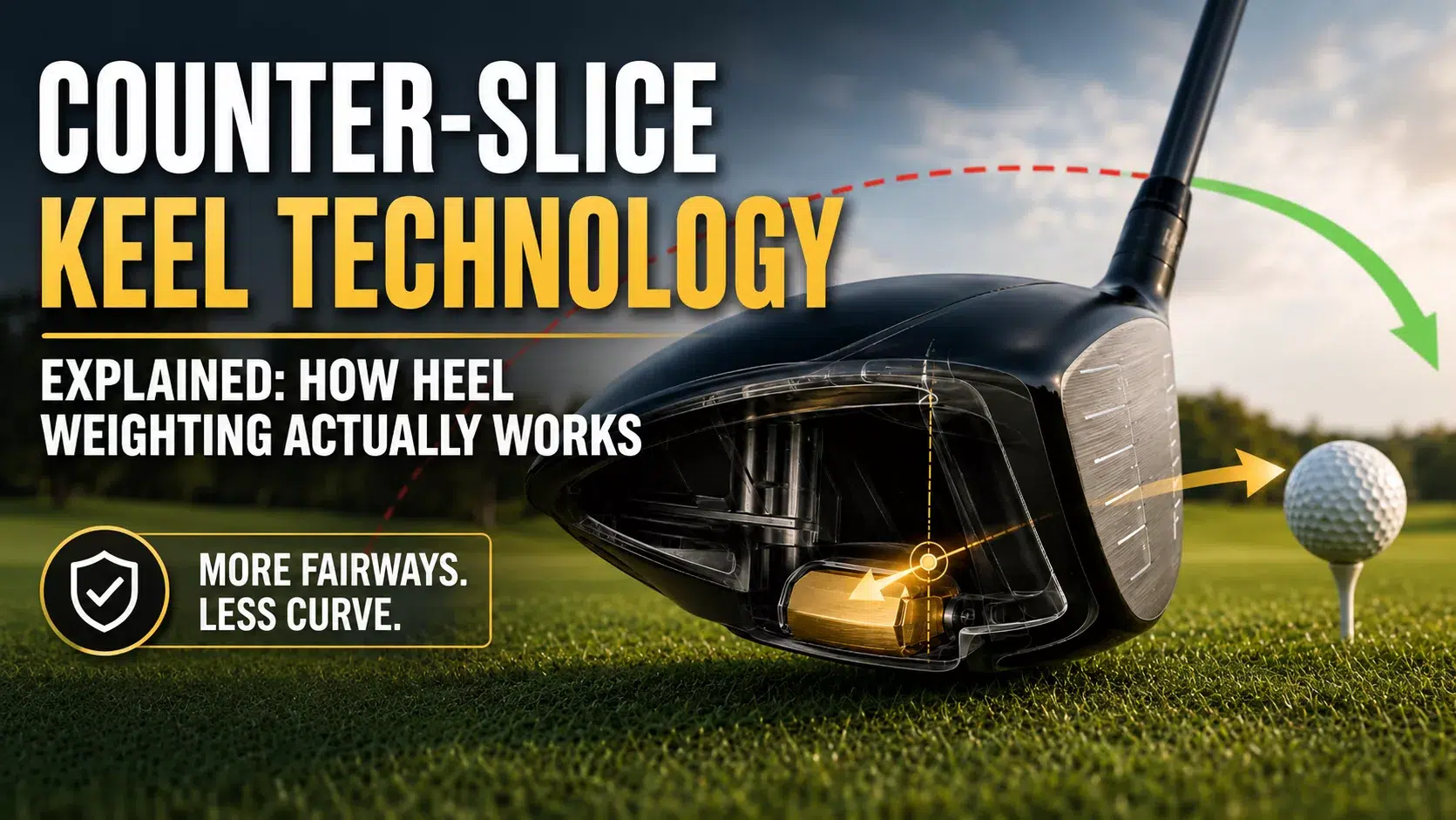
Counter-Slice Keel Technology Explained: How Heel Weighting Actually Works
Quick answer: The Counter-Slice Keel is the internal heel weighting system built into the Performance [...]
How Good Do You Need to Be to Play a Golf Course? There’s No Skill Requirement — Only a Pace Requirement
Nobody checks your scorecard at the gate. There is no minimum skill level to play [...]