This website uses cookies to improve your experience. We\'ll assume you\'re ok with this, but you can opt-out if you wish. Read More
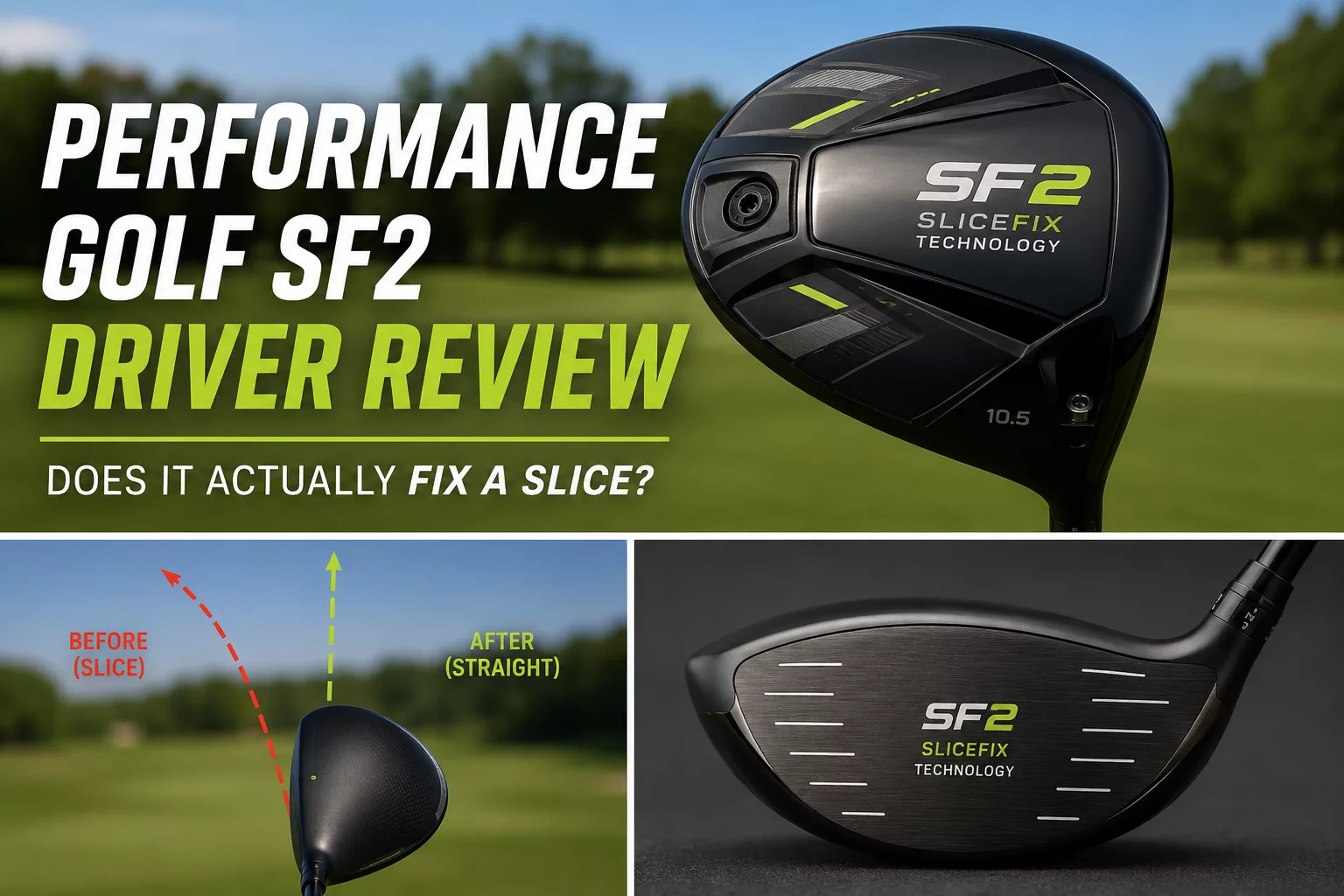
Performance Golf SF2 Driver Review: Does It Actually Fix a Slice?
Categories :
Performance Golf SF2 Driver Review: Does It Actually Fix a Slice?
The short answer: yes. For most amateur golfers, it works. There are real caveats, a billing issue you need to know about before you buy, and two or three player types for whom it makes zero sense. This review covers all of it.
The Slice Is Costing You More Than You Think
Somewhere around 80% of amateur golfers fight a slice. That shapes entire rounds. You aim left, hope for the best, watch the ball peel right into the rough, and lose 20 to 40 yards of effective distance every time.
Sidespin is brutal. A ball curving hard right travels a fraction of the distance a straight ball does.
Performance Golf built the SF2 driver to attack that specific problem. This review explains exactly how it works, what it delivers, and what you need to know before you hand over $350.
What Is the Performance Golf SF2 Driver?
The SF2 is Performance Golf’s second-generation slice-fighting driver. The biggest upgrade over the SF1 is the switch from carbon fiber to an all-titanium, three-piece head construction.
Performance Golf is a direct-to-consumer brand: no retail stores, no fitting centers. Sold online and shipped to your door.
Key specs at a glance:
| Spec | Detail |
|---|---|
| Construction | 3-piece forged titanium |
| Loft | 12° (fixed) |
| Face angle | 3° closed |
| Shaft length | 45 inches (counterbalanced) |
| Price | $350 |
| Adjustability | None (fixed hosel) |
The lack of adjustability matters. You’re buying a driver tuned to one job. That’s a feature for some golfers and a dealbreaker for others.
How the Slice Correction Actually Works
Most driver reviews skip this part or dress it up in marketing language. Here are the mechanics, explained plainly.
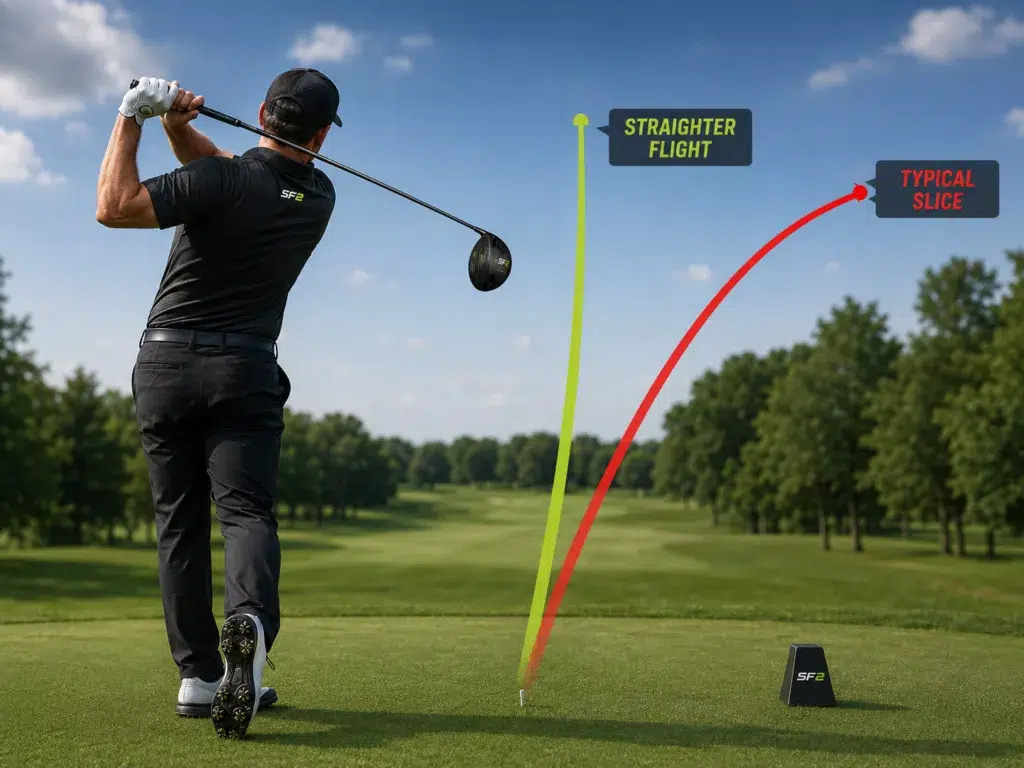
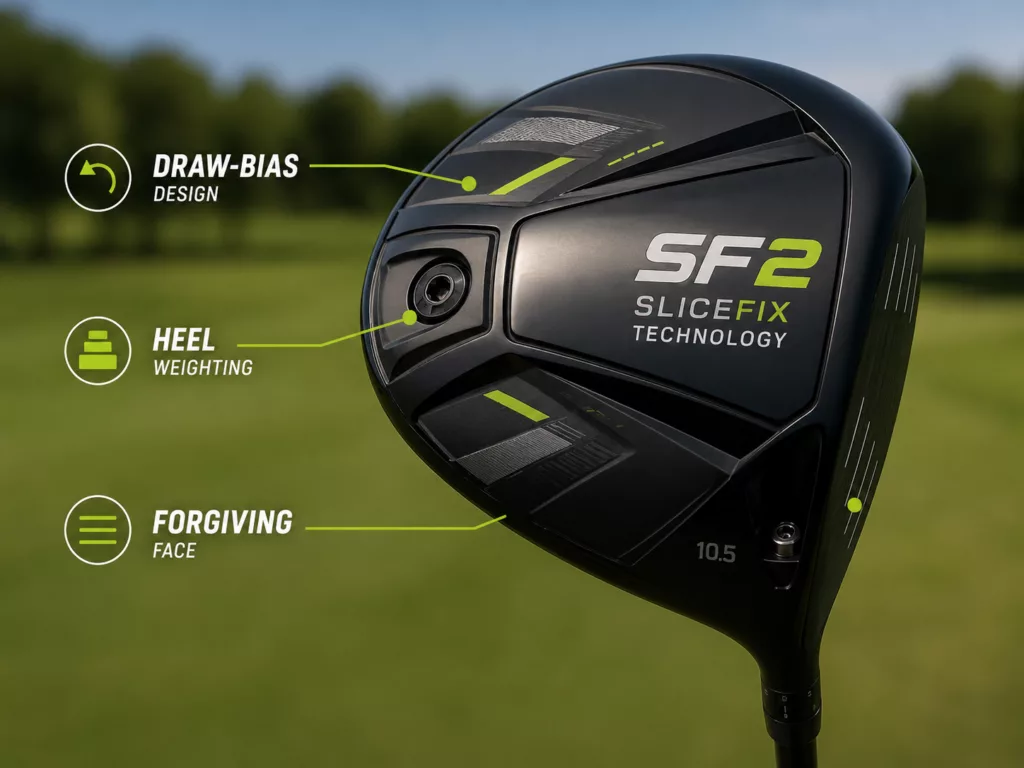
A slice happens because the clubface is open relative to your swing path at impact. An open face puts left-to-right sidespin on the ball (for a right-hander). The SF2 attacks this from three angles:
1. The 3° Closed Face
The face is pre-set 3 degrees closed, meaning it already points slightly left of where you’re aiming at address. For context, most standard drivers have a square or 1° open face.
This built-in offset means that even if you arrive at impact with a slightly open face (which slicers almost always do), the net result is closer to square. Think of it as giving yourself a 3° head start on squaring the face before you even swing.
2. Deep Heel Weighting
The SF2 puts weight deep in the heel to square the face faster through impact. Here’s why that matters: weight in the heel shifts the center of gravity (CG) toward the heel side of the head. When the CG sits in the heel, the head naturally wants to rotate closed through the hitting zone.
It doesn’t guarantee a square face, but it assists the squaring motion your hands are supposed to produce. For golfers whose hands don’t fully release, the heel CG picks up some of that slack.
3. Draw-Calibrated Bulge
Standard driver faces have a curved bulge designed to impart corrective spin. When you hit the toe, the bulge kicks the ball right to compensate for gear effect that pushes it left.
The SF2 flattens the bulge in the heel specifically. This flatter heel face works with the other anti-slice features to reduce right-to-right shot shape rather than fighting against them.
All three working together: If you hit the heel (where slicers tend to miss), a standard driver’s gear effect actually makes your slice worse. The SF2’s heel weighting, closed face, and modified bulge all pull in the same direction: toward a squarer, straighter, or gently drawing ball flight.
Does it work for every swing? No. If your swing path is severely out-to-in and your face is wide open, the SF2 will reduce the slice, not eliminate it. For the vast majority of mid-to-high handicappers with a moderate slice, the mechanics are sound.
The Honest Truth About Distance Gains
Performance Golf’s marketing talks about 20+ yard gains. That number is real for some golfers, but the reason matters.
Distance gains come mainly from eliminating slice-related yardage loss, not from increased ball speed. Marketing distance claims are overstated. Golfers Authority
Here’s the distinction: a severe slice ball flight loses carry distance because the ball is flying at an angle. A ball that starts 30 yards left and curves 50 yards right isn’t traveling 200 yards forward.
Fix the slice, and you recover yards that were already there in your swing speed. You’re reclaiming distance that sidespin was stealing.
For a 90 mph swinger who previously sliced most drives into the rough:
- Before SF2: 180 yards effective carry with heavy sidespin
- After SF2: 200-215 yards straight or with a draw
That 20-35 yard gain is real. Every yard of it comes from recovering lost distance, from straightening the ball flight. That’s the honest framing, and it’s actually more compelling than the marketing spin. It’s achievable for nearly any slicer regardless of swing speed.
Shaft Fitting Matrix
The SF2 uses a fitting-by-speed approach: you choose from weight tiers rather than a full shaft menu. Here’s how to match your swing speed to the right flex:
| Swing Speed (mph) | Recommended Shaft Weight | Flex Feel |
|---|---|---|
| Under 80 mph | 50-55g | Senior / Ladies |
| 80-90 mph | 57g | Regular |
| 90-100 mph | 60g | Regular / Stiff |
| 100+ mph | 65g | Stiff |

How to measure your swing speed if you don’t know it:
- Most golf retailers and driving ranges offer launch monitor sessions
- A 7-iron that carries 150 yards corresponds to roughly 90-95 mph driver swing speed
- If you can reach par-4s under 400 yards in two, you’re likely 90 mph or above
Getting the shaft weight wrong matters. Too light, and you’ll lose control at the top. Too heavy, and you’ll under-release and add loft. Neither helps a slicer.
USGA Conformance: Read This Before You Enter a Tournament
This section doesn’t exist in most SF2 reviews. It should.
Whether the SF2 appears on the USGA Conforming Driver Heads list cannot be confirmed from publicly available evidence. Marketing language alone is not proof of conformance.
The USGA Equipment Database is updated every Monday and lists all driver heads submitted and determined to conform to the Rules of Golf. Competition committees can require that a player’s driver appears on the conforming list. USGA
What you need to do: Before using the SF2 in any USGA-sanctioned competition (club championships, amateur events, any stroke play with rules officials), check the USGA Equipment Database yourself at usga.org.
Search “Performance Golf SF2.” If it’s there, you’re fine. If it isn’t, you cannot use this driver in that event without risking disqualification.
For casual rounds and non-sanctioned play, this is irrelevant. For competitive play, verify first.
The PG1 Billing Issue – Addressed Directly
This is the part almost no review covers, and it’s the question most buyers have.
When you buy the SF2, Performance Golf may present you with a PG1 membership offer during checkout. Sometimes it’s framed as a trial, sometimes bundled with the purchase.
The original purchase includes a 14-day trial to the membership, with disclosure that it automatically continues at $29 per month unless canceled. Better Business Bureau
The problem: many buyers miss this.
Reviews show recurring complaints about unexpected billing and difficulty canceling subscriptions, with reports of unauthorized charges and trouble reaching live support.
A law firm is actively investigating widespread complaints that consumers were enrolled in recurring billing programs without clear disclosure, with consumers alleging payments they never consented to.
What you should do before clicking buy:
- Read every screen in the checkout process carefully
- Screenshot the checkout confirmation showing exactly what you agreed to
- Set a phone reminder for Day 12 of your trial (2 days before it ends)
- If you want to cancel, email support@performancegolf.com or call 800-523-5760; they offer a 30-day satisfaction guarantee with full refund JoinChargeback
- Monitor your bank statement for the first two months after purchase
The SF2 itself is a legitimate product. The billing friction is a real issue that real customers have experienced. Going in with eyes open protects you completely.
SF2 vs. TaylorMade Burner SuperFast 2.0 vs. Ping G430 SFT
These three names come up together in searches constantly. Here’s a direct comparison:
| Comparison | SF2 | TaylorMade Burner SuperFast 2.0 | Ping G430 SFT |
|---|---|---|---|
| Anti-slice approach | 3° closed face + heel weighting + modified bulge | Draw-biased weighting, high launch | 22g moveable heel weight, Draw/Draw+ setting |
| Adjustability | None | Loft only (±2°) | Loft (±1.5°) + moveable weight |
| Face angle at address | Visibly closed | Looks relatively neutral | Noticeably closed |
| Price (new) | $350 | Discontinued (used: ~$50-100) | ~$400-500 |
| USGA conforming | Verify independently | Yes (legacy list) | Yes |
| Draw bias intensity | Very aggressive | Moderate | Moderate to aggressive (Draw+) |
| Best for | 15+ handicap slicer | Budget secondary club | 10-20 handicap, wants adjustability |
TaylorMade Burner SuperFast 2.0: This driver is over a decade old. It has a mild draw bias and was well-regarded at release, but you’re buying dated technology.
Face materials and CG engineering have advanced considerably. It makes sense as a $60 used purchase to experiment with, not as a primary driver investment in 2026.
Ping G430 SFT: The G430 SFT carries a 22-gram moveable weight near the heel, with PING claiming up to 20 yards of right-to-left correction in the Draw+ setting. It also features variable face thickness technology for ball speed gains (especially under 90 mph), along with loft and lie adjustability.
A more complete driver with more options, at a higher price. Built for golfers who want to dial things in rather than fix a slice out of the box. The SF2 is more aggressive in its anti-slice bias; the G430 SFT gives you more control over how much bias you apply.
Verdict by Player Type
The SF2 is the right driver for you if:
- You carry a 15-30 handicap and slice at least half your drives
- You’re not playing in USGA-sanctioned tournaments (or you’ve verified conformance)
- You want a plug-and-play fix without tinkering with weights and settings
- You’ve already tried alignment fixes and grip adjustments with limited success
- You don’t want to spend $500+ on a Ping G430 SFT
Look elsewhere if:
- You’re a 6-12 handicap with a workable fade; this club’s 3° closed face will fight your natural shot shape
- You play in club championships or USGA-sanctioned events and can’t confirm conformance
- You want adjustability to tune loft, spin, or bias over time
- You hit a consistent draw already; the SF2 will turn that into a hook
- You’re primarily interested in raw ball speed gains (this isn’t that club)
The Bottom Line
The SF2 does what it claims for the right golfer. The anti-slice mechanics (closed face, heel weighting, modified bulge) are real design choices that work together to reduce open-face impact. Most moderate slicers will see genuine improvement from round one.
The distance gains are real too, just framed differently than the marketing suggests. You’re recovering yards stolen by sidespin. For a slicer, that’s often worth more than raw speed gains.
Go in knowing the PG1 subscription situation, read your checkout screens carefully, and verify USGA conformance if it matters to your game. Do that, and there’s very little downside to trying a driver backed by a 365-day return policy.
Ready to Try It Yourself?
If you’ve read this far and the SF2 sounds like it fits your game, here’s the direct link to the current offer, including any bundle pricing Performance Golf is running right now:
The 365-day money-back guarantee removes most of the financial risk. If it doesn’t fix your slice, send it back.
Looking to see our recommendations on fall clothes to help your game? Check out our fall clothes review here.
Disclosure: This page contains affiliate links. If you purchase through them, we may receive a commission at no additional cost to you. All opinions and assessments are our own.
24 thoughts on “Performance Golf SF2 Driver Review: Does It Actually Fix a Slice?”
Leave a Reply
Related Post

Senior Golf Discounts: Most Courses Start Between 50 and 62 — Here’s How to Find Yours
There’s no standard senior age in golf. Most courses set the threshold somewhere between 50 [...]
Budget Golfer’s Complete Guide: Save $2,000+ This Year
Master the art of affordable golf without sacrificing your passion for the game Bottom Line [...]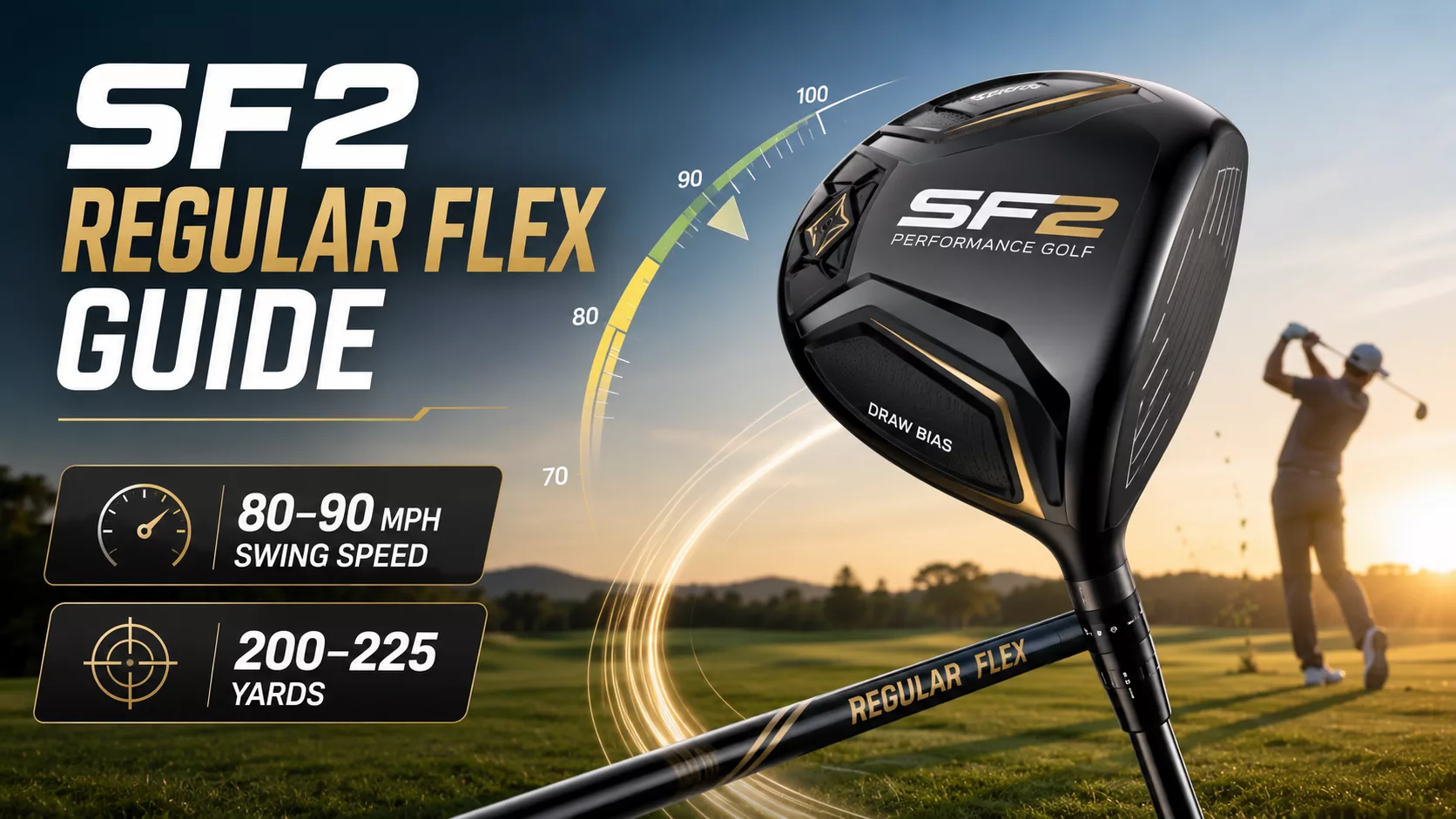
Hi there,
I enjoyed reading your review. It’s been many years since I last played golf, but I remember just how much difference a driver can make. My old driver would consistently send the ball around 280 yards, and I had the opportunity to try a friend’s newer driver. To my surprise, I was hitting over 300 yards with very little adjustment. Technology really has come a long way.
For golfers who struggle with a slice, reviews like yours are valuable because it’s easy to get caught up in marketing claims. In your opinion, would this driver also benefit someone with a fairly consistent swing who is mainly looking for more forgiveness, or is it really designed for players battling a slice?
Thanks for sharing your insights!
Hey Bryce,
Thanks so much for the kind words, and great question! You’re right that driver technology has come a long way — going from 280 to 300+ yards just by switching clubs says a lot about how much modern head design and face technology matter.
To answer your question directly: the SF2 is definitely built with slice correction as its primary mission. The Forward Axis Weighting is specifically engineered to help square the face at impact, which is why it shines for golfers fighting a left-to-right ball flight. That said, the same design elements that fix a slice — the weighting, the larger sweet spot, and the forgiving face — also benefit players with a consistent swing who just want more forgiveness on off-center strikes.
Here’s my honest take, though: if you already have a fairly consistent, neutral swing, you might not need the slice-correction bias, and a more traditional forgiveness-focused driver could serve you just as well (and possibly give you more workability). The SF2 is at its best when a slice is the main problem you’re trying to solve.
For a player like you describe, I’d suggest testing it side by side with a standard game-improvement driver before committing — the difference in feel and ball flight will tell you quickly which one fits your swing.
Thanks for stopping by, and if you do get back out on the course after all these years, I’d love to hear how it goes!
I enjoyed this review because it explains why the club works instead of simply repeating the marketing claims. As someone who has played enough golf to know how frustrating a persistent slice can be, I appreciate that you pointed out the SF2 isn’t magic. If a golfer has major swing flaws, a driver can help reduce the miss, but it can’t completely replace good fundamentals.
I also thought your explanation of where the distance gains come from was refreshing. Recovering yards that were being lost to sidespin is a much more believable claim than promising everyone an extra 20 or 30 yards through technology alone. That kind of honesty makes the review more credible.
If a golfer is willing to work on both equipment and technique, would you recommend investing in a slice-correcting driver like the SF2 first, or spending the same amount on a few lessons before upgrading the driver? It seems like the best long-term results might come from finding the right balance between the two.
– Scott
Thanks, Scott — this is exactly the kind of thoughtful question I wish more golfers asked before pulling out their wallet.
You’ve hit on something important: equipment and technique aren’t competing solutions, they’re complementary ones. But if I had to advise someone on where to put their first dollar, here’s how I’d break it down.
If your slice is severe — the kind that costs you two or three fairways a round and has you aiming at the left tree line just to stay in play — I’d actually lean toward the driver first. Here’s why: a slice-correcting driver like the SF2 gives you immediate, playable results, and there’s a psychological benefit that’s easy to underestimate.
When you’re not dreading every tee shot, you enjoy the game more, you play more often, and you’re in a much better headspace to work on your swing. Lessons are a slower burn, and a lot of golfers quit on them before the changes take hold because they’re still getting punished on the course every weekend.
If your slice is mild to moderate, I’d flip that advice: take the lessons first. A good instructor can often fix a grip or path issue in two or three sessions, and then you’re choosing your next driver based on your improved swing rather than buying a band-aid for a problem you’re about to fix anyway.
The best long-term answer, as you said, is both — use the equipment to keep the game fun and playable while you build better fundamentals underneath it. The golfers I’ve seen make the biggest lasting improvement did exactly that.
Appreciate you reading closely enough to catch the sidespin point, too. Recovered distance is real distance — it just doesn’t make for as flashy a headline.
I’ve been thinking about the SF2 driver as a possible gift for a friend who struggles with slicing most of his drives, and I appreciate how clearly you explained the mechanics behind the closed face and heel weighting. It’s good to know the distance gains come from recovering lost yardage rather than raw speed; that feels more realistic than the usual marketing hype.
One thing I’m wondering: since the SF2 doesn’t have adjustability, do you think it’s better suited as a long‑term driver, or more of a transitional club to help someone build confidence before moving on to a more customizable option?
Hey Alice,
Thanks for reading, and that’s a sharp question — especially since you’re buying it for someone else.
My honest answer: it depends entirely on how severe your friend’s slice is and whether he plans to work on it.
For a golfer who slices most of his drives and isn’t actively taking lessons, I’d call the SF2 a legitimate long-term driver. The lack of adjustability isn’t really a limitation for him, because the settings he’d want are already baked in — 3° closed face, deep heel weighting, 12° loft. He’s not going to out-grow it as long as the slice is still there, and honestly, most golfers with adjustable drivers never touch the wrench anyway.
Where it becomes a transitional club is if he’s committed to fixing his swing. Once a slice genuinely straightens out, that 3° closed face stops being a helper and starts being a hook machine. At that point he’d want something neutral and adjustable.
One practical heads-up for a gift purchase, though: because there’s no adjustability, the shaft flex is the only variable you get to choose, and there’s no way to compensate afterward if it’s wrong. The SF2 is fitted by swing speed tier rather than a full shaft menu, so if you can find out roughly how fast he swings — or even just what flex is in his current driver — that’s worth doing before you order. Also know that the loft is a fixed 12°, which is high. That’s intentional and it helps most slicers, but if your friend already hits the ball high and has decent speed, he may find it balloons on him. I’ve seen that complaint from a few buyers.
If you’re unsure about his specs, it might be worth checking Performance Golf’s return window before ordering so there’s an easy path if the flex isn’t right. Great gift idea either way — hope it takes some frustration out of his tee shots!
Thank you for your detailed and balanced review. I appreciate that you went beyond the marketing claims to explain the science behind the SF2 driver’s anti-slice design while also addressing important considerations like shaft fitting, tournament conformity, and billing transparency. Providing readers with both the benefits and the limitations empowers golfers to make informed decisions, which is exactly what trustworthy product reviews should do.
Hey Kavitha
Thank you — that’s exactly what I’m going for, so it means a lot to hear it said that way.
The three things you singled out are the ones I think get skipped most often in driver reviews, and they’re worth restating for anyone else reading this thread:
Shaft fitting matters more on the SF2 than on most drivers, because there’s no adjustability to fall back on. The head is fixed at 12° with a 3° closed face, so shaft weight and flex are the only variables you control. Get that wrong and you’ve undercut the whole design.
Tournament conformity is a genuine open question, not a knock on the club. If you play in USGA-sanctioned events or club championships, don’t take anyone’s word for it — including mine. The USGA Conforming Driver Heads list is public and updated weekly, and it takes about a minute to check. For casual rounds it’s a non-issue, but it’s the kind of thing you want to know before, not after.
Billing transparency is the one I’d have appreciated a heads-up on myself. Direct-to-consumer golf brands often bundle subscriptions or trials alongside the hardware purchase, and it’s easy to click through without noticing. Read the checkout page carefully and know what you’re agreeing to.
None of that makes the SF2 a bad club — I think it does what it claims for the golfer it’s built for. It just means the purchase deserves the same scrutiny you’d give any $350 piece of equipment.
If there’s anything I didn’t cover that you’re still wondering about, ask away — reader questions are usually what tell me where a review has gaps.
My husband is an avid golfer, and I just go and hack from time to time. He is constantly chasing the next best thing when it comes to drivers and this titanium one looks great for the serious golfer, but for a hacker like me it probably wouldn’t improve my play much.
Over a long distance I can see how the driver can affect the slice and how far the ball curves, and it can make a huge difference to where the ball ends up. I think the technique will also come into play a lot here as you need to know how to connect the ball with the driver to get that perfect shot.
Hey Michel
Thanks for the comment — and I want to gently push back on one thing, because I think you may have it backwards!
The SF2 is actually built for the golfer who plays occasionally, not the one chasing the newest release every season. Its whole design philosophy is to correct the ball flight for you: the face is set 3° closed, the weight sits deep in the heel to help the face square up through impact, and the shaft is a little shorter than standard at 45 inches to make it easier to control. Every one of those choices helps a casual player more than a low-handicapper. Your husband, if he already has a consistent swing, might find that closed face turns his good shots into hooks.
You’re absolutely right that technique matters — no driver makes contact for you, and I say that pretty plainly in the review. But here’s the thing about the “hacker” self-assessment: someone who plays a few times a year usually isn’t going to overhaul their swing, and that’s fine. That’s exactly the golfer who gets the most out of equipment doing some of the work. The goal isn’t a perfect shot, it’s keeping the ball in play so the round stays fun instead of frustrating.
If you ever want to give it a real try, one tip: make sure the shaft flex matches your swing speed. The SF2 doesn’t have adjustable settings, so flex is the one thing you get to choose, and it’s the difference between the club helping you and fighting you.
Next time your husband is shopping for his next driver, you might just let him know you’d like a turn testing this one.
Wow, this is interesting! The clearest value here is framing the SF2 as a shot-shape tool rather than a magic distance club: a closed face and heel-biased design can help a moderate slicer reclaim distance that was already being lost to a big right miss. Those are genuine anti-slice design choices, but golfers should still use a range session to compare dispersion with their current driver before deciding it earns a place in the bag.
The fixed 12° setup also seems like a major fork in the road, because it may be a welcome plug-and-play option for a high-handicap player while giving a golfer with a reliable fade very little room to adapt. The reminder to scrutinize the checkout flow is especially useful, since buyers deserve to know exactly which recurring membership, if any, accompanies a club purchase.
Hi Aly
Appreciate the thoughtful read — “shot-shape tool rather than distance club” is a better one-line summary than anything I managed in the whole article.
Your range-session point deserves more detail than I gave it, so let me expand for anyone else reading:
Don’t measure the SF2 by your best drive. Hit ten balls with your current driver and ten with the SF2, and write down all twenty results — not the carry number, but where each one finished left-to-right. The SF2’s case isn’t that it produces a longer best shot. It’s that it should tighten the spread, and specifically pull in that big right miss. If your worst five shots with it finish meaningfully closer to your target line than your worst five with your current driver, it’s doing its job. If the spread looks the same, it isn’t the club for you, no matter what the good ones felt like.
On the fixed 12°: I’d add that it’s a fork in the road you can’t walk back. With an adjustable driver, a swing that improves can be re-tuned. With the SF2, if your slice genuinely straightens out, the 3° closed face goes from asset to liability and you’re shopping again. Whether that’s a problem depends on how realistic you’re being about changing your swing — for a lot of golfers, honestly, it isn’t going to change much, and the plug-and-play simplicity is the point.
And yes on the checkout flow. That section wasn’t fun to write, but it’s the part I’d want to read if I were the one buying.
What stood out to me is that the SF2 can reduce one problem while possibly creating another. The closed face and heel weighting may straighten a slice, but a golfer whose swing improves could later start missing left. That makes this feel more like a tool for a specific ball flight than a driver for every stage of a golfer’s game. During the return period, would it make sense to track both the starting direction and the amount of curve for each drive? A ball that curves less but starts too far left may look improved at first while hiding a new problem.
Hey Bob,
This is the most useful question anyone’s asked in these comments, so let me give it a proper answer.
Yes — track both, and they’re telling you two completely different things.
Start direction is mostly about your face angle at impact. Modern ball flight data puts it at roughly 75-85% face, with swing path making up the rest. So where the ball starts is basically a readout of where the clubface was pointing.
Curve is about face relative to path. If the face is closed to the path, you get draw spin. Open to the path, fade spin. The gap between the two is the amount of curve.
That distinction is exactly why your concern is valid. The SF2’s 3° closed face changes your start direction whether or not it fixes your slice, because you’re now delivering a more closed face at impact by design. So a slicer might see this progression:
Before: starts on line, curves hard right, finishes right
After: starts left, curves right, finishes near the target
That second one is a real improvement — the ball’s in the fairway. But you’re right that the ball is no longer starting where you’re aimed, and you’re relying on the curve to bring it back. If your swing then improves and the slice spin drops, the curve no longer offsets the start line, and you’re pulling it left.
How I’d actually track it during the return window: keep a simple two-column note for every tee shot — start line (left / on / right) and curve (left / straight / right). Fifteen or twenty drives is enough to see the pattern. Then read it like this:
Starts left, curves right, finishes near target → working as designed
Starts on line, curves less → best case, genuinely straighter
Starts left, curves left → this is the warning sign. Pull-hook. The correction has gone past neutral for your swing, and this is the miss to watch for.
Do this on the course, not just the range. Range mats and no defined target line make start direction almost impossible to judge honestly.
One thing that softens the risk a bit: the fixed 12° loft is high, and higher loft means more backspin relative to sidespin, which limits how much the ball can hook. It doesn’t eliminate the possibility, but it makes a big left miss less likely than the same face angle on a 9.5° head.
Your framing is the right one, though — this is a driver for a particular ball flight, not for every stage of a golfer’s game. That’s not a criticism of it. It’s just what it is, and knowing that going in is how you avoid being disappointed later.
This is an interesting topic because a golf driver can sometimes make a noticeable difference for players who struggle with a slice, but I think it is important to separate equipment from technique. A slice is often connected to swing path and clubface position, so a more forgiving or draw-biased driver may help reduce the problem without necessarily fixing the underlying swing.
I also like the point about recovering distance rather than simply creating extra distance. If a golfer can keep more drives in play and reduce the amount of distance lost to a severe curve, that can make a significant difference to their overall game.
For me, the ideal approach would be combining the right equipment with practice and proper swing fundamentals. Technology can help make the game more enjoyable, but it shouldn’t completely replace improving the swing.
Hey Maia,
Well said, and I agree with your framing completely.
Let me add the piece that usually gets left out of this conversation, though: when people say “work on your swing,” they rarely say what to work on, and slice practice in particular tends to get aimed at the wrong thing.
You named the two variables correctly — path and face. Here’s the part that surprises most golfers: the face matters far more than the path for a slice. Face angle at impact accounts for roughly 75-85% of where the ball starts, and the slice curve itself comes from the face being open relative to the path. So a golfer with an out-to-in path and a square-to-that-path face hits a straight pull, not a slice. It’s the open face that turns it into a banana.
That matters practically, because most self-taught slice fixes go after the path — swinging more from the inside, dropping the trail shoulder — while leaving the face wide open. Result: a shot that starts right and curves right. Worse than where they started, which is why so many golfers conclude practice doesn’t work and go buy a driver instead.
If someone’s going to spend range time on this, grip is where I’d start. A grip that’s too weak (hands rotated too far left for a right-hander) makes an open face nearly unavoidable no matter what the path does. It’s unglamorous, it feels awful for about two buckets, and it fixes more slices than any drill.
Which loops back to your point about combining the two. The equipment buys you playable golf while the fundamentals catch up — and if you’re going to work on fundamentals anyway, it’s worth knowing that a driver with a built-in 3° closed face is doing to the face what you’re trying to teach yourself to do. That’s a reason to think about the order you do things in.
I watch dozens of golfers slice balls into my backyard every single weekend, so anything that promises to fix that trajectory has my full support! The review’s breakdown of the SF2’s counterweighting actually makes a lot of sense given how many frantic hook-and-slice trajectories I see from my porch. If this driver saves my patio furniture from taking another stray hit, I might just start buying them as gifts for my neighborhood regulars.
Hi Leah,
This might be the best comment I’ve gotten on this review. Living on a golf course is the one perspective I hadn’t considered, and honestly, you’ve probably seen more slices in a single Saturday than most instructors see in a month.
One small clarification worth making, since the terms get mixed up a lot: the SF2 uses heel-biased weighting rather than counterweighting. Heel weighting means mass is positioned toward the heel of the clubhead, which helps the toe rotate through impact faster so the face closes on its own. Counterweighting is a different thing — that’s adding weight in the butt end of the grip to change the club’s overall balance. Both affect how the club feels, but only the heel bias is doing the anti-slice work.
As for your patio furniture, here’s the honest news: a slice-correcting driver will pull those balls left of where they’ve been landing. Whether that helps you depends entirely on which side of the fairway you’re on. If you’re right of it, you may get some relief. If you’re left of it, I’ve just made your situation worse and I apologize in advance.
Buying them as gifts for the neighborhood regulars is a genuinely funny idea, though there’s a cheaper version worth considering first: most slices come from an open clubface at impact, and the most common cause of that is a grip that’s too weak. Telling a stranger their grip is wrong is a delicate social maneuver, admittedly. But it costs nothing, and it fixes the problem at the source rather than one club at a time.
Good luck out there. May your windows stay intact.
This was an interesting review to come across because I’m actually new to golf and haven’t played the sport myself yet. I have a friend who plays golf sometimes, and I’ve told him that I would like to go with him one day so I can see what it’s like and maybe try playing for myself. At first, I didn’t really understand why choosing the right driver could make such a difference, and my friend wasn’t able to explain it in a way that was easy for me to understand. After reading your review, I have a much better understanding of the concept, especially when it comes to the problem of slicing the ball and how the SF2 is designed to help. For someone who is just starting to learn about golf, I found the explanation helpful. I’m curious, though, how does the SF2 feel for someone who is completely new to golf, and would you recommend it as a driver for a beginner?
Hi Monica,
Welcome to golf, and thanks for the kind words — knowing the explanation landed for someone brand new is genuinely useful feedback for me.
I’m going to give you an answer you might not expect: I wouldn’t recommend the SF2 as your first driver, and the reason has nothing to do with whether it’s a good club.
Here’s the thing. The SF2 is a correction for a specific problem. Its face is built 3 degrees closed and its weighting pushes the ball left, all to counteract a slice. That’s genuinely useful if you slice. But you haven’t played yet, so neither of us knows what your miss is going to be.
You might slice. You might hook. You might develop a fairly neutral swing and never need correction at all. Buying a slice fix before you know you slice is a bit like buying reading glasses before you’ve had your eyes checked.
If you turn out to hook the ball, the SF2 would actively make it worse.
What I’d suggest instead, in order:
Go play with your friend first, and don’t buy anything. Rent or borrow clubs for the first few rounds. Most courses rent sets, and your friend may well have an old driver sitting in his garage.
Once you’ve played a handful of times, you’ll know your miss. That’s the moment to start shopping, because now you’re solving a problem you actually have rather than one you might have.
When you do buy, consider a used driver from two or three years ago rather than new. The technology gap is small and the price difference is enormous. A beginner’s swing changes a lot in the first year, and it’s much easier to move on from a $150 club than a $400 one.
To answer your actual question about feel: the SF2 is forgiving and easy to get airborne, which beginners generally like. The 12-degree loft helps the ball up and the shorter 45-inch shaft makes it easier to control than a longer driver. If you did end up slicing, it would be a reasonable pick. I just wouldn’t buy it before knowing that.
One last thing, and it matters more than any driver: the driver is the hardest club in the bag to hit. If you’re new, the fastest route to enjoying your first rounds is leaving it in the bag entirely and teeing off with a 5-wood or a hybrid.
Shorter shaft, more loft, far easier to make contact with. Plenty of good golfers still do this on tight holes. Nobody’s watching, and it’s a lot more fun than losing three balls before you reach the green.
Have a great time out there, and come back and tell me how the first round goes.
Thanks for the detailed review. What mattered to me most is that you focused on more than just whether the driver works. You also explained what buyers should be careful about before making a purchasing decision.
I haven’t played golf before, but I found the explanation of how a slice can affect distance interesting. I also agree with your point that the product may not suit everyone, rather than presenting it as something every golfer should use.
A question though, if someone has a moderate slice but is still fairly new to golf, would you recommend trying to improve their swing first before buying a corrective driver like the SF2, or do you think using both approaches together makes more sense?
Hey Mohamed,
Thanks for reading, and good question — the “fairly new” part changes my answer quite a bit.
For a newer golfer with a moderate slice, I’d say work on the swing first, and I’d say it more strongly than I would for someone who has played for twenty years.
Here’s the reasoning. A swing that’s still forming is the cheapest one to fix. You haven’t spent years grooving a motion, building compensations around it, or developing the muscle memory that makes change feel wrong. A grip adjustment that takes an experienced slicer months to accept might take you two range sessions, because you don’t have anything to unlearn yet. That window doesn’t stay open. Every round you play with an open clubface makes it a little more permanent.
The second reason is more practical. A newer golfer’s swing changes a lot in the first year or two, sometimes dramatically. The SF2 has a fixed 3 degree closed face and no adjustability, so it’s built to correct one particular ball flight. If your swing straightens out over your first couple of seasons, that same correction stops helping and starts producing hooks, and you’re buying a driver again. Someone with a settled swing doesn’t face that risk nearly as much.
And the third: a slice from an open face isn’t a driver problem, it’s a swing problem showing up most visibly in the driver. You’re slicing your irons too, you just notice it less because the ball isn’t traveling far enough to curve dramatically. A corrective driver fixes one club out of fourteen. A grip fix fixes all of them.
That said, “both together” is absolutely reasonable in one scenario: if the slice is bad enough that golf isn’t fun, buy the club. A game you enjoy is a game you keep playing, and there’s no improvement path for someone who quits in frustration. Just treat the driver as a bridge rather than a solution, and keep working on the swing underneath it.
A practical middle road, since you mentioned you’re fairly new: don’t buy anything yet. Borrow or rent for a few more rounds, get one lesson focused specifically on grip and face control, and see where your ball flight lands after that. You’ll then be buying for the swing you actually have instead of the one you have today. Used drivers from a few seasons back are worth a look too, since the technology gap is small and the price gap is not.
I wrote a full breakdown of this exact decision, with a table to help you find your own situation, here: https://affordablegolfcourses….
Hope the first rounds go well.
Does swing speed affect how well this driver can help with a slice? I imagine a golfer with a slower swing might get a different result than someone who swings much faster. I’d also be interested to know how much the shaft flex matters here. Could choosing the wrong flex cancel out some of the anti-slice benefit, even if the driver head itself is designed to help keep the ball straighter?
Hey Hannah,
Two good questions, and the answer to both is yes — more than most golfers realize.
On swing speed: the head's correction is mechanical and static, so it works the same way at any speed. The face is built 3 degrees closed and the heel weighting encourages the toe to rotate through impact whether you swing 70 MPH or 110. What changes is how much there is to correct in the first place. Sidespin scales with clubhead speed, so a faster swing with an open face produces a bigger, uglier slice than a slower swing with the same face angle. That cuts both ways. The faster player has more curve to recover, so a successful fit shows a more dramatic improvement. The slower player was losing less to sidespin to begin with, so the gain looks more modest even when the club is doing its job properly.
There's a second effect worth knowing about. Slower swings generate less backspin, and backspin is part of what keeps a ball from curving sideways. That's one reason the SF2's higher loft matters more for slower swingers than it might appear on paper.
On shaft flex, your instinct is exactly right, and this is the part that trips people up. The wrong flex can absolutely cancel out the head's anti-slice design.
Too stiff is the more common mistake and the more damaging one here. A shaft that's too stiff for your speed won't load and unload properly through the downswing, which means the head doesn't release and the face arrives open. That is the same open face the SF2's closed face angle is there to correct, so you've created the problem the club was built to solve. If you're slicing consistently with a stiff shaft, the shaft itself is a prime suspect. A lot of golfers play stiff out of habit or ego and lose both distance and accuracy for it.
Too flexible causes the opposite problem, and it's underrated on this particular driver. A shaft that's too soft releases early and closes the face. Stack that on top of a head already built 3 degrees closed and you can tip from a corrected slice into a pull-hook. With a neutral driver you'd have more margin for error. With a slice-correcting one, you have less.
The SF2 comes in five flex tiers matched to swing speed: Ladies at 50-65 MPH, Senior/Soft at 70-80, Regular at 80-90, Stiff at 90-100, and X-Stiff above 100. Shaft weight climbs along with it, from the 50-55 gram range up to 65 grams. Since the head has no adjustability, flex is the one fitting variable you control, and there's no way to compensate afterward if you get it wrong.
Two practical notes. Get your actual swing speed measured on a launch monitor rather than guessing from your best drive — most golf shops will do it free, and almost everyone guesses high. And if you land right on a boundary between tiers, tempo breaks the tie: an aggressive transition at 90 MPH points toward Stiff, while a smooth tempo at 82 points toward Senior rather than Regular.
I wrote a full breakdown of the flex tiers with distance conversion tables for anyone without launch monitor access here:
SF2 Driver Shaft Flex Guide