This website uses cookies to improve your experience. We\'ll assume you\'re ok with this, but you can opt-out if you wish. Read More
Performance Golf SF2 vs Callaway Paradym Draw: Is the Price Difference Justified?
Categories :
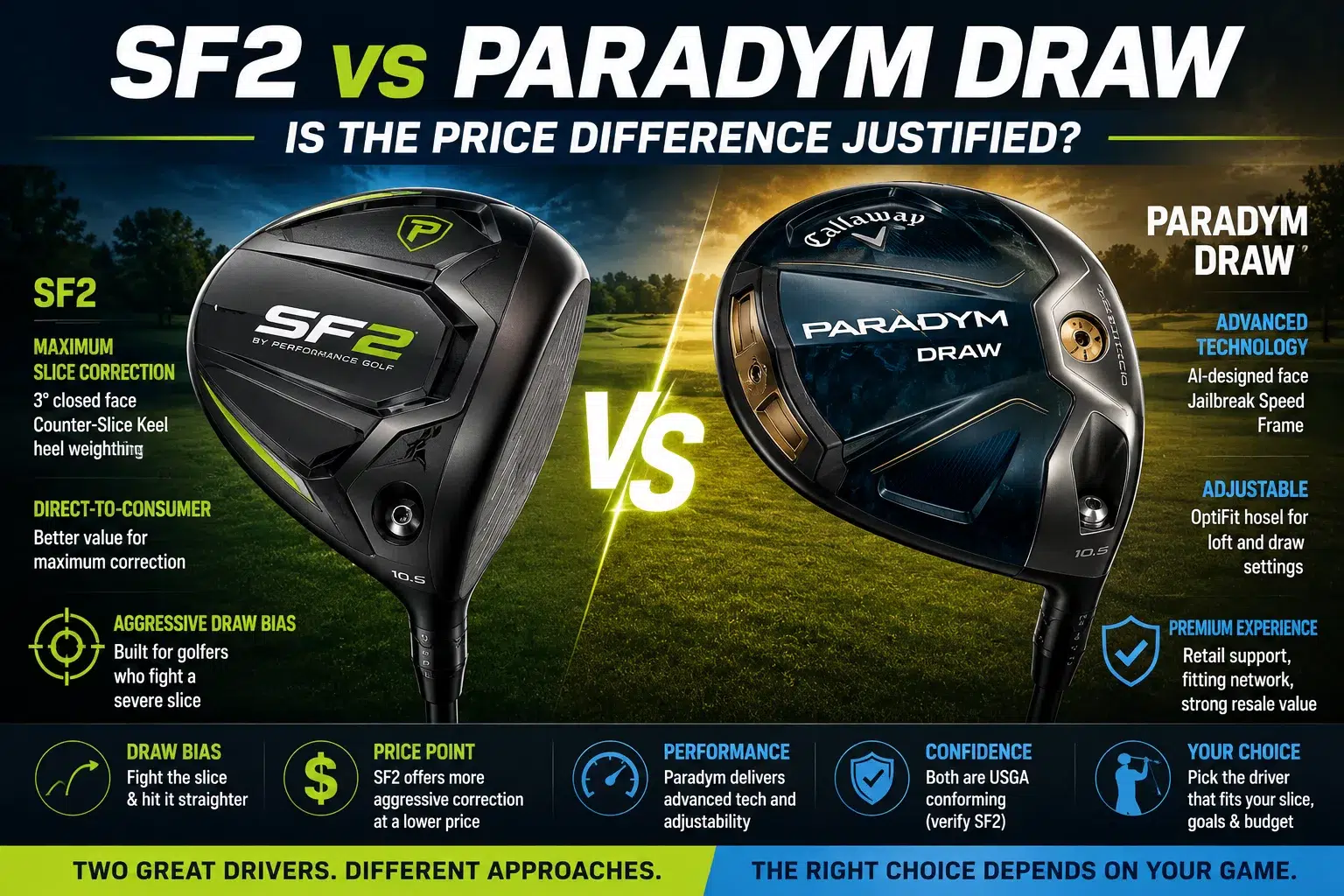
Quick answer: The Callaway Paradym Draw is a premium, confirmed USGA-conforming draw-bias driver built on Callaway’s most advanced face and body technology, with full retail support, manufacturer warranty, and strong resale value.
The Performance Golf SF2 is a direct-to-consumer driver with more aggressive slice correction at a different price point and purchase experience. If you want the most advanced face technology available in a draw-bias driver and can access Callaway’s fitting network, the Paradym Draw is worth the premium.
If you need maximum directional correction for a severe slice and are comfortable buying direct, the SF2 delivers that more aggressively at its price point. This guide explains exactly where each dollar goes.
Why This Is the Most Important Price Comparison in Draw-Bias Drivers
The SF2 versus Paradym Draw comparison is uniquely useful because it forces a direct answer to the question most recreational golfers are actually asking when they research draw-bias equipment: is spending significantly more on a premium OEM driver actually worth it for a high handicapper who just wants to stop slicing?
The honest answer is nuanced — and it depends almost entirely on what’s causing your slice and what you’re optimizing for. This comparison gives you the framework to answer that for your specific situation.
Head-to-Head Specs
| Feature | Performance Golf SF2 | Callaway Paradym Draw |
|---|---|---|
| Head Size | 445cc | 460cc |
| Face Technology | Forged titanium face | Callaway’s Triaxial Carbon crown with Jailbreak Speed Frame |
| Slice Correction Method | 3° closed face + Counter-Slice Keel heel weighting | Internal draw-bias weighting with Paradym’s AI-designed face |
| Crown Material | Standard titanium | Triaxial Carbon — 44% lighter than standard carbon, frees mass for repositioning |
| Adjustability | Fixed | Adjustable hosel (OptiFit) for loft and draw settings |
| MOI | Lower due to 445cc head | High MOI — 460cc head with carbon crown mass savings repositioned for forgiveness |
| Ball Speed Technology | Forged titanium face | AI-designed Flash Face with Jailbreak Speed Frame |
| USGA Conformance | Marketing claims conforming; verify independently | Confirmed conforming |
| Manufacturer Warranty | Direct return policy (verify terms) | Full Callaway manufacturer warranty |
| Retail Availability | Direct-to-consumer only | Major golf retail, Callaway fitting centers nationwide |
| New Price | Direct-to-consumer pricing | Premium retail pricing |
| Used Price | Limited secondary market | $200-$300 used as model ages (2nd Swing, eBay) |
The Technology Gap: What Callaway’s Engineering Actually Buys You
This is the central question of this comparison, and it deserves a direct answer rather than vague statements about “advanced technology.”
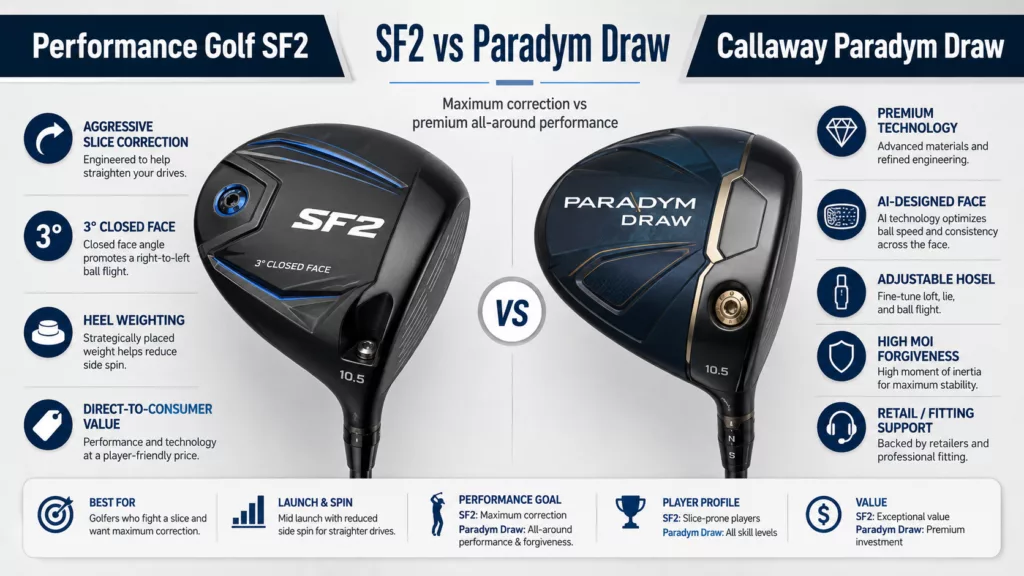
Here is specifically what Callaway’s engineering investment delivers in the Paradym Draw that the SF2 does not:
Triaxial Carbon Crown: The Paradym’s crown is made from a carbon composite that is 44% lighter than standard carbon crowns. That saved weight doesn’t disappear — Callaway repositions it lower and deeper in the head to lower the CG and increase MOI.
For a high handicapper, lower CG means higher launch without adding loft, and higher MOI means off-center hits retain more ball speed and directional control.
AI-Designed Flash Face: Callaway uses artificial intelligence to design the face geometry of the Paradym, optimizing ball speed across more of the face than human engineers can achieve through traditional design iteration.
The result is a larger high-ball-speed zone that extends further toward the heel and toe than previous generations. For golfers who don’t consistently hit the sweet spot, this is measurable — not just marketing.
Jailbreak Speed Frame: Two internal bars connecting the crown and sole stiffen the body of the club, which forces more of the energy at impact through the face rather than being absorbed by body flex.
Combined with the AI face, this produces higher ball speeds across more of the face more consistently.
OptiFit Adjustable Hosel: The Paradym’s hosel allows you to adjust loft and draw settings after purchase.
This means if you buy the club and find the draw bias is too strong or your launch angle needs adjustment, you can fine-tune it without buying a new club. The SF2’s fixed configuration gives you no such flexibility.
What the SF2 has that the Paradym doesn’t: A more aggressive, dual-mechanism slice correction approach. The Paradym’s draw bias is refined and sophisticated, but it’s calibrated for moderate correction within a premium driver experience. It is not engineered specifically for the heavy slicer the way the SF2 is — that’s a deliberate design choice, not an oversight.
Ball Speed: Where the Premium Actually Shows Up
For most high handicappers, the conversation about ball speed is secondary to the conversation about direction — hitting it straighter matters more than hitting it faster. But ball speed is worth understanding clearly because it affects total distance and because the SF2 vs Paradym comparison is often framed incorrectly in this area.
The Paradym Draw’s AI face and Jailbreak Speed Frame will produce faster ball speeds than the SF2 on center strikes, and more importantly will maintain higher ball speeds on off-center strikes due to the AI face’s expanded high-speed zone.
This is a genuine, measurable performance difference that translates to distance — especially on heel and toe strikes where recreational golfers lose the most ball speed.
However — and this is critical — a slicer who hits the SF2 and gains 20-30 yards by straightening their ball flight will see more total distance improvement than a slicer who hits the Paradym without eliminating the slice.
The Paradym’s ball speed advantages only manifest fully when the ball is going reasonably straight. If you’re still slicing with the Paradym’s more moderate draw bias, you’re paying for face technology that isn’t helping you as much as a more aggressive correction would.
This is the fundamental tension of this comparison: the Paradym is a better driver in almost every technical sense, but the SF2 may be a better driver for your specific problem if that problem is a severe, consistent slice that moderate draw bias can’t fully correct.
Adjustability: Why the OptiFit Hosel Matters More Than Most Buyers Realize
The Callaway Paradym Draw’s adjustable OptiFit hosel is one of the most underappreciated features in this comparison, and it deserves direct attention.
When you buy a fixed-configuration club like the SF2 and it doesn’t feel quite right — the draw bias is slightly too strong, or the launch angle is a touch low, or the face angle looks slightly off at address — your options are limited. You either play through it or buy a different club.
When you buy the Paradym Draw and discover the same things, you turn the hosel to adjust.
This post-purchase flexibility has real financial value that doesn’t show up in the sticker price comparison: it increases the probability that the club actually fits your swing over time, and it eliminates the cost of buying another club if your initial setup isn’t quite right.
For a golfer who is still learning their game and whose swing is actively improving — which describes most high handicappers — adjustability has even more value because what fits your swing today may not fit it in six months as you improve.
The Fitting Advantage: Callaway’s Network vs Self-Selection
Callaway has one of the most extensive fitting networks in golf, with certified fitters at major retail locations, dedicated Callaway Performance Centers, and fitting events at golf courses across the country.
A Callaway fitting session for the Paradym Draw gives you launch monitor data showing your actual ball speed, launch angle, spin rate, and dispersion with the specific club and shaft combination being considered — before you commit to purchasing.
This data-driven approach dramatically increases the probability that you walk away with the right shaft flex, loft setting, and draw bias configuration for your specific swing.
The SF2’s self-selection process asks you to estimate your swing speed and select a shaft flex accordingly. For many golfers this estimate is accurate enough, but for golfers who genuinely don’t know their swing speed, the margin for error is real — and buying the wrong flex can undermine even the most well-engineered slice correction system.
Is the Price Difference Justified? The Honest Answer
For most recreational golfers who are asking this question, the answer is: it depends on one thing — how severe is your slice?
If your slice is mild to moderate: The Callaway Paradym Draw’s combination of superior face technology, adjustable hosel, higher MOI, and confirmed conformance justifies its premium for a golfer who wants the best overall driver experience and plans to keep improving their game.
The extra investment pays back through better ball speed on mishits, adjustability as your swing evolves, and stronger resale value if you eventually upgrade again.
If your slice is severe and consistent: The SF2’s more aggressive correction may deliver more immediate, noticeable improvement on the course than the Paradym’s more refined, moderate draw bias.
Paying significantly more for technology that doesn’t fix your primary problem isn’t good value, even if the technology is objectively superior in other dimensions.
The budget consideration: If the price difference between the two clubs represents a meaningful financial stretch, a used Paradym Draw at $200-$300 from 2nd Swing or eBay closes the gap considerably while still delivering Callaway’s face technology, adjustable hosel, and confirmed conformance.
This used option is worth factoring into the comparison before defaulting to the new-versus-new price comparison.
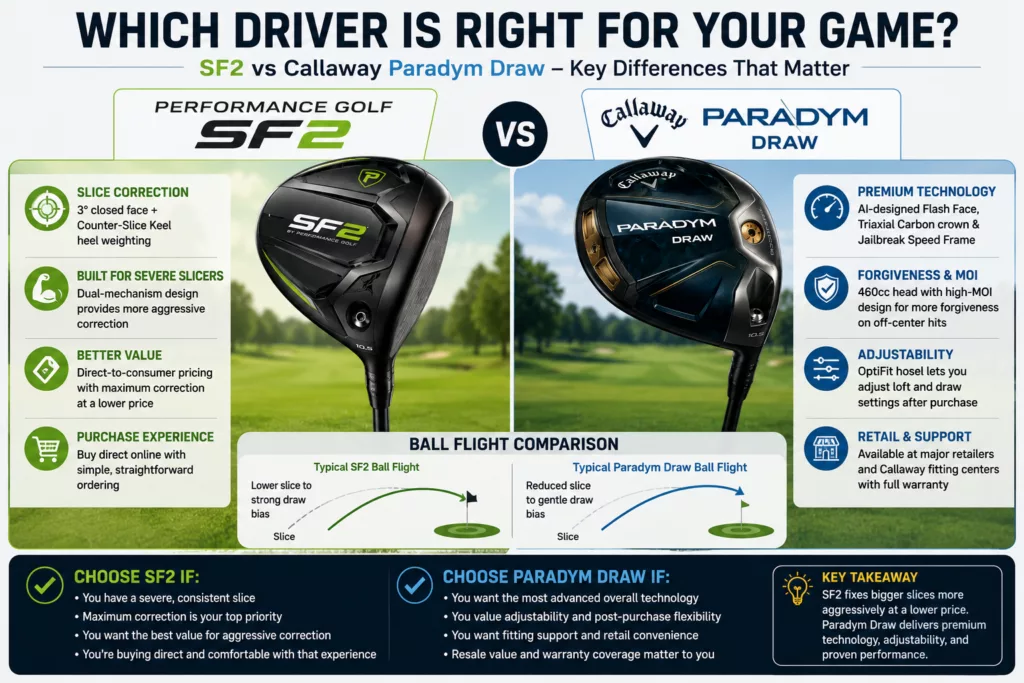
Who Should Buy Each Club
Choose the Callaway Paradym Draw if:
- Your slice is mild to moderate and you want the most advanced overall driver technology available in a draw-bias configuration
- You value adjustability and want the ability to fine-tune loft and draw setting after purchase
- You want access to Callaway’s fitting network for a data-backed purchase decision
- You play in handicap rounds or competitions and need confirmed USGA conformance without verification steps
- Resale value matters — the Paradym holds its value significantly better than DTC alternatives
- You’re willing to invest at the premium level and want full manufacturer warranty backing
Choose the Performance Golf SF2 if:
- Your slice is severe and consistent and moderate draw-bias correction hasn’t been sufficient in the past
- Maximum directional correction is your single highest priority above all other performance factors
- You’re comfortable with a direct-to-consumer purchase experience and have reviewed the return policy thoroughly
- You’re not currently playing in sanctioned competitions where USGA conformance needs to be independently verified
- Budget is a meaningful constraint and you want to prioritize correction over overall technology

Frequently Asked Questions
Is the Callaway Paradym Draw worth the premium over the SF2? For golfers with a mild-to-moderate slice who want the best overall driver technology, adjustability, and retail support, yes. For golfers with a severe slice who need maximum directional correction, the SF2’s more aggressive design may deliver more relevant improvement at its price point.
Can I adjust the draw bias on the Callaway Paradym Draw after purchasing? Yes — the Paradym’s OptiFit adjustable hosel allows you to modify loft settings and access draw-specific configurations. This post-purchase flexibility is one of the Paradym’s clearest advantages over fixed-configuration options.
Does the Callaway Paradym Draw come in left-handed? Callaway typically offers left-handed options across their Paradym lineup — confirm current availability directly with Callaway or your retailer before purchasing. The SF2 is available in right-handed only.
What is the used price for a Callaway Paradym Draw? As the model ages into the secondary market, used Paradym Draw drivers are appearing on sites like 2nd Swing and eBay in the $200-$300 range depending on condition and shaft. Verify current pricing directly with used golf retailers.
Is the AI-designed face on the Paradym Draw actually better for high handicappers? Yes, measurably — the AI face produces faster ball speeds across a wider area of the face, which directly benefits high handicappers who don’t consistently find the sweet spot. The benefit is most visible on heel and toe strikes where traditional faces lose ball speed more dramatically.
Which driver has a better return policy — the SF2 or the Paradym Draw? The Paradym Draw purchased through major retail follows standard retailer return policies, typically 30-90 days depending on the retailer, with in-store return options.
Performance Golf’s direct return policy for the SF2 has historically offered longer windows but requires shipping returns and has specific terms worth reviewing before purchase.
This comparison is based on publicly available specifications and manufacturer information as of 2026. Pricing and availability can change — verify current details directly with retailers or manufacturers before purchasing.
Related Post

How Far in Advance Should You Book a Tee Time? 24–48 Hours for the Best Price
For the lowest rate, book 24 to 48 hours ahead — that’s when courses discount [...]
Are Municipal Golf Courses Any Good? What to Expect in 2026
Are Municipal Golf Courses Any Good? What to Expect Before You Book Municipal golf courses [...]