This website uses cookies to improve your experience. We\'ll assume you\'re ok with this, but you can opt-out if you wish. Read More
TaylorMade Burner SuperFast 2.0 Review: Is This 2011 Cult Classic Still Worth Buying in 2026?

Categories :
Quick answer: Yes — but only if you buy the right version and know what you’re getting. The TaylorMade Burner SuperFast 2.0 is a legitimately good driver for slower swing speeds and golfers who struggle with a slice, available used for $70-$120.
Its lightweight 279-gram head, confirmed USGA conformance, and strong secondary market availability make it a surprisingly competitive option in 2026, even against modern draw-bias drivers.
However, the 46.5-inch stock shaft length and the critical difference between the standard, TP, and Draw Edition versions mean buying blind from a used listing is a real risk. This review covers everything you need to know before you buy.
Why Golfers Are Still Talking About a 2011 Driver in 2026
Most golf drivers have a shelf life of two or three years in public consciousness before being replaced by newer models. The TaylorMade Burner SuperFast 2.0 has defied that pattern for fifteen years, and it’s worth understanding why before deciding whether this club deserves a spot in your bag.
Three things kept this driver in the conversation longer than almost any other non-adjustable driver in modern golf:
1. It actually worked for slower swing speeds. At 279 grams, the SuperFast 2.0 was one of the lightest driver heads TaylorMade had ever produced at the time of release. For golfers in the 70-85 MPH swing speed range, the lighter head promoted faster swing speed without the instability that plagued earlier lightweight designs, and many slower swingers found they could generate their best driver numbers with it.
2. The white crown became a visual identity. The matte-white crown distinguished the SuperFast 2.0 instantly at address and became something golfers either loved or hated — but either way remembered. This visual distinctiveness contributed to its word-of-mouth longevity in ways that forgettable black crown designs never achieved.
3. The Draw Edition quietly solved a real problem. While the standard SuperFast 2.0 wasn’t specifically a slice-correction club, the Draw Edition’s heel weighting helped a generation of recreational slicers find more fairways, and those golfers have been recommending it to other slicers ever since.
The Three Versions: This Is the Most Important Thing to Understand Before You Buy
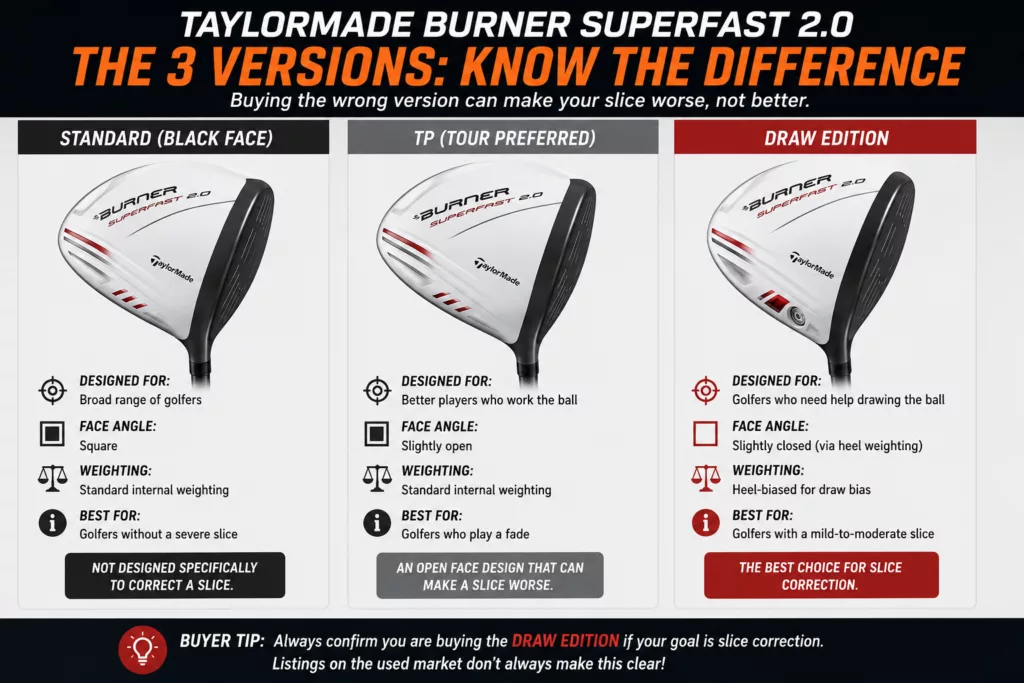
This is where most used market buyers make expensive mistakes. The TaylorMade Burner SuperFast 2.0 came in three distinct versions that perform very differently from each other, and used listings on eBay and secondary golf retailers don’t always distinguish between them clearly.
Standard (Black Face Edition)
The base model. Square face angle, standard internal weighting, designed for a broad range of golfers. Has no specific slice-correction features.
If you’re buying specifically to fix a slice, this is not the version you want. Look for “SuperFast 2.0” without any edition designation — this is the one most commonly misrepresented in used listings as a general draw-bias driver when it isn’t.
TP (Tour Preferred)
The version most often misunderstood by recreational golfers. The TP has a slightly open face angle, designed for better players who intentionally work the ball with a controlled fade. It produces the opposite result from what a slicer is looking for. If you already slice and you accidentally buy the TP version, you’ve made your problem worse.
The TP is typically distinguished by different cosmetic details and sometimes a different shaft — always confirm the version designation before purchasing.
Draw Edition
The version that matters for this review’s primary audience. The Draw Edition features internal heel weighting specifically positioned to promote a draw ball flight and help correct a slice tendency.
This is the closest equivalent to what the Performance Golf SF2 offers in the used market. If your goal is slice correction, the Draw Edition is the only SuperFast 2.0 model worth considering, and confirming you’re actually buying this specific version before completing any used purchase is non-negotiable.
Specifications: What You’re Actually Getting
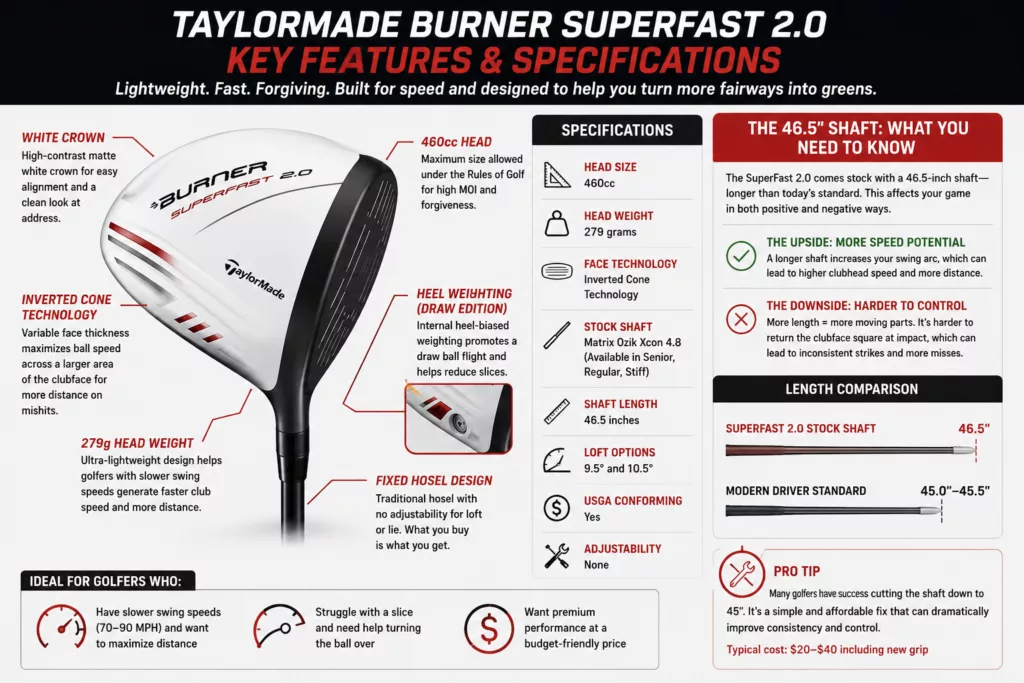
Head Size: 460cc — full maximum under the Rules of Golf, offering the highest possible MOI in this class
Head Weight: 279 grams — notably lightweight for a driver head of this era, designed to enable faster swing speeds at the lighter total club weight
Face Material: TaylorMade’s Inverted Cone Technology face — a face design that maximizes ball speed across a larger area of the clubface, expanding the effective sweet spot beyond the geometric center
Stock Shaft: Matrix Ozik Xcon 4.8 — a lightweight graphite shaft that complemented the lightweight head design. Available in multiple flexes (Senior, Regular, Stiff) in original-production clubs.
Stock Shaft Length: 46.5 inches — this is longer than the modern standard of 45-45.5 inches and is the single most important spec to understand before swinging this club for the first time
Face Angle (Draw Edition): Slightly closed at address via internal heel weighting — less aggressive than the Performance Golf SF2’s 3° closed face, but provides meaningful directional correction for mild-to-moderate slicers
Adjustability: None — the SuperFast 2.0 is a fixed hosel design with no loft or lie adjustment capability
USGA Conformance: Confirmed conforming as a standard TaylorMade OEM release. Verify current list status at usga.org for your specific model and era if using in sanctioned competition.
The 46.5-Inch Shaft: Why This Matters More Than Any Other Spec
If there is one thing that separates golfers who have a great experience with the SuperFast 2.0 from those who are disappointed with it, it’s awareness of the shaft length before the first swing.
Modern driver shafts are standardized around 45-45.5 inches. The SuperFast 2.0’s 46.5-inch shaft is a full inch longer than modern standard, which affects your game in two specific ways:
Positive: A longer shaft increases the arc of your swing, which can generate more clubhead speed if you make solid contact. This is why TaylorMade marketed the SuperFast series on distance — the length was a deliberate design choice to boost speed numbers.
Negative: A longer shaft makes it harder to return the clubface consistently square to the ball at impact, especially for golfers with mid-to-high handicaps. More length means more moving parts in the swing, and for golfers who already struggle with consistency, that extra inch can introduce new miss patterns even while the draw-bias weighting is trying to correct an existing one.
The practical fix: Many SuperFast 2.0 owners have the club cut down to a 45-inch standard length by a local club fitter. This is a straightforward job for any pro shop or golf repair service, typically costs $20-$40 including a new grip, and often dramatically improves consistency for golfers who were fighting the extra length.
If you buy a SuperFast 2.0 and immediately feel like you can’t control it, get the shaft trimmed before writing the club off entirely.
How the Draw Edition Actually Fixes a Slice
The Draw Edition’s slice correction mechanism works through internal heel weighting that shifts the center of gravity (CG) toward the heel side of the clubhead. This CG position influences the club’s behavior through impact in two related ways:
First, the heel-biased CG naturally promotes a slightly more inside-out swing path through the impact zone, which is the opposite of the out-to-in path that typically produces a slice. The club wants to swing in the direction that produces a draw, which subtly encourages your hands and arms to follow.
Second, the heel CG position makes the face more likely to be square or slightly closed at impact rather than open, reducing the glancing contact that sends the ball spinning hard to the right.
What the Draw Edition doesn’t do — and what’s worth being honest about — is aggressively close the face angle the way the Performance Golf SF2’s 3° closed setup does.
The SuperFast 2.0 Draw Edition’s correction is more subtle, making it well-suited for golfers with a mild-to-moderate slice who need a nudge in the right direction rather than a forceful intervention. Golfers with a severe, heavy slice may find the correction isn’t aggressive enough on its own.
Who the SuperFast 2.0 Is Actually Right For
Best fit — the mild-to-moderate slicer with a slower swing speed: If your slice is frustrating but not catastrophic, you’re in the 70-90 MPH swing speed range, and you want a lightweight, draw-biased driver at a used price under $120, the Draw Edition SuperFast 2.0 is genuinely hard to beat in its price class.
Good fit — the budget-conscious golfer who wants USGA conformance: Unlike some direct-to-consumer draw-bias options where conformance requires independent verification, the SuperFast 2.0 gives you confidence walking into any club competition without needing to check a database first.
Good fit — the golfer who wants a low-risk used market trial: At $70-$120 with strong resale demand, the financial downside if the club doesn’t work for you is limited compared to buying a new DTC driver with an uncertain resale market.
Not the right fit — the severe slicer who needs maximum correction: If your ball flight is a dramatic banana slice on almost every drive, the SuperFast 2.0 Draw Edition’s subtler correction may not be aggressive enough. A more forceful closed-face driver like the Performance Golf SF2 or a current-generation OEM option like the Ping G430 SFT may serve you better.
Not the right fit — the golfer who needs shaft adjustability: The fixed hosel means you get one loft, one lie angle, and whatever flex you bought. No post-purchase fine-tuning. Golfers who want to dial in their launch conditions after purchase need an adjustable-hosel modern driver instead.
Where to Buy a Used SuperFast 2.0 and What to Look For
Best sources in 2026:
- 2nd Swing Golf — typically offers graded condition ratings and a return policy on used clubs. Most reliable for condition accuracy.
- eBay — widest selection and lowest prices, but requires more buyer diligence on seller descriptions and condition photos.
- Callaway Golf Pre-Owned — occasionally carries mixed-brand inventory including TaylorMade.
- Golf Galaxy Pre-Owned / PGA Tour Superstore Pre-Owned — physical inspection possible if you have a location nearby.
What to confirm before buying:
- Version: Confirm explicitly that you’re purchasing the Draw Edition and not the standard or TP version. Ask the seller directly if the listing doesn’t specify.
- Face condition: Ask for a clear photo of the face showing the hitting area. Significant scoring line wear or impact marks concentrated in one area can indicate a deformed face or heavily used club.
- Shaft integrity: Check for cracks or nicks in the shaft, particularly near the hosel. The Matrix Ozik shaft is good, but 15-year-old graphite deserves a visual check.
- Grip condition: Expect to replace the grip on any used SuperFast 2.0 — budget $10-$15 for a new grip installation at a local pro shop or do it yourself.
- Hosel area: Check for any damage or rattling around the hosel, which on a fixed-hosel driver can indicate an impact or storage issue.
SuperFast 2.0 vs. Modern Draw-Bias Alternatives: The Honest Truth
The most common question serious buyers ask before pulling the trigger on a used SuperFast 2.0 is: how does it actually stack up against modern alternatives?
Here’s the straightforward answer:
Face technology: A current-generation driver face (Ping G430 SFT, TaylorMade Qi10 Max D-Type, Callaway Paradym X) will generate more ball speed across a wider area of the face than the SuperFast 2.0’s Inverted Cone Technology.
This is simply 15 years of engineering advancement. The gap is real, though not dramatic for slower swing speeds where overall ball speed is lower to begin with.
MOI and forgiveness: The SuperFast 2.0’s 460cc head gives it a competitive MOI compared to the Performance Golf SF2’s 445cc, and it’s comparable to many modern 460cc options in terms of head size. Where modern drivers have an advantage is in how precisely they can distribute that mass using sophisticated internal structures.
Adjustability: Fixed versus adjustable is the clearest modern advantage. Any 2020+ driver with an adjustable hosel gives you post-purchase flexibility the SuperFast 2.0 simply cannot match.
Value: At $70-$120 used, the SuperFast 2.0 is competing at a price point where modern alternatives simply cannot show up. The question isn’t whether it matches a $300+ new driver — it’s whether it represents better value than other options in the same used price range, and the answer is generally yes for its target buyer.

Frequently Asked Questions
Is the TaylorMade Burner SuperFast 2.0 still good in 2026? For the right golfer — slower swing speed, mild-to-moderate slice, budget-conscious — yes, genuinely. The technology is older but still functional, and the price-to-performance ratio in the used market is strong.
What is the difference between the Burner SuperFast 2.0 and the SuperFast 2.0 TP? The TP (Tour Preferred) has a slightly open face angle designed for better players who work a controlled fade. The standard Draw Edition has heel weighting for slice correction. These are opposite tools — buying the wrong version will make your miss worse, not better.
Is the Burner SuperFast 2.0 USGA conforming in 2026? The SuperFast 2.0 was confirmed conforming at launch as a standard TaylorMade OEM submission. As with any older equipment, verify current list status directly at usga.org if you plan to use it in sanctioned competition, since the USGA periodically reviews older equipment.
Should I cut down the shaft on the Burner SuperFast 2.0? If you’re struggling with consistency, yes — having a local club fitter trim the shaft to a modern 45-inch standard length often significantly improves control. This is a $20-$40 job at most pro shops.
How much does a used Burner SuperFast 2.0 Draw Edition sell for? Typically $70-$120 in good condition through reputable used golf retailers and eBay in 2026. Condition, shaft, and grip state will affect the final price.
Can I replace the stock Matrix Ozik shaft on the SuperFast 2.0? Yes, though the hosel is non-adjustable, a club fitter can reshaft the driver with a modern lightweight shaft if you want to upgrade from the original Matrix Ozik. This adds cost but can significantly update the club’s performance characteristics.
This review is based on publicly available specifications, buyer reports, and independent analysis as of 2026. The TaylorMade Burner SuperFast 2.0 is a discontinued product — verify current used market pricing and availability through the retailers listed above before purchasing.
Related Post

Are Golf Discount Cards Worth It? Only If You’d Play Three of the Courses Anyway
A golf discount card pays for itself when at least three of its courses are [...]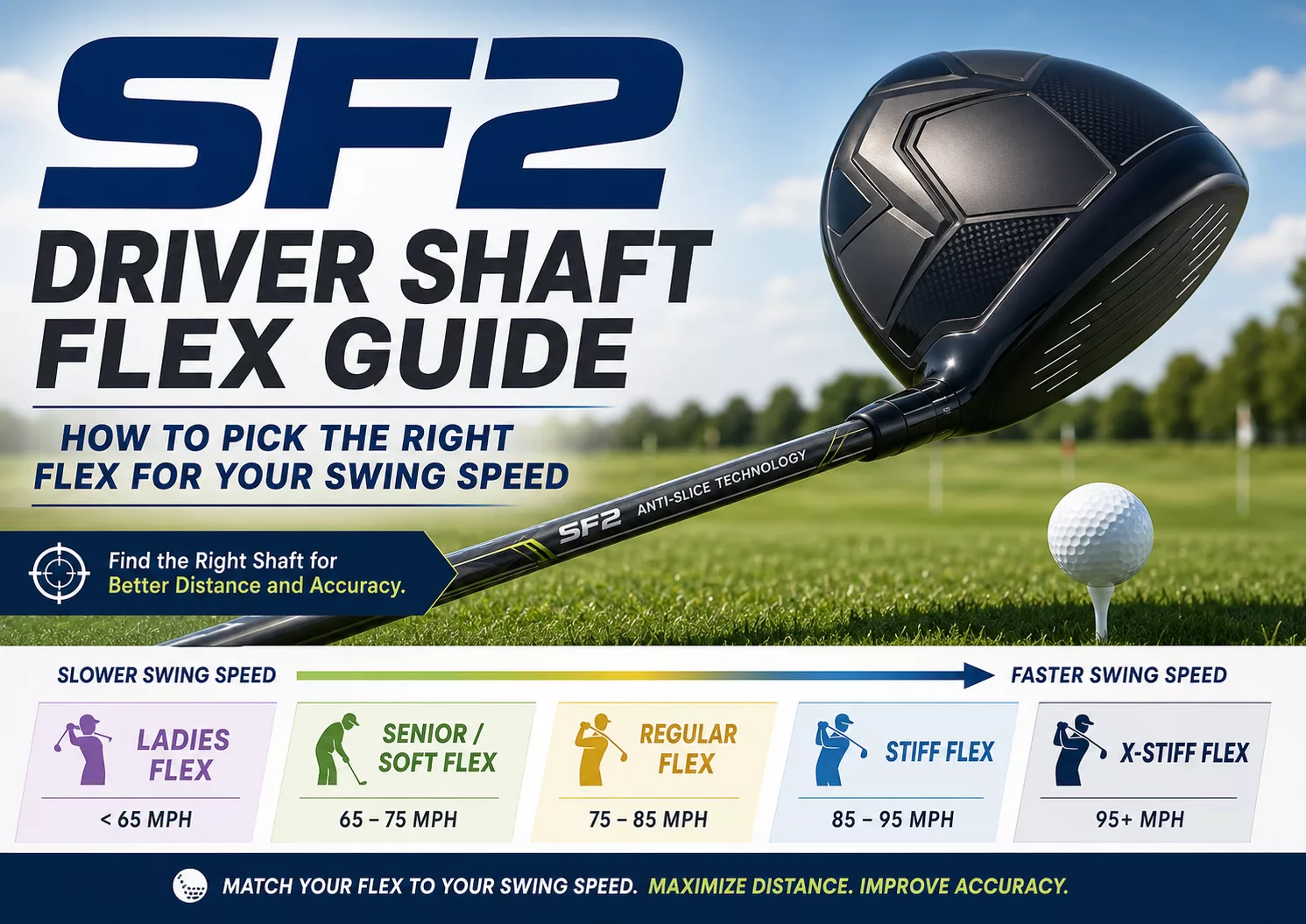
SF2 Driver Shaft Flex Guide: How to Pick the Right Flex for Your Swing Speed
Quick answer: The Performance Golf SF2 driver comes in five shaft flex options matched to [...]