This website uses cookies to improve your experience. We\'ll assume you\'re ok with this, but you can opt-out if you wish. Read More
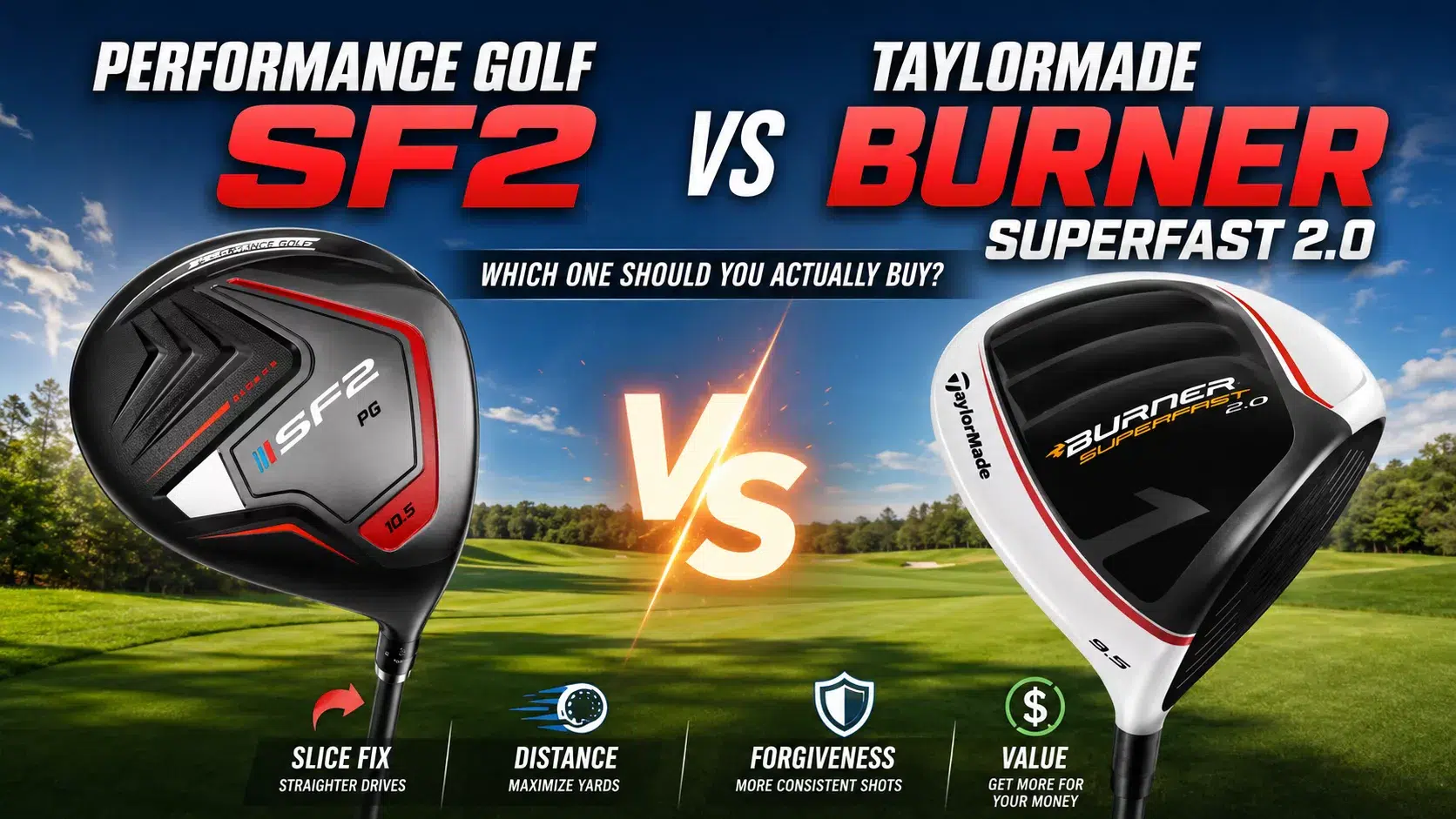
Performance Golf SF2 vs TaylorMade Burner SuperFast 2.0: Which One Should You Actually Buy?
Categories :
Quick answer: The Performance Golf SF2 is a newer, purpose-built slice-correction driver designed specifically around heel weighting and a closed face angle for golfers with slower swing speeds and consistent slices.
The TaylorMade Burner SuperFast 2.0 is a 2011 legacy driver with a genuine cult following, available used for $70-$120, that offers similar lightweight draw-bias benefits in its Draw Edition but with older face technology and a notably longer 46.5-inch stock shaft.
If you want the most targeted, modern slice correction and don’t mind buying outside traditional retail, the SF2 is the more purpose-built option. If you want a confirmed USGA-conforming club with strong resale value and don’t mind older technology, the SuperFast 2.0 Draw Edition is the better-value pick.
Why These Two Clubs Keep Getting Compared
If you’ve searched “SF2 driver,” you’ve probably noticed something confusing: there are two completely different clubs that show up. One is the modern, direct-to-consumer Performance Golf SF2. The other is the TaylorMade Burner SuperFast 2.0 — a club golfers have nicknamed “SF 2.0” for over a decade, distinctive for its matte-white crown and lightweight build.
The confusion isn’t an accident. Both clubs are chasing the same buyer: someone with a slice, a slower swing speed, and a desire for more forgiveness off the tee. Once golfers research one, they almost always stumble onto the other — which is exactly why this comparison gets asked about constantly in golf forums and Facebook groups.
Here’s the full breakdown.
Head-to-Head Specs
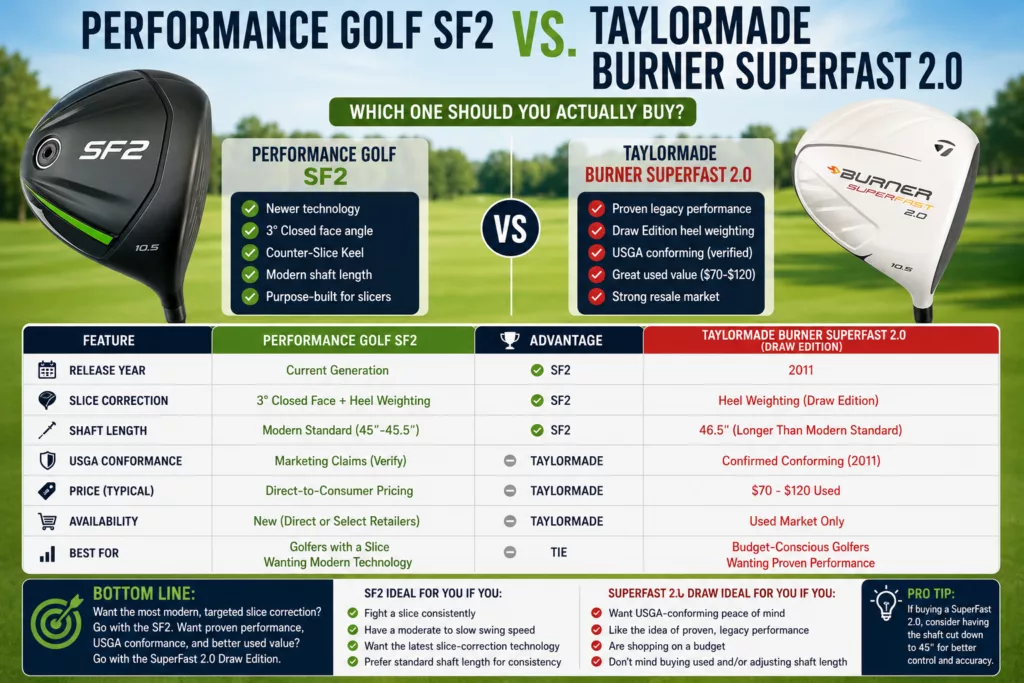
| Feature | Performance Golf SF2 | TaylorMade Burner SuperFast 2.0 |
|---|---|---|
| Release Year | Current generation | 2011 |
| Head Size | 445cc | 460cc |
| Head Weight | Lightweight forged titanium | 279 grams (notably light for its era) |
| Face Angle | 3° closed (standard model) | Square (standard), open (TP), closed heel weighting (Draw Edition) |
| Stock Shaft Length | Standard modern length | 46.5 inches (longer than modern standard) |
| Stock Shaft | Performance Golf proprietary, 50g-60g range | Matrix Ozik Xcon 4.8 |
| Slice Correction Method | Closed face + Counter-Slice Keel heel weighting | Heel weighting (Draw Edition only) |
| USGA Conformance | Marketing claims conforming; independent verification recommended | Confirmed conforming (era-appropriate, verify current list status) |
| New Price | Direct-to-consumer pricing | No longer sold new |
| Used Price | Limited resale market, lower demand | $70-$120 on eBay, 2nd Swing, Callaway Golf Pre-Owned |
| Purchase Channel | Performance Golf direct or select retailers | Used market only (eBay, 2nd Swing, Callaway Pre-Owned) |
The Slice Correction Comparison
This is the question that actually matters for most buyers researching both clubs: which one does a better job fixing a slice?
The SF2’s approach is more aggressive and more targeted. The 3° closed face angle works in combination with the Counter-Slice Keel — internal heel weighting designed specifically to influence club path through impact. The face is engineered to look square at address despite being technically closed, which means the correction is happening without the golfer needing to consciously adjust their setup.
The SuperFast 2.0’s approach depends entirely on which version you’re buying. The standard Black Face model has no special slice-correction features — it’s simply a lightweight, easy-swinging driver. The TP (Tour Preferred) version actually has a slightly open face angle, designed for better players who fade the ball intentionally — this is the wrong choice for a slicer.
The Draw Edition is the one that matters for this comparison: it features internal heel weighting similar in concept to the SF2’s Counter-Slice Keel, designed specifically to help golfers who fight a slice.
The verdict: If you’re comparing slice correction specifically, you need to compare the SF2 against the SuperFast 2.0 Draw Edition — not the standard or TP models, which are different tools for different problems.
Between those two, the SF2’s combination of closed face angle plus heel weighting is a more layered, modern approach. The SuperFast 2.0 Draw Edition relies on heel weighting alone, which is still effective but less aggressive in its correction.
The Shaft Length Problem With the SuperFast 2.0
This is one of the most common complaints from golfers who buy a used SuperFast 2.0 without fully researching it first.
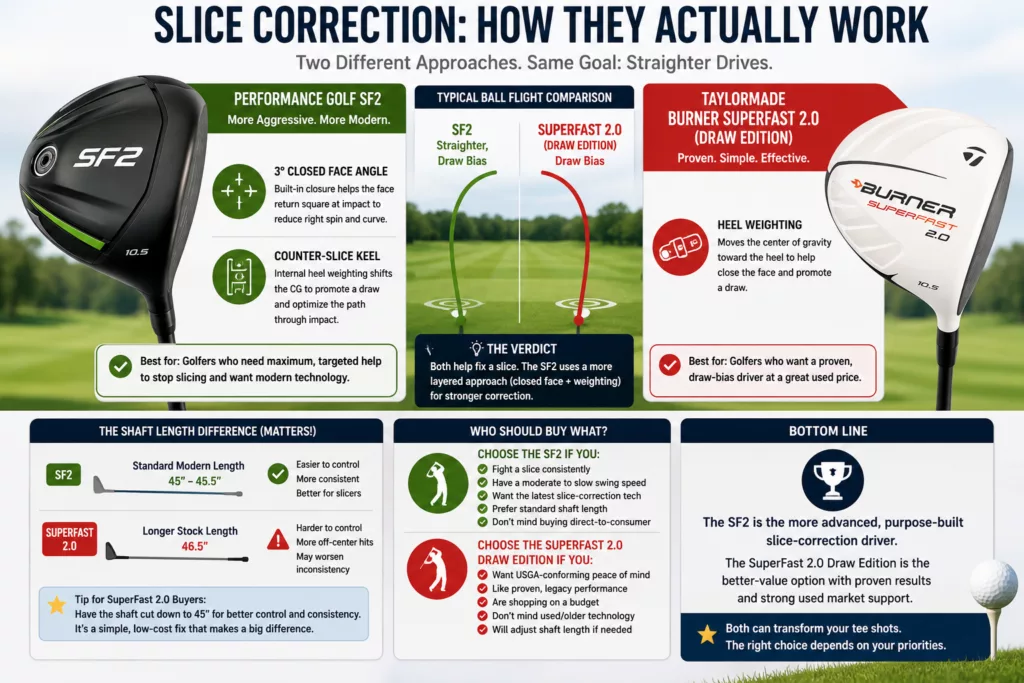
The stock shaft length is 46.5 inches, compared to the 45-45.5 inch standard on most modern drivers. That extra inch might not sound significant, but it has real consequences for off-center contact, especially for golfers who already struggle with consistency.
A longer shaft increases clubhead speed potential, but it also increases swing arc and makes it harder to return the face squarely to the ball — which can actually work against a golfer trying to fix a slice, since inconsistent contact from a longer shaft can introduce new mishits even if the draw-bias weighting is doing its job.
The SF2’s shaft length follows modern standard sizing, which removes this variable entirely. For a golfer who already has consistency issues, this is a meaningful practical advantage in the SF2’s favor — even though the SuperFast 2.0’s overall package looks appealing on paper.
If you do go the SuperFast 2.0 route, many golfers have it cut down to a modern 45-inch length by a local club fitter, which is a low-cost adjustment worth factoring into your total used-club budget.
USGA Conformance: A Real Difference Between These Two Clubs
This is an area where the SuperFast 2.0 has a clear advantage.
As a major OEM release from a recognized brand, the Burner SuperFast 2.0 went through TaylorMade’s standard pre-launch USGA submission process in 2011. While conforming equipment lists are periodically reviewed and clubs can theoretically be removed, a TaylorMade release from this era is generally well-documented and verifiable.
The SF2, as a newer direct-to-consumer release, has a less established conformance record. Performance Golf’s marketing claims the SF2 is tournament-legal, but independent reviewers have had difficulty confirming its presence on the official USGA conforming driver list. (See our full breakdown: Is the Performance Golf SF2 Driver USGA Conforming? for the complete verification process.)
If you play in club competitions or sanctioned events, this is a real factor in the decision. The SuperFast 2.0 gives you more confidence walking into a tournament round without needing to verify anything first.
Resale Value: Why This Matters More Than Most Buyers Realize
Here’s a financial consideration that rarely gets discussed in driver comparisons but should factor heavily into your decision.
The TaylorMade Burner SuperFast 2.0 holds resale value remarkably well for a 15-year-old club, consistently selling for $70-$120 on eBay and through used golf retailers like 2nd Swing and Callaway Golf Pre-Owned. This is because TaylorMade is a globally recognized brand with strong tour presence and broad consumer trust — buyers searching used golf clubs know what they’re getting.
The SF2, as a direct-to-consumer brand without major retail presence or tour visibility, does not currently have an established secondary resale market with comparable demand. If you buy an SF2 and later decide it isn’t right for your game, your ability to recoup any of that cost through resale is significantly weaker than it would be with the SuperFast 2.0.
Practical takeaway: If you’re not fully certain a draw-bias driver is going to solve your slice, the SuperFast 2.0 represents a lower-risk financial trial — even if it doesn’t work out, you can likely resell it for close to what you paid. The SF2 carries more resale risk if your purchase doesn’t work out.
Which One Should You Actually Buy?
Here’s the honest breakdown by golfer type:
Choose the SF2 if:
- You want the most modern, purpose-built slice correction technology available
- You have a confirmed slower swing speed and want a driver specifically calibrated to that range
- You’re not planning to play in sanctioned tournaments or handicap-counting competitions
- You’re comfortable buying through a direct-to-consumer brand and understand the return policy before purchasing
Choose the TaylorMade Burner SuperFast 2.0 (Draw Edition specifically) if:
- You want a confirmed USGA-conforming club for tournament and handicap play
- You want a lower financial risk purchase with strong resale value if it doesn’t work out
- You don’t mind buying used and potentially having the shaft cut down to modern length
- You value buying from an established major OEM brand with tour-tested technology, even if it’s an older release
Avoid both and consider a current-generation OEM draw-bias driver (Ping G430 SFT, TaylorMade Qi10 Max D-Type, Callaway Paradym X) if:
- You want the absolute latest face technology and highest MOI forgiveness
- Budget allows for $200+ on a confirmed-conforming, professionally fit driver
- You want full manufacturer support, warranty, and a recognized brand for both performance and resale

A Word of Caution on the SuperFast 2.0 Used Market
If you decide to go the SuperFast 2.0 route, buy carefully. This is a 15-year-old club, and used market listings vary widely in actual condition versus advertised condition. Before buying:
- Confirm you’re getting the Draw Edition specifically if slice correction is your priority — sellers don’t always distinguish clearly between Black Face, TP, and Draw Edition in listings
- Ask for clear photos of the face for wear, micro-cracks, or scoring line degradation
- Check the grip condition — most used grips at this age need replacement, factor that small cost into your budget
- Verify the shaft hasn’t been swapped from the stock Matrix Ozik Xcon 4.8 unless that’s specifically what you’re looking for

Frequently Asked Questions
Is the TaylorMade Burner SuperFast 2.0 the same thing as the Performance Golf SF2? No. They are completely different products from different companies that happen to share a similar nickname. The Burner SuperFast 2.0 is a 2011 TaylorMade release with white crown design; the SF2 is a current-generation direct-to-consumer driver from Performance Golf.
Which is better for fixing a slice, the SF2 or the SuperFast 2.0? For dedicated slice correction, you need to compare the SF2 specifically against the SuperFast 2.0 Draw Edition — not the standard or TP versions, which don’t have the same heel-weighted slice correction design. Between those two, the SF2’s combination of closed face plus heel weighting is generally a more aggressive correction approach.
Can I still buy a new TaylorMade Burner SuperFast 2.0? No, this model has been discontinued for years and is only available on the used/secondary market through retailers like 2nd Swing, eBay, and Callaway Golf Pre-Owned.
Is the 46.5-inch shaft on the SuperFast 2.0 a dealbreaker? Not necessarily, but it’s worth knowing about before you buy. Many golfers have the shaft cut down to a standard 45-inch length by a local club fitter for better control, which is a low-cost adjustment.
Which club has better resale value if I decide it’s not for me? The TaylorMade Burner SuperFast 2.0 holds resale value significantly better due to brand recognition and established secondary market demand. The SF2 currently has a much weaker resale market.
This comparison is based on publicly available specifications, buyer reports, and independent reviewer findings as of 2026. Specifications and pricing can change — verify current details directly with sellers before purchasing.
Related Post

Best Golf Drivers 2025: Wisconsin Course-Tested Reviews Under $400
Finding the perfect golf driver can transform your game, but with dozens of options available, [...]
Best Affordable Golf Courses in Texas: Top Budget-Friendly Options for Every Golfer
Texas has a surprisingly wide range of quality golf courses that won’t empty your pockets. [...]