This website uses cookies to improve your experience. We\'ll assume you\'re ok with this, but you can opt-out if you wish. Read More
Is the Performance Golf SF2 Driver USGA Conforming? What Tournament Players Need to Know
Categories :
Quick answer: Performance Golf’s marketing materials state the SF2 driver is legal for tournament play. However, independent reviewers have noted that the SF2 head has been difficult to locate on the official USGA conforming driver heads list. If you intend to use the SF2 in any sanctioned tournament, club championship, or handicap-counting round, you should verify its current status directly in the USGA database before putting it in your bag — not by relying on the manufacturer’s claim alone.
Why This Question Matters More Than You Think
Most casual golfers never think about USGA conformance. They buy a club, they play golf, end of story.
But the moment you enter a club championship, a member-guest tournament, a state amateur qualifier, or even a regular weekend stroke play round where you’re posting a handicap score, conformance becomes a real issue. Playing with a non-conforming driver in a handicap round technically invalidates the score. Playing one in a club competition can result in disqualification.
This is why the conformance question about the SF2 generates consistent search traffic — not from tour players, but from everyday club golfers who want to know if they can use it in their Saturday morning stroke play group or their club’s annual member-guest event without getting flagged.
What the USGA Conforming Driver List Actually Is
The USGA (United States Golf Association) maintains an official list of equipment that has been independently tested and verified to meet the Rules of Golf. For drivers specifically, the list confirms that the clubhead, face, and overall construction fall within the legal limits for:
- Coefficient of Restitution (COR): The “trampoline effect” of the face — capped at 0.830
- Characteristic Time (CT): A related measurement of face flexibility during impact — maximum 257 microseconds with a tolerance of 18 microseconds
- Head Volume: Maximum 460cc
- Club Length: Maximum 48 inches (though the USGA and R&A have proposed reducing this to 46 inches for elite competition)
- Moment of Inertia (MOI): Maximum 5900 g·cm² about the vertical axis
A club that passes all of these tests earns a place on the conforming list. One that fails any test — or that was never submitted for testing — does not appear on the list.
Critically, absence from the list is not the same as confirmation that a club is non-conforming. A club can be absent from the list simply because the manufacturer never submitted it for testing, not because it failed. However, for tournament purposes, most competition committees and rules officials treat “not on the list” and “non-conforming” as functionally equivalent.
What Performance Golf Says About SF2 Conformance
Performance Golf’s marketing materials and product pages assert that the SF2 driver is fully conforming and legal for tournament play. This is the official position of the brand.
Performance Golf is not alone in making this claim — most golf equipment brands assert conformance in their marketing. The difference is that major OEM brands like TaylorMade, Callaway, Ping, and Titleist submit every driver model to the USGA for listing before launch as a standard part of their product release process. Their clubs appear on the conforming list by the time the product hits retail shelves.
Direct-to-consumer (DTC) brands operating outside traditional retail channels do not always follow the same pre-launch submission process, which is why independent reviewers have flagged the SF2’s list status as worth verifying independently.
How to Check the USGA Conforming List Yourself
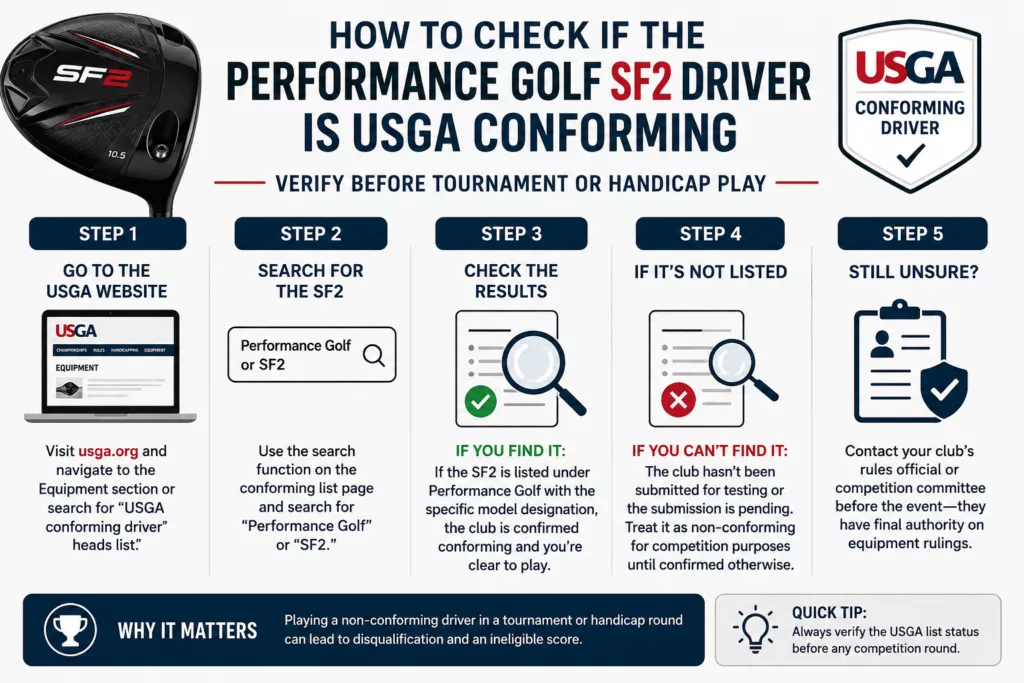
This is the most important section of this article. Here’s exactly how to verify the SF2’s current status:
Step 1: Go to usga.org and navigate to the Equipment section, or search directly for “USGA conforming driver heads list.”
Step 2: Use the search function on the conforming list page to search for “Performance Golf” or “SF2.”
Step 3: If you find the SF2 listed under Performance Golf with the specific model designation, the club is confirmed conforming and you’re clear to play it in sanctioned events.
Step 4: If you cannot find it listed, that means either the club hasn’t been submitted for testing or the submission is still pending. In either case, treat it as non-conforming for competition purposes until confirmed otherwise.
Step 5: If you’re still unsure, contact your club’s rules official or competition committee before the event — they have final authority on equipment rulings in local competitions.
What Happens If You Play a Non-Conforming Driver in a Tournament
This is worth understanding clearly because the consequences differ depending on the type of competition:
In a stroke play event (club championship, qualifier, etc.): Under Rule 4.1a, if you start a round with a non-conforming club in your bag, you are disqualified from the round. There is no penalty option — it’s an automatic DQ. If you discover the club is non-conforming during the round (not before), you must immediately take it out of play and cannot use it for the remainder of the round, but you are not disqualified if you stop using it.
In a match play event: The opponent can choose to enforce the disqualification or waive it. Practically speaking, most club-level match play competitors would enforce it if they were aware.
In a handicap round: Technically, playing with non-conforming equipment makes the round ineligible for handicap posting under the World Handicap System. In practice, this is rarely enforced at the casual level, but it is the rule.
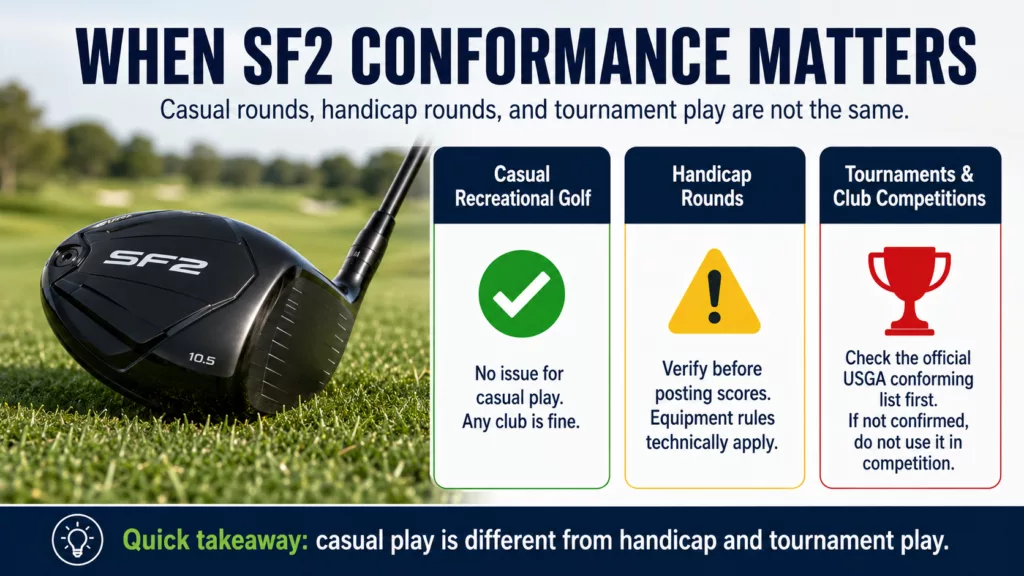
In a casual, non-competitive round: No consequences whatsoever. Play whatever you want.
The Practical Reality for Different Types of SF2 Buyers
Understanding the conformance situation is most useful when you match it to your actual playing situation:
If you play purely recreational golf and never post handicap scores or enter competitions: The conformance question is irrelevant to you. Play the SF2 and focus entirely on whether it fixes your slice.
If you post handicap scores but play casual rounds: Technically you should verify conformance, but the practical enforcement risk at most clubs is minimal. That said, verifying takes five minutes and eliminates any ambiguity.
If you play in club competitions, member-guests, or handicap events: Verify the USGA list status before your first tournament round. If you can’t confirm it’s listed, leave the SF2 in the car and use your backup driver for competition play.
If you play in USGA-sanctioned amateur events or state qualifiers: Do not use the SF2 in competition until you have confirmed its presence on the USGA list. The stakes of a DQ at this level are too high to rely on a manufacturer’s marketing claim.
How the SF2 Compares to Its Conforming Competitors
For golfers in the tournament-play category who need a draw-bias driver they can use without any conformance anxiety, here are the confirmed alternatives to consider:
Ping G430 SFT: Ping submits all models to the USGA as part of their standard release process. The G430 SFT is confirmed conforming, fully adjustable, and engineered with Straight Flight Technology for draw bias. Pre-owned examples run $180-$250.
TaylorMade Qi10 Max D-Type: Confirmed conforming, 460cc high-MOI head with draw bias built into the internal weighting. Retail pricing is significantly higher than the SF2, but pre-owned examples are becoming available.
Callaway Paradym X: Conforming, draw-biased, and available through mainstream retail with full fitting support.
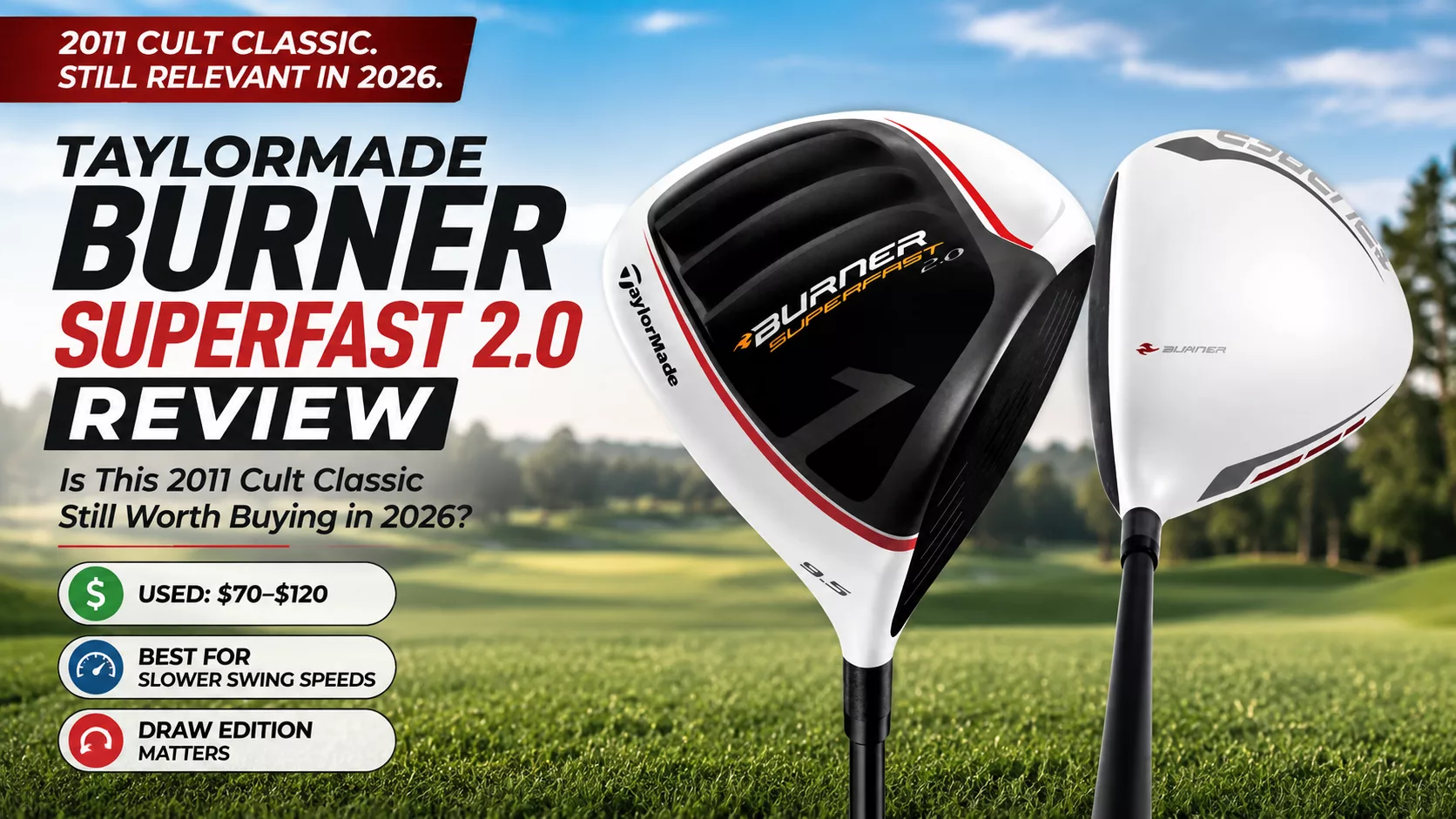
TaylorMade Burner SuperFast 2.0 Draw Edition: A legacy option from 2011 with confirmed historical conformance status and strong secondary market availability at $70-$120. Worth noting that the USGA periodically reviews older clubs and their list status can change, so verify even this one if using in competition.
The Bottom Line
Performance Golf asserts the SF2 is conforming. For casual play and recreational golf, that assertion is probably sufficient — the club’s physical design does not appear to push against any of the major conformance limits on its face (COR, CT, volume, MOI).
For tournament and competition play, the standard you should hold yourself to is independent verification on the USGA list — not the manufacturer’s claim. Five minutes on usga.org before your club championship is a much better use of time than discovering the issue on the first tee.
If the SF2 is listed, play it with confidence. If it isn’t, you have plenty of confirmed conforming draw-bias alternatives that will fix your slice just as effectively.
Frequently Asked Questions
Is the Performance Golf SF2 driver legal for casual golf rounds? Yes — USGA rules only apply to competitions and handicap rounds. For casual recreational play, any club is legal regardless of conformance status.
What is the USGA CT limit for driver faces? The maximum Characteristic Time (CT) for a driver face is 257 microseconds, with an 18-microsecond tolerance, giving an effective limit of 275 microseconds. Faces that exceed this are considered non-conforming due to excessive spring-like effect.
Does a driver need to be on the USGA list to be legal for handicap posting? Under the World Handicap System, scores must be made under the Rules of Golf, which includes equipment rules. Technically, using non-conforming equipment makes a round ineligible for posting, though this is rarely audited at the club level.
How often does the USGA update their conforming equipment list? The USGA updates the conforming equipment lists on a rolling basis as manufacturers submit products for testing. The list is searchable online and reflects current approved status at any given time.
If the SF2 isn’t on the USGA list, does that mean it failed testing? Not necessarily. Absence from the list means either the club was never submitted for testing, or the submission is pending. It does not confirm the club failed any specific test.
Can my club’s competition committee make a ruling on the SF2 if it’s not on the USGA list? Yes. Local competition committees have authority to make equipment rulings for their events. Most committees follow the USGA list as their standard reference, meaning an unlisted club would typically be treated as non-conforming for their purposes.
This article reflects publicly available information about USGA conformance processes and independent reviewer findings as of 2026. USGA list status can change — always verify directly at usga.org before any competition round.
Related Post
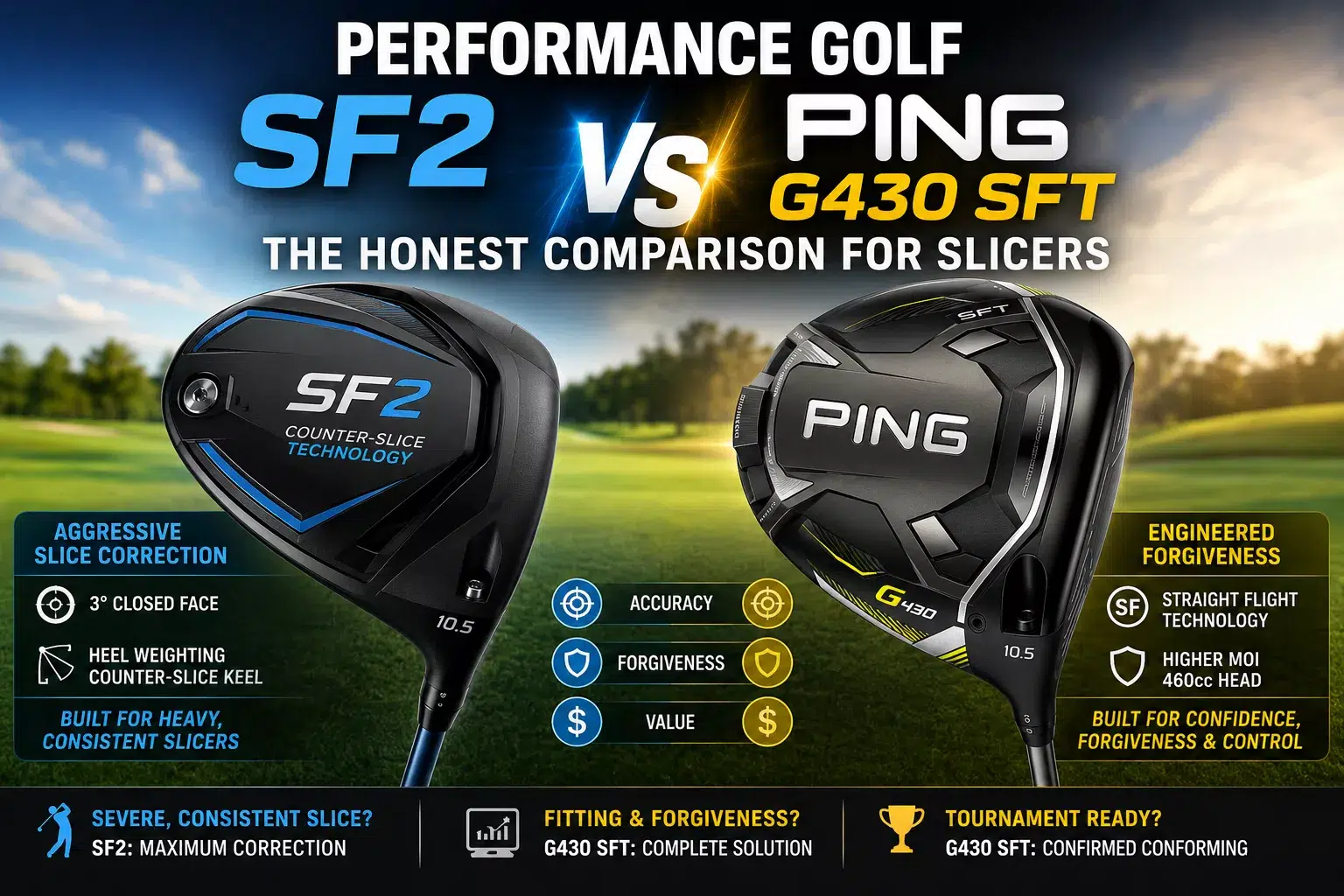
Performance Golf SF2 vs Ping G430 SFT: The Honest Comparison for Slicers
Quick answer: The Ping G430 SFT is a premium, confirmed USGA-conforming draw-bias driver with Ping’s [...]
Senior Golf Discounts: Most Courses Start Between 50 and 62 — Here’s How to Find Yours
There’s no standard senior age in golf. Most courses set the threshold somewhere between 50 [...]