This website uses cookies to improve your experience. We\'ll assume you\'re ok with this, but you can opt-out if you wish. Read More
445cc vs 460cc Driver: Does Head Size Actually Matter for High Handicappers?
Categories :
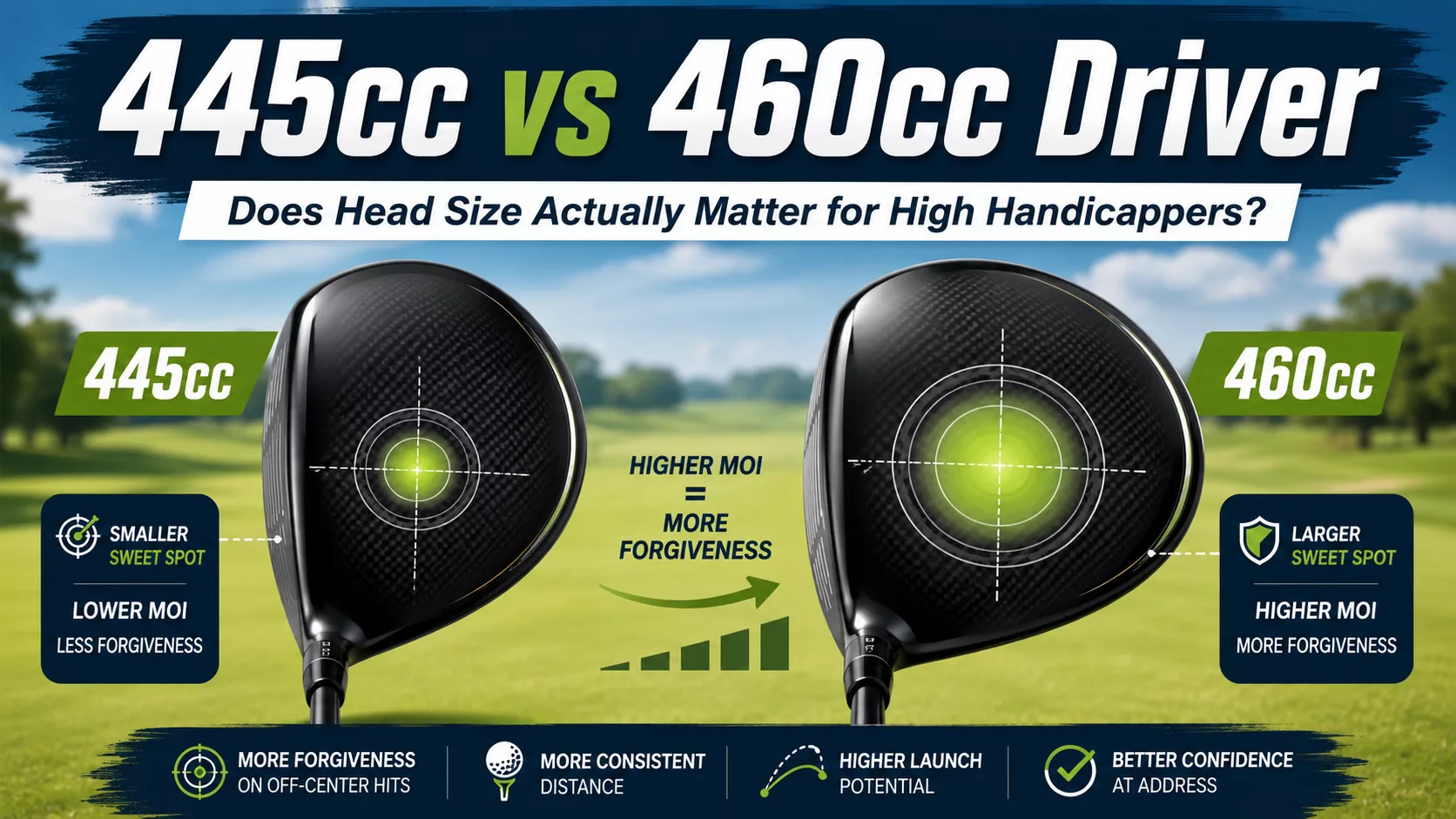
Quick answer: Yes, head size matters — but not in the way most golfers think. A 460cc driver head has a higher maximum MOI (Moment of Inertia), which means more forgiveness on off-center hits across the full face.
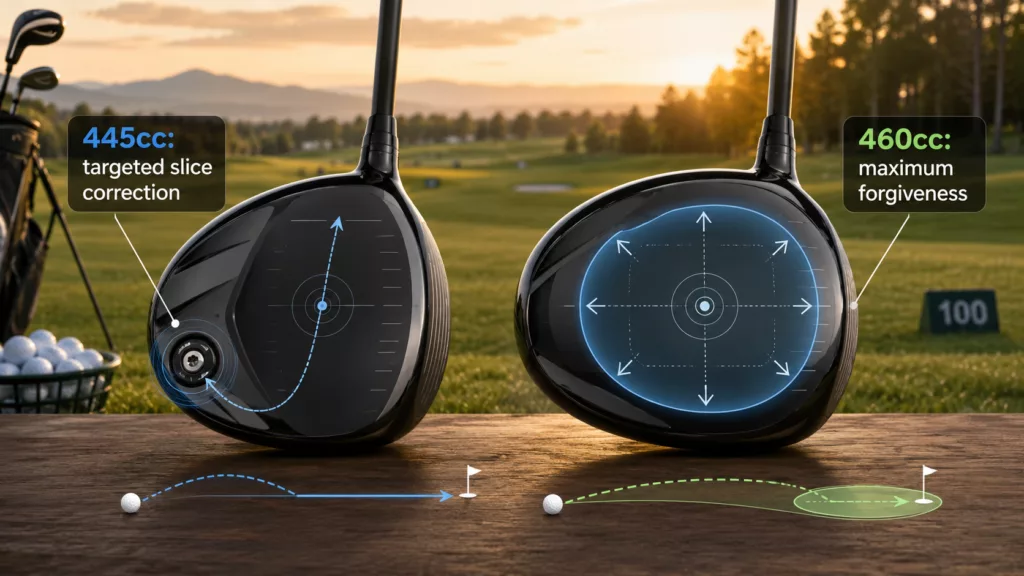
A 445cc head allows more precise internal weight positioning, which some manufacturers use to deliver more targeted correction for specific miss patterns like a consistent slice.
For most high handicappers whose misses are scattered and inconsistent, 460cc is the safer choice. For high handicappers whose miss is singularly and predictably a slice, a well-engineered 445cc head like the Performance Golf SF2 can outperform a 460cc head in the dimension that matters most for their game.
Why This Question Comes Up in the SF2 Research Journey
The 445cc vs 460cc question enters most SF2 research journeys at a specific moment: when a golfer comparing the SF2 to competitors notices that the SF2 has a smaller head than the Ping G430 SFT, the Callaway Paradym Draw, or the TaylorMade Qi10 Max D-Type — all of which use 460cc heads — and wonders whether they’re giving something up.
This is a legitimate question and it deserves a direct technical answer rather than a vague reassurance that “both are great in their own way.”
What MOI Actually Is and Why It Matters
MOI stands for Moment of Inertia. In the context of a golf driver, it measures the clubhead’s resistance to twisting when the ball is struck away from the geometric center of the face.
When you hit a shot toward the toe of the club, the head wants to rotate open (clockwise for a right-handed golfer) around the point of contact. High MOI resists that rotation, keeping the face closer to square through impact and preserving more ball speed and direction control on the mishit.
When you hit a shot toward the heel, the opposite happens — the head wants to rotate closed — and again, high MOI resists that unwanted rotation.
The practical result: a high-MOI driver is more forgiving on off-center strikes because it maintains face angle and ball speed across a larger area of the face.
How Head Size Relates to MOI
Head size and MOI are related but not identical. A larger head creates more potential for high MOI because mass can be distributed further from the center of the head — and mass distributed further from the center contributes more to rotational resistance than the same mass positioned close to the center.
The USGA allows a maximum head volume of 460cc and a maximum MOI of 5900 g·cm² around the vertical axis. Premium 460cc drivers from major OEM brands are typically engineered specifically to approach both of these limits simultaneously, using advanced materials and weight redistribution to push MOI as high as possible within the maximum head size.
A 445cc head starts with a smaller canvas. The theoretical maximum MOI achievable in a 445cc head is lower than in a 460cc head at equivalent material quality, because there is simply less room to push mass to the perimeter. This is a physics constraint, not a manufacturing shortcut.
However — and this is where the SF2’s design philosophy becomes relevant — the 15cc size reduction gives the manufacturer more flexibility in how internal mass is positioned.
Instead of distributing weight for maximum omnidirectional MOI, a 445cc head can concentrate weight precisely for a specific purpose, such as shifting the CG aggressively toward the heel for maximum draw bias without compromising other structural requirements.
The Real-World Forgiveness Difference Between 445cc and 460cc
For a golfer hitting the center of the face every time, head size is irrelevant to performance — MOI only matters on off-center strikes. The question is: how often does a high handicapper miss the center?
Answer: frequently. Studies of recreational golfer impact patterns consistently show that the average high handicapper strikes the face across a wide area, with toe and heel misses being common alongside center strikes.
This is precisely why the golf equipment industry has spent decades engineering higher MOI — because the players who need the most help are also the ones who most consistently hit off-center.
What this means for the 445cc vs 460cc decision:
A high handicapper whose misses are scattered across the face in multiple directions — sometimes toe, sometimes heel, sometimes thin — benefits most from the highest possible MOI. For this player, the 460cc head’s broader forgiveness envelope is directly addressing their most common problems.
A high handicapper whose misses are directionally specific — almost always a slice to the right from an open face at impact, with otherwise reasonable contact quality — may actually benefit more from a 445cc head that uses the freed mass budget for aggressive heel weighting, because their primary problem is directional rather than contact-based.
The honest assessment is that most high handicappers fall into the first category — their misses are inconsistent and scattered. The second category (consistent slicer with otherwise reasonable contact) is a real player type but a narrower subset of the high handicapper population.
What Performance Golf Traded Away With 445cc — And What They Got
Performance Golf made a specific engineering tradeoff when designing the SF2 at 445cc rather than the maximum 460cc. Understanding that tradeoff clearly is useful for making an informed purchase decision.
What they traded away:
- Theoretical maximum MOI is lower than a 460cc head could achieve
- Slightly smaller face area, which reduces the margin for off-center hits before ball speed drops significantly
- Visual footprint at address is marginally smaller, which some golfers find less confidence-inspiring
What they got in return:
- Ability to position the Counter-Slice Keel heel weighting more precisely and aggressively than a 460cc head would allow within the same structural constraints
- Slightly more aerodynamic head profile through impact, which can contribute marginally to clubhead speed
- A head geometry that supports the 3° closed face angle more cleanly in combination with the heel weighting
Whether that tradeoff works in your favor depends entirely on your miss pattern. For the target SF2 buyer — a recreational golfer with a severe, consistent slice and otherwise reasonable contact quality — the tradeoff is in their favor. For a recreational golfer who sprays the face in multiple directions and occasionally slices, the tradeoff works against them.
Does the Smaller Head Look Different at Address?
This is a practical question that gets asked less often but matters for actual on-course confidence.
At 445cc, the SF2’s head is noticeably smaller than a 460cc driver when you set it behind the ball. How significant that visual difference is depends on what you’re used to.
Golfers who have played 460cc drivers for years will notice the smaller footprint. Some find it looks “cleaner” and easier to aim; others find it less confidence-inspiring. Neither reaction is wrong — clubhead appearance at address has a real psychological effect on swing confidence, and a club that looks wrong to you is worth taking seriously even if the specs are otherwise correct.
If the SF2’s 445cc footprint concerns you visually, the best approach is to find a demo or check video reviews that show the head at address before purchasing, since direct handling isn’t possible through the DTC purchase model. A club that looks off to your eye at setup creates a compensatory move in the swing before you’ve even started the backswing.
Head Size Comparison: The SF2 Against Its Main Competitors
| Driver | Head Size | MOI Approach | Primary Forgiveness Type |
|---|---|---|---|
| Performance Golf SF2 | 445cc | Heel-concentrated for draw bias | Directional (slice correction) |
| Ping G430 SFT | 460cc | Maximized omnidirectional via Dragonfly crown savings | Omnidirectional across full face |
| TaylorMade Qi10 Max D-Type | 460cc | Maximum MOI with D-Type heel weighting | Omnidirectional plus draw bias |
| Callaway Paradym Draw | 460cc | High MOI via Triaxial Carbon crown mass savings | Omnidirectional plus draw bias |
| Cleveland Launcher XL Draw | 460cc | High MOI via HiBore Crown lower CG | Launch-optimized plus draw bias |
| TaylorMade Burner SuperFast 2.0 | 460cc | MOI via ultra-thin walls and lightweight construction | Omnidirectional (Draw Edition adds heel weighting) |
The pattern is clear: every major OEM competitor uses 460cc. The SF2 is the only draw-bias driver on this list using a smaller 445cc head, and it does so specifically to enable more aggressive heel weighting rather than to cut costs or reduce complexity.
The Bottom Line: Which Head Size Is Right for Your Game?
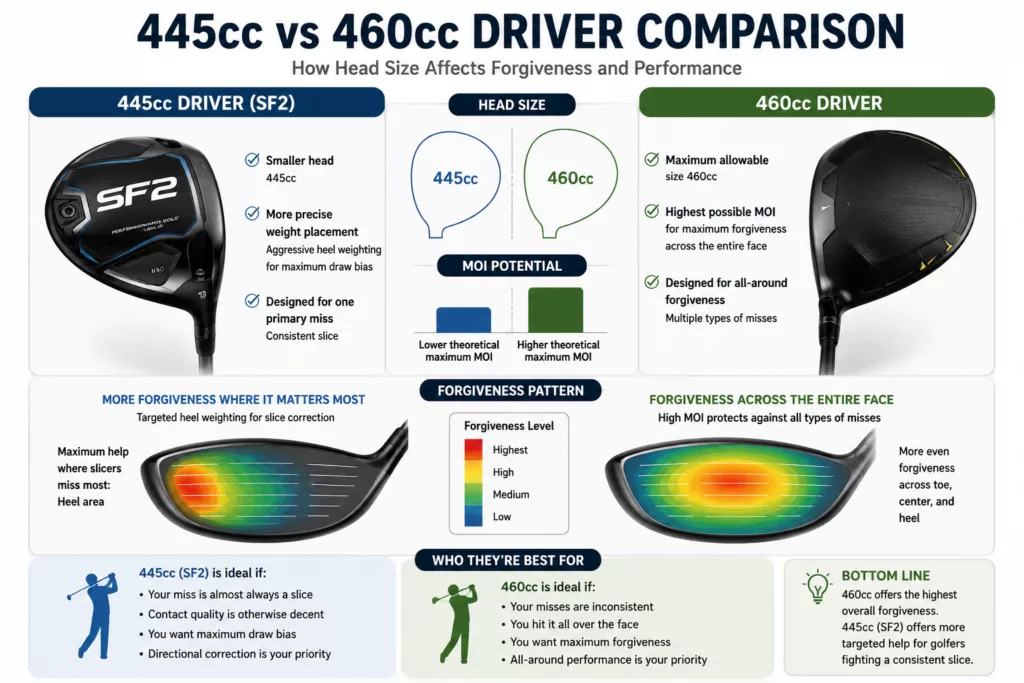
Choose a 460cc draw-bias driver if: Your misses are inconsistent — sometimes a slice, sometimes a thin shot, sometimes a toe strike, sometimes a pull. You need forgiveness across the whole face, not just in one direction. The Ping G430 SFT, TaylorMade Qi10 Max D-Type, and Callaway Paradym Draw all deliver draw bias within a high-MOI 460cc package.
The SF2’s 445cc head may be right for you if: Your slice is severe and consistent — almost every drive goes right, the contact quality is otherwise reasonable, and you’ve already tried or considered moderate draw-bias 460cc options without finding sufficient correction. The SF2’s 445cc tradeoff is worth accepting when maximum directional correction is the single most important variable.
The honest middle ground: If you’re genuinely uncertain which category your game falls into, a session on a launch monitor looking at your impact pattern across 10-15 drives will tell you more than any spec comparison. Scattered impact across the face points toward 460cc. Consistent heel-heavy contact with an open face points toward the SF2’s targeted correction approach.

Frequently Asked Questions
Is a 460cc driver always more forgiving than a 445cc driver? In terms of omnidirectional MOI forgiveness across the full face, a well-engineered 460cc head has a higher theoretical ceiling than a 445cc head. However, a 445cc head can achieve higher directional forgiveness for a specific miss pattern through more precise weight positioning. Forgiveness depends on what type of miss you’re most trying to protect against.
Will I lose distance with a 445cc driver compared to 460cc? Head size alone does not determine distance — face technology, CG position, loft, and shaft all play larger roles. A 445cc head with a well-engineered face can match or exceed a 460cc head in ball speed on center strikes. The distance difference between the two is more likely to come from off-center performance than from the head size itself.
Can you tell the difference between 445cc and 460cc at address? Yes — the 15cc difference is noticeable when setting up behind the ball, particularly for golfers accustomed to 460cc heads. The 445cc footprint is marginally smaller and some golfers find it looks less confidence-inspiring. Testing the visual appearance before committing to a DTC purchase is worth doing through video reviews if an in-person demo isn’t possible.
Why don’t more manufacturers use 445cc heads for draw-bias drivers? Most major OEM manufacturers have determined that the broader market prefers maximum forgiveness (460cc) even for draw-bias applications, and they achieve their draw correction through weight repositioning within the 460cc frame. Performance Golf’s choice of 445cc reflects a specific philosophy that prioritizing aggressive correction for severe slicers outweighs the MOI cost for their target customer.
Is the USGA maximum head size 460cc? Yes. Under the Rules of Golf, the maximum permissible driver head volume is 460cc, with a tolerance of 10cc. The SF2’s 445cc head is well within this limit.
This article is based on publicly available specifications and general golf equipment engineering principles as of 2026. Always verify current specifications directly with manufacturers before purchasing.
Related Post
Are Golf Discount Cards Worth It? Only If You’d Play Three of the Courses Anyway
A golf discount card pays for itself when at least three of its courses are [...]
Performance Golf SF2 vs Callaway Paradym Draw: Is the Price Difference Justified?
Quick answer: The Callaway Paradym Draw is a premium, confirmed USGA-conforming draw-bias driver built on [...]