This website uses cookies to improve your experience. We\'ll assume you\'re ok with this, but you can opt-out if you wish. Read More
Are Municipal Golf Courses Any Good? What to Expect in 2026

Categories :
Are Municipal Golf Courses Any Good? What to Expect Before You Book
Municipal golf courses range from genuinely rough to genuinely remarkable — and the price tag tells you almost nothing about which one you’re booking. Some of the most celebrated courses in American golf are municipal: Bethpage Black on Long Island has hosted two U.S. Opens and a PGA Championship. Torrey Pines in San Diego has hosted two U.S. Opens and holds a PGA Tour event every year. Both are city or county owned, and both let anyone with a tee time walk on.
That’s the ceiling. The floor exists too, and this guide is about telling them apart before you spend your Saturday and your money. Because when a muni is good, weekday municipal golf is the best value in the sport — full stop.
What “Municipal” Actually Means
A municipal course is owned by a city, county, or park district rather than a private operator. That ownership shapes everything about your round:
- Access is the point. Munis exist to provide public golf, so there’s rarely a membership barrier, dress codes are relaxed, and rates are set with residents in mind — often with a resident discount you should always ask about.
- Budgets are political. A muni’s condition depends on a parks department budget competing against roads, pools, and playgrounds. This is the single biggest driver of quality variance.
- They’re not “daily fee” courses. A daily-fee course is privately owned but open to the public, and it lives or dies on profit, so it usually invests more in conditioning — and charges accordingly. Munis often deliver 80% of the daily-fee experience for 50% of the price.
The Proof That Munis Can Be Elite
If anyone tells you municipal golf is inherently second-rate, these are the counterexamples:
- Bethpage Black (Bethpage State Park, NY) — U.S. Opens in 2002 and 2009, PGA Championship in 2019. State-owned, famous for its first-come tee time line.
- Torrey Pines South (San Diego, CA) — U.S. Opens in 2008 and 2021, and the annual PGA Tour stop on the South Course. City owned.
- Chambers Bay (University Place, WA) — 2015 U.S. Open, owned by Pierce County.
- Brown Deer Park (Milwaukee County, WI) — hosted the PGA Tour’s Milwaukee event for years, including Tiger Woods’ professional debut in 1996.
None of these are cheap in peak season anymore, but they prove the category’s potential. More importantly, the same forces that made them good — committed superintendents, steady play revenue, and a local golf community that demands quality — operate at hundreds of ordinary munis charging $30.
Why Muni Quality Varies So Much
Four factors explain nearly all of it:
1. Irrigation and water access. The clearest dividing line in municipal golf. A muni with a strong irrigation system and water rights stays green through August; one without it goes brown and firm. Note that brown isn’t automatically bad — firm, dry fairways can play beautifully — but patchy, inconsistent turf is a different story.
2. Whether the course is self-funding. Munis that cover their own costs from green fees reinvest in the course. Munis subsidized as a general parks amenity are often first in line for budget cuts.
3. Rounds volume. High-volume munis generate revenue but absorb enormous wear — 40,000+ rounds a year punishes greens and tee boxes. Moderate-volume munis in decent markets often present better.
4. Superintendent tenure. Underrated and very real. Courses with a long-tenured superintendent tend to have consistent conditions, because the knowledge of that specific property’s drainage and soil doesn’t reset every few years.
How to Judge a Muni Before You Book
You can assess an unfamiliar municipal course in about five minutes:
Look for an active league and men’s/women’s club scene. This is the strongest single signal. Regulars who play a course weekly won’t tolerate bad greens quietly — they pressure the parks department, and conditions follow. If the course website lists multiple leagues and a club championship, that’s a well-watched course.
Read reviews for the word “greens,” not “beautiful.” Recent reviews that specifically praise or criticize putting surfaces tell you more than star ratings. Photos posted by golfers in the last 60 days beat the course’s own marketing images every time.
Ask the pro shop one question: “When were the greens last aerified?” A course that answers precisely is a course that plans its agronomy. A vague answer is its own answer. And practically: greens punched within the last 2–3 weeks will putt poorly through no fault of the course — worth rescheduling rather than judging.
Check the resident vs. non-resident rate spread. A big spread usually signals a course the municipality genuinely invests in for its taxpayers.
Scan the course’s own conditions page or social feed. Munis that post frost delays, aerification schedules, and cart-path-only notices are communicating with regulars — a healthy sign.
What to Honestly Expect at a $30 Muni
Setting expectations correctly is what makes budget golf enjoyable rather than disappointing. At a solid municipal course, plan on:
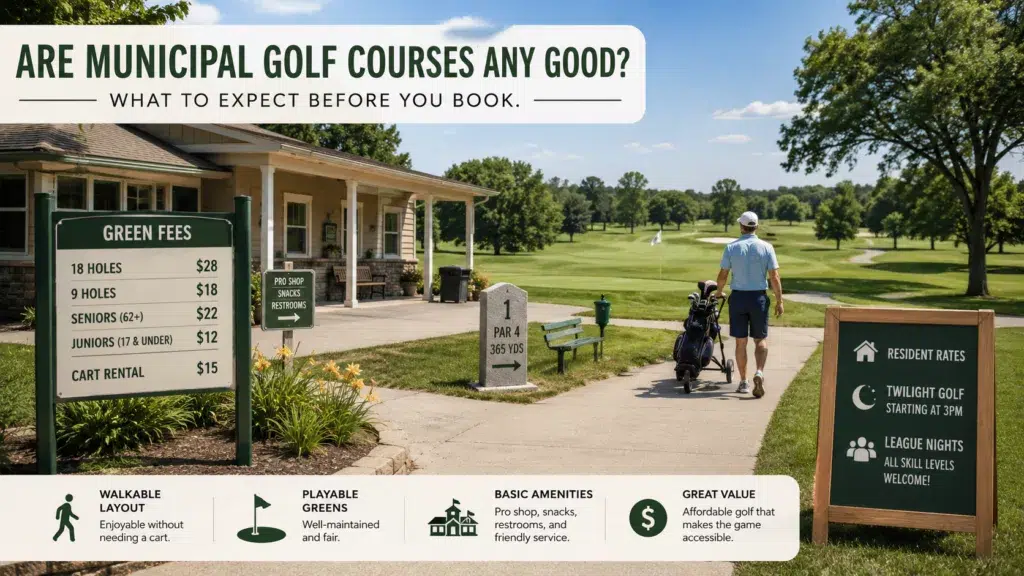
Generally fine: greens that roll true if slower than a country club’s, fairways that are playable if not striped, and a straightforward, walkable layout.
Commonly inconsistent: bunker sand depth and quality (the most frequently under-budgeted item in municipal golf), cart path condition, and the practice facility — many munis have a putting green and little else.
Basic by design: the clubhouse, the food, and the pro shop inventory. You’re paying for the golf course, not the amenities.
The real variable: weekend pace. Popular munis on Saturday mornings can run five hours or more. This is the most common complaint about municipal golf, and it’s almost entirely solvable by when you choose to play.
When to Play a Muni (The Timing That Changes Everything)
- Weekday mornings — the sweet spot. Empty tee sheets, fresh conditions, and often the lowest published rates.
- Weekday twilight — the deepest discount in public golf, frequently 30–50% off; our guide to when twilight rates start covers the sunset math so you actually finish.
- Avoid league nights — most munis run weekday evening leagues. Call and ask which nights; play the others.
- Avoid the two weeks after aerification — ask before booking, not after putting.
- Shoulder seasons (April–May, September–October) — excellent conditions, thin crowds, and often reduced rates.
The Value Case
Here’s the math that makes municipal golf the backbone of affordable play. A weekday muni round at $28–35 walking delivers conditions that frequently match $55–70 daily-fee courses. Play once a week for a 28-week season and you’re at roughly $900 — against $1,700+ for the same season at daily-fee pricing.
For a new golfer especially, munis are the right classroom: relaxed dress codes, forgiving atmospheres toward beginners, and low enough stakes that a bad round costs you $30 instead of $90. (If you’re pricing out the whole hobby, our real-numbers guide to starting golf itemizes where green fees fit in the total.)
Finding Good Munis Near You
Start with your county or city parks department website — most list every course they operate, with rates and league schedules in one place. From there, cross-reference recent golfer photos and greens-specific reviews using the checklist above.
For Wisconsin golfers, our county-by-county public course guides break down every municipal and public option by region, with current rate ranges and what to expect at each — the fastest way to find the good $30 rounds near you.
Local golf cards often include several municipal courses — worth running the break-even numbers before buying one
The Bottom Line
Are municipal golf courses any good? The best are exceptional enough to host national championships, and the ordinary ones are frequently the smartest golf purchase available — provided you know how to read them. Look for active leagues, ask about aerification, avoid weekend mornings and league nights, and play weekday or twilight.
Do that, and municipal golf stops being the compromise option and becomes the strategy.
Frequently Asked Questions
Are municipal golf courses good? Quality varies widely, but the best municipal courses are elite — Bethpage Black and Torrey Pines are municipally owned and have hosted U.S. Opens. Ordinary munis typically deliver conditions comparable to daily-fee courses charging nearly double, with the main trade-offs being basic amenities, inconsistent bunkers, and slow weekend pace.
What’s the difference between a municipal and a daily-fee golf course? A municipal course is owned by a city, county, or park district and operated as a public amenity, usually with resident discounts and relaxed dress codes. A daily-fee course is privately owned but open to the public, and typically invests more in conditioning and amenities at a higher price.
How can you tell if a cheap golf course is well maintained? Check for an active league and club scene, since regulars pressure for good conditions. Read recent reviews that mention greens specifically rather than overall star ratings, look at golfer-posted photos from the last 60 days, and call the pro shop to ask when the greens were last aerified — a precise answer signals a well-managed course.
Why are municipal golf courses cheaper? Munis are owned by municipalities and operated to provide public access rather than maximize profit, and they typically spend less on clubhouses, dining, and practice facilities. Budgets come partly from public funds, and rates are often set with resident taxpayers in mind.
When is the best time to play a municipal course? Weekday mornings offer the best conditions and thinnest crowds, while weekday twilight offers the deepest discounts, often 30 to 50 percent off. Avoid weekend mornings for pace, ask which evenings leagues run, and avoid the two to three weeks following greens aerification.
Upcoming Articles:
Best Affordable Golf Courses in Wisconsin
Best Golf Courses for Beginners Near You
Related Post

GolfNow Hidden Fees Explained: What You Actually Pay at Checkout
You found a $22 tee time on GolfNow. By the time you hit “confirm,” your [...]