This website uses cookies to improve your experience. We\'ll assume you\'re ok with this, but you can opt-out if you wish. Read More
Cart Fee vs. Walking Rate: Walking Saves $225–$330 in a Typical Season
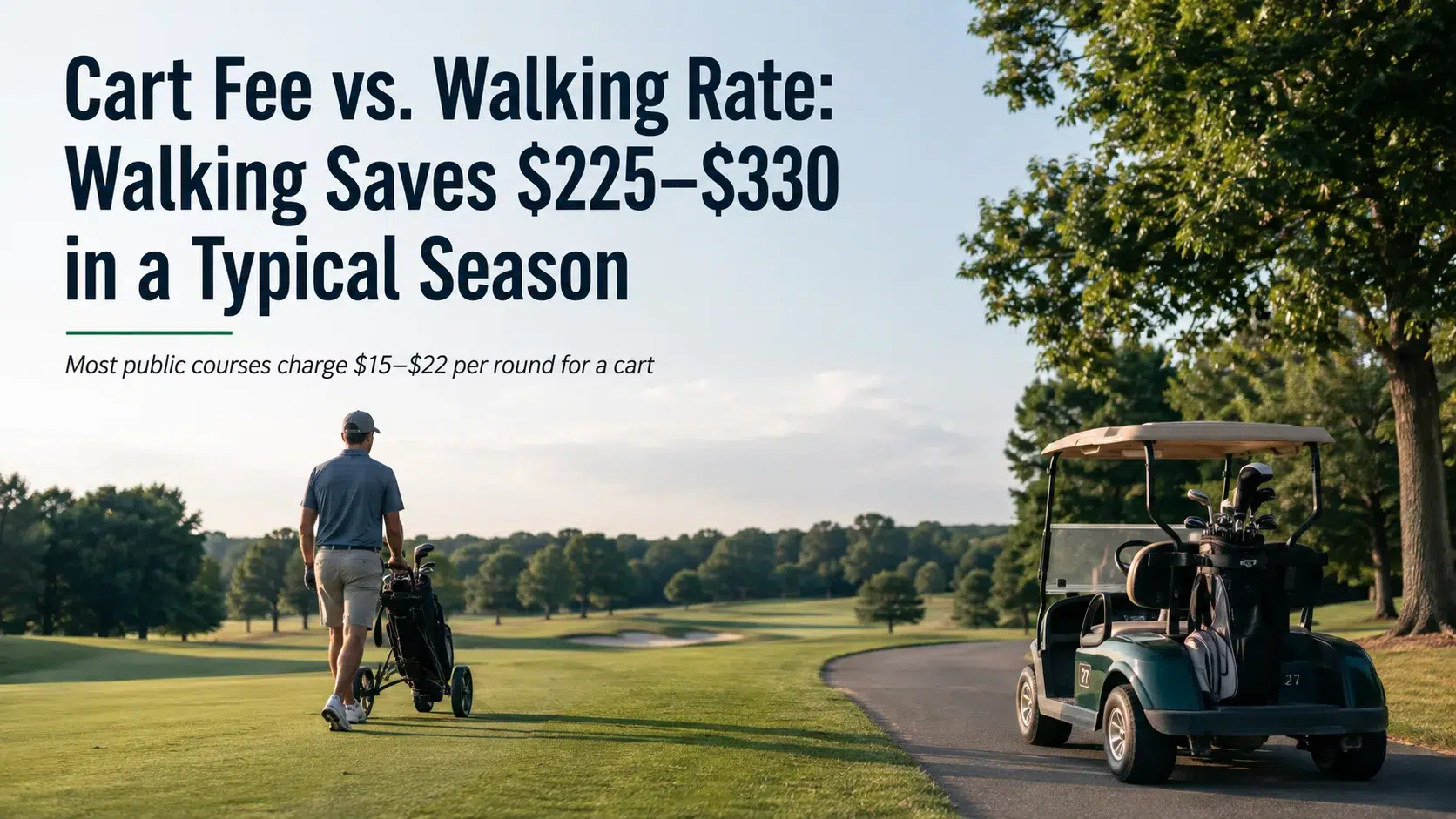
Golf cart fees run $15–22 per round at most public courses, so a golfer who walks 15 rounds a season keeps roughly $225–330 that would otherwise go to the cart barn — and picks up 75 to 90 miles of low-impact exercise in the process.
Whether walking is right for you depends on the course, your body, and how much you enjoy the ride. But most golfers have never actually run the numbers or asked whether their course has a walking rate. Here’s both.
How much does a golf cart cost per round?
Most public and municipal courses charge $15–22 per player for 18 holes, and $10–14 for nine. Resort and upscale daily-fee courses run higher, sometimes $25–35, and a few build the cart into a single bundled rate with no separate line item.
The important detail: cart fees are usually charged per player, not per cart. Two golfers sharing one cart typically pay two fees. This surprises people who assume splitting a cart splits the cost.
How much money do you save walking over a season?
Between $150 and $440 depending on how often you play. Here’s the math at a $18 average cart fee:
| Rounds per season | Cart fees paid | Saved by walking |
|---|---|---|
| 10 rounds | $180 | $180 |
| 15 rounds | $270 | $270 |
| 20 rounds | $360 | $360 |
| 25 rounds | $450 | $450 |
| 40 rounds | $720 | $720 |
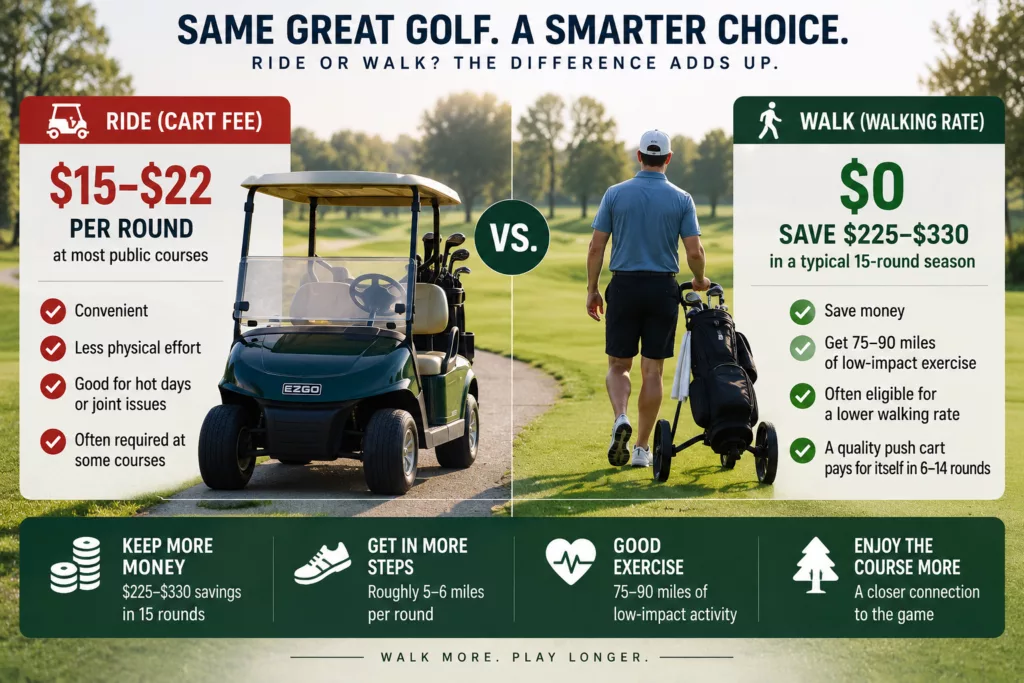
For context, a golfer playing 20 rounds a year who switches to walking saves enough over two seasons to cover a used complete club set, a season’s worth of balls, and several rounds besides.
Do golf courses let you walk?
Most do. Municipal and public courses almost always permit walking, and many actively encourage it — walking golfers are cheaper for the course to serve, since carts require purchase, maintenance, charging, and staff.
The exceptions cluster in predictable places: some daily-fee and resort courses require carts on weekend mornings, some require them at all times, and courses with long distances between greens and the next tee sometimes mandate them for pace.
Municipal courses are your most reliable option for walking — our guide to judging municipal course quality covers finding good ones near you.
Why do some courses require carts?
Three reasons, in rough order of honesty: pace of play, course layout, and revenue.
Pace is the stated reason and it’s partly legitimate on very busy weekend mornings, though the research on this is less one-sided than courses suggest (more below).
Layout is the most legitimate: some modern courses were routed with carts assumed, leaving quarter-mile walks between a green and the next tee.
Revenue is the unstated one — cart fees are high-margin income, and a course that bundles the cart into the rate collects it from everyone.
Is there a walking rate if the cart is bundled into the price?
Often yes, and often unadvertised. This is the single most useful question in this article: “Do you have a walking rate?”
Many courses that display one bundled price will quote a lower walking rate if asked directly at the pro shop or by phone.
It isn’t on the website because the bundled rate is more profitable, not because the walking rate doesn’t exist. Worst case they say no and you’ve lost twenty seconds.
Do season passes include carts?
Frequently not — and this is where passholders lose the most money without noticing. A pass covering green fees only, combined with $18 carts on 50 rounds, means $900 in fees the pass never touched.
If you’re weighing a pass, cart inclusion belongs in the break-even calculation from the start. Our guide to season pass vs. pay-per-round math walks through the formula and the other six questions worth asking before you buy.
What is a golf trail fee?
A trail fee is what a course charges you to use your own cart on their property, typically $5–10 per round or a few hundred dollars annually. It exists because a golfer with a personal cart otherwise pays the course nothing for cart access while still using the paths.
Trail fees apply to riding carts you own — push carts are almost never charged. If you own a riding cart and are considering a season pass, ask specifically whether a trail fee applies on top, since it can quietly add several hundred dollars to your season.
How far do you actually walk playing 18 holes?
Roughly 5 to 6 miles on a typical course, or about 10,000 to 13,000 steps. Hilly or spread-out layouts push past that; compact, walkable older courses come in nearer 4.5 miles.
Riding in a cart still involves walking — usually 2 to 3 miles across a round, since you’re constantly stepping to and from the ball and around greens. The gap between walking and riding is real but smaller than people assume.
Is walking 18 holes good exercise?
It’s substantial low-impact activity. Walking a full round burns a meaningful number of calories — commonly estimated in the 1,200–2,000 range depending on body weight, terrain, and whether you carry, push, or use a caddie — versus considerably less when riding.
More relevant than the calorie figure: walking golf is sustained, moderate, low-impact movement over four hours, the kind of activity that’s generally easy on joints compared with running.
If you have any joint, cardiac, or mobility concerns, it’s worth a conversation with your doctor about what pace and distance make sense for you rather than working from a general figure.
Does walking slow down play?
Usually not, and often the reverse. A single walking golfer or a walking twosome frequently moves faster than a cart foursome, because walkers go directly to their own ball while a shared cart has to drive to one player’s ball, then the other’s.
Where carts genuinely help pace is on long, spread-out layouts and with slower-moving players. On a compact, traditional course, a group of walkers is rarely the problem — and any course that assumes otherwise hasn’t watched closely.
Is a push cart worth it?
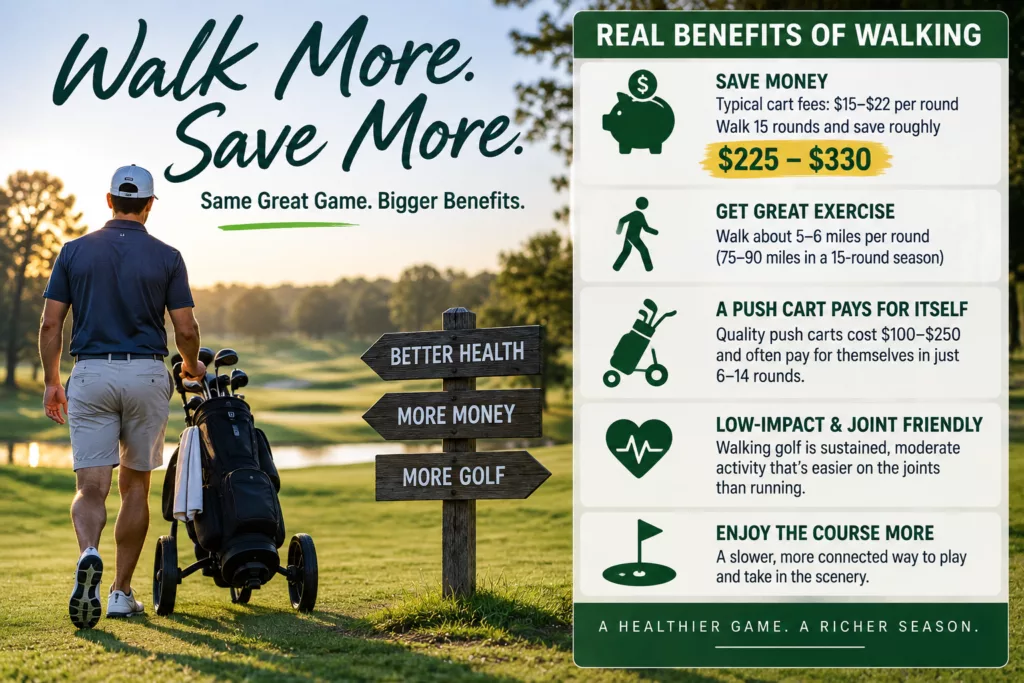
Yes, for almost anyone walking regularly. A quality three-wheel push cart runs $100–250, which means it pays for itself in 6 to 14 rounds of avoided cart fees — often inside a single season.
The bigger benefit is that pushing is dramatically easier than carrying. Carrying a full bag over five miles is genuine work by the back nine; pushing removes nearly all of that strain while keeping the walk.
If you tried walking once with a carry bag and hated it, that’s worth knowing — the bag was likely the problem, not the walking. Our real-numbers guide to starting golf covers where a push cart fits among first-season purchases.
When should you ride instead?
Riding makes sense more often than walking purists admit:
- Extreme heat or humidity, where a five-mile walk becomes a genuine health risk
- Courses routed for carts, with long green-to-tee transfers
- Joint pain, injury, or recovery — riding is what keeps many golfers in the game
- When you’re playing with riders and walking would separate you from the group’s social side
- Tight schedules where the cart genuinely saves you time
The goal isn’t purity. It’s knowing what the cart costs so the choice is deliberate.
The Bottom Line
Cart fees at $15–22 per round add up to $225–330 across a typical 15-round season and more for frequent players.
Most public and municipal courses permit walking, many have an unadvertised walking rate you have to ask for, and a $100–250 push cart pays for itself within a season while removing the strain that makes carrying unpleasant.
Ask the pro shop two questions — “Do you have a walking rate?” and “Is walking allowed at all times?” — and you’ll know exactly what your options cost.
Frequently Asked Questions
How much does a golf cart cost per round? Most public and municipal courses charge $15 to $22 per player for 18 holes and $10 to $14 for nine holes. Resort and upscale courses often run $25 to $35. Cart fees are typically charged per player rather than per cart, so two golfers sharing a cart usually pay two fees.
How much money do you save by walking instead of riding? At an average $18 cart fee, walking saves about $180 over 10 rounds, $270 over 15 rounds, and $360 over 20 rounds. A golfer playing 40 rounds a season keeps roughly $720 that would otherwise go to cart fees.
Do golf courses let you walk? Most public and municipal courses permit walking, and many encourage it since walkers cost the course less to serve. Exceptions include some daily-fee and resort courses that require carts on weekend mornings or at all times, and courses routed with long distances between greens and the next tee.
What is a trail fee in golf? A trail fee is a charge for using your own riding cart on a course’s property, typically $5 to $10 per round or a few hundred dollars annually. Push carts are almost never subject to trail fees. Golfers who own riding carts should ask whether a trail fee applies before buying a season pass.
Is a golf push cart worth buying? For regular walkers, yes. A quality three-wheel push cart costs $100 to $250 and pays for itself in roughly 6 to 14 rounds of avoided cart fees. Pushing also removes most of the physical strain of carrying a bag over five to six miles, which is what makes many golfers dislike walking in the first place.
Related Post

Golf Ball Compression Guide for Slow Swing Speeds
Bottom Line Up Front: If you swing your driver under 85 mph, choose golf balls [...]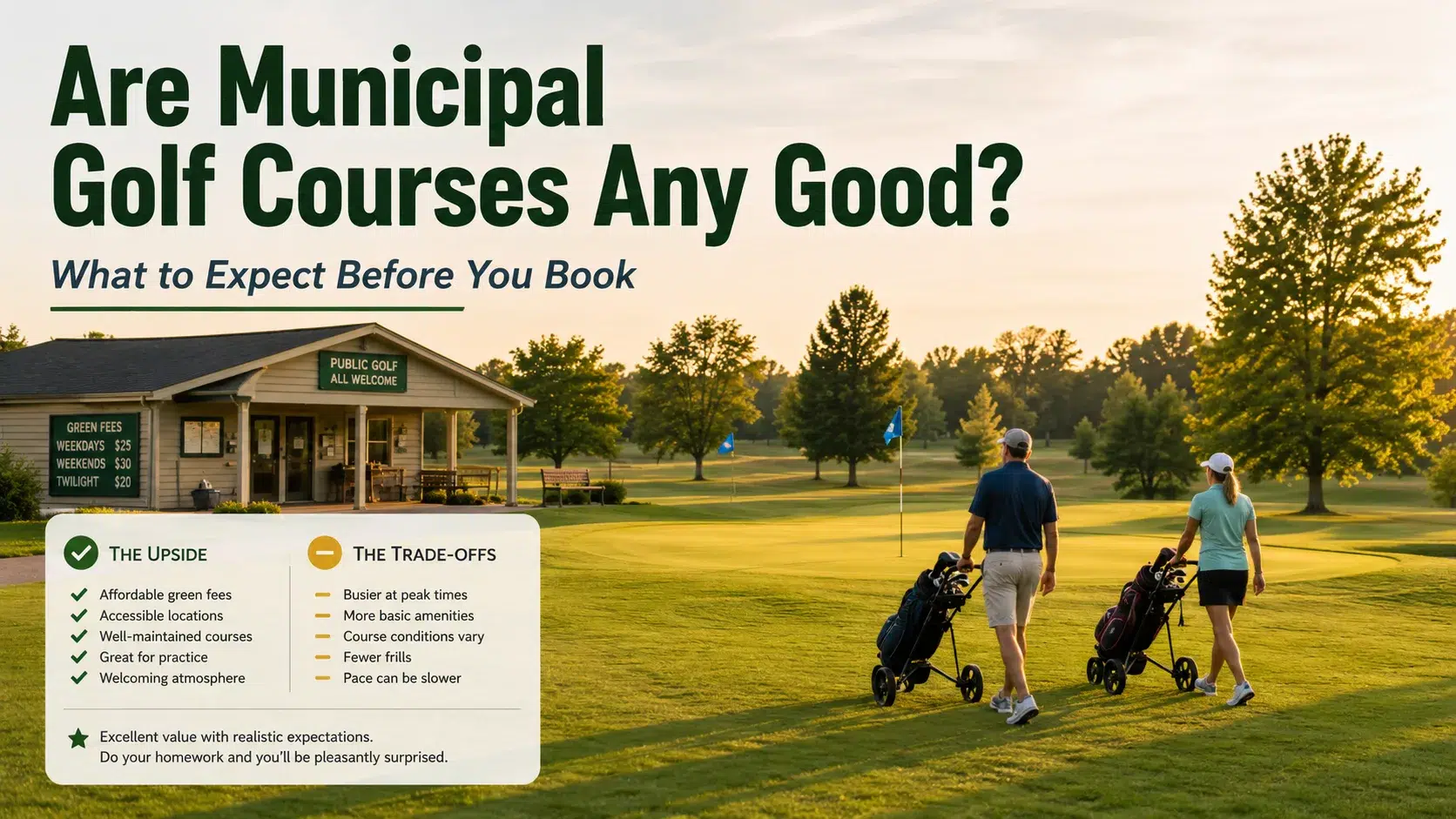
Are Municipal Golf Courses Any Good? What to Expect in 2026
Are Municipal Golf Courses Any Good? What to Expect Before You Book Municipal golf courses [...]