This website uses cookies to improve your experience. We\'ll assume you\'re ok with this, but you can opt-out if you wish. Read More
Does a Closed Face Driver Fix a Slice Better Than an Offset Driver?
Categories :
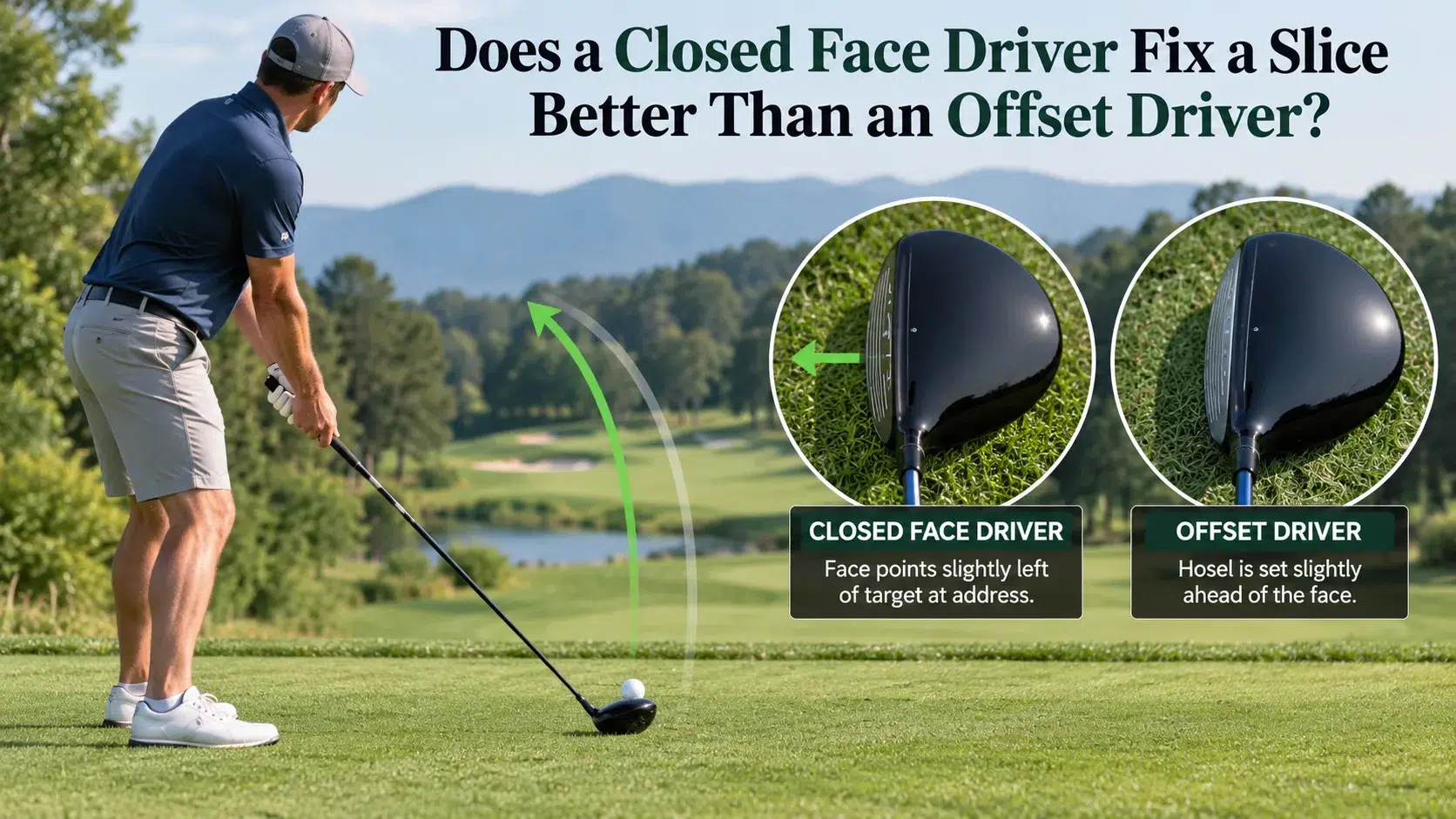
Quick answer: A closed face driver sets the face angle pointing slightly left of target at address, directly reducing the open face condition that creates sidespin and causes a slice. An offset driver positions the hosel ahead of the face, giving your hands a split-second more time to rotate the clubface closed through impact.
Both fix a slice through different mechanisms — closed face works at address and impact, offset works during the swing. For most recreational slicers, a closed face driver produces more immediate, noticeable correction. Offset drivers are more common in irons than drivers and work best for golfers whose timing is the primary cause of their open face at impact.
Why This Comparison Matters for Slicer Equipment Research
If you’ve been researching draw-bias drivers and anti-slice equipment, you’ve probably encountered both terms — closed face and offset — sometimes used interchangeably and sometimes treated as completely different things.
They are different things, and understanding the distinction helps you evaluate whether a specific club is actually targeting your slice problem or simply using terminology that sounds corrective without delivering meaningful correction.
The Performance Golf SF2, for example, uses a closed face angle combined with heel weighting — not an offset hosel. Understanding why Performance Golf chose that approach over an offset design tells you something meaningful about the engineering philosophy behind the club and whether it matches your specific slice profile.
What a Closed Face Driver Is
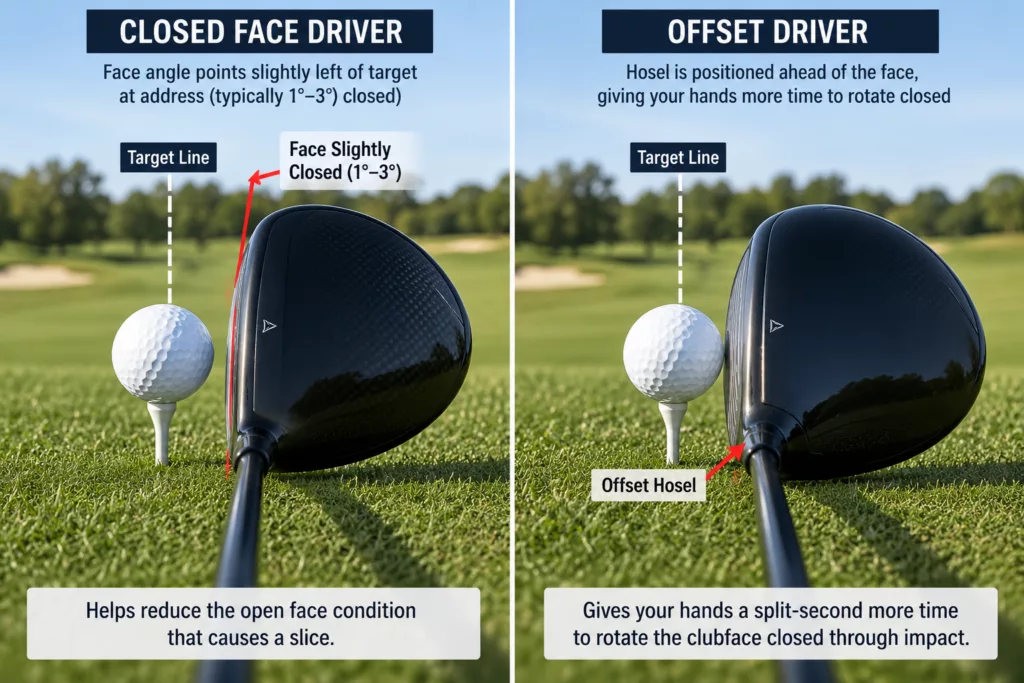
A closed face driver has its face angle set to point slightly left of the target line at address — typically 1° to 3° closed relative to a square (neutral) face position.
When you set a closed face driver behind the ball, the face is already pointing left of where a standard driver would point. This means:
At address: The face is closer to square relative to a neutral swing path before the swing even begins. A golfer who struggles to square the face at impact starts from a more corrected position.
At impact: Even if the face rotates open slightly during the downswing — which is the most common cause of slicing — it arrives at impact closer to square than a neutral face would, because it started closed. The open-face condition that creates sidespin is reduced at the source.
Visual effect: A 3° closed face is designed to look approximately square at address to most golfers’ eyes — the closure is small enough that the brain reads it as neutral even though it’s technically pointing left. This is a deliberate design choice to prevent the compensatory adjustments golfers make when a club looks “wrong” at setup.
The Performance Golf SF2 uses a 3° closed face angle as its primary face correction mechanism, combined with the Counter-Slice Keel heel weighting as a secondary correction.
What an Offset Driver Is
An offset driver positions the hosel — the sleeve that connects the shaft to the head — forward of the leading edge of the face. When you look down at an offset driver at address, the face appears to be set slightly behind the hosel rather than directly in line with it.
This design gives the golfer’s hands a fractional time advantage at impact. Here’s the mechanics:
The timing mechanism: In a standard driver, the hosel and face arrive at the impact zone simultaneously. In an offset driver, the hosel reaches the impact zone slightly before the face does. This means the golfer’s hands — which are connected to the hosel through the shaft — have traveled slightly further through the impact zone by the time the face actually contacts the ball.
Why extra time helps: Squaring the clubface is a rotation movement — the hands and forearms rotate to close the face through impact. More time in the impact zone means more rotation opportunity. A golfer whose slice comes from insufficient face rotation through impact gets the extra rotation window they need to square the face.
Why offset is more common in irons than drivers: The timing window created by offset is most useful for slower-moving clubheads — irons — where precise contact with the ball demands exact face positioning.
In drivers, where the ball is struck off a tee at higher speeds, the offset effect is smaller proportionally and the visual appearance of the offset hosel at address can be disruptive to some golfers’ setup.
The Key Mechanical Difference: When Each Correction Happens
This is the most important distinction between the two designs:
Closed face correction happens before and at impact. The face is already in a corrected position at address. The correction is guaranteed regardless of what happens during the swing — even a golfer who doesn’t change anything about their swing benefits from the pre-set face correction.
Offset correction happens during the swing. The extra time created by the offset hosel only produces benefit if the golfer’s hands and arms actually use that time to rotate the face. A golfer whose hands are passive through impact — a common characteristic of severe slicers — may not generate the additional rotation that the offset design is trying to enable.
Practical implication: For severe slicers with very passive hands through the impact zone, a closed face driver may produce more reliable, immediate correction than an offset driver. The closed face delivers correction whether or not the golfer does anything differently. The offset driver gives the golfer more opportunity for correction but requires the golfer to take advantage of it.
Can a Driver Be Both Closed Face and Offset?
Yes — and some game-improvement drivers use both simultaneously. A driver with both a slightly closed face and an offset hosel is delivering correction through two separate mechanisms, similar to how the SF2 combines a closed face with heel weighting.
However, most draw-bias drivers in the premium OEM category (Ping G430 SFT, Callaway Paradym Draw, TaylorMade Qi10 Max D-Type) use neither offset nor a dramatically closed face — they rely primarily on internal heel CG weighting to produce draw bias while maintaining a conventional face and hosel appearance that better players find more confidence-inspiring at address.
The SF2’s explicit 3° closed face is more aggressive than most premium OEM draw-bias options in this respect — it’s a deliberate choice to prioritize maximum correction for severe slicers over the conventional appearance preferred by better players.
Which One Fixes a Slice Better?
The honest answer depends on what’s causing your specific slice:
Closed face driver fixes a slice better if:
- Your open face at impact is the primary cause — you arrive at impact with the face pointing right of your swing path
- Your swing path is reasonably neutral or only mildly out-to-in
- You want guaranteed correction that doesn’t depend on what your hands do through impact
- You’ve tried standard draw-bias equipment and found the correction insufficient
Offset driver fixes a slice better if:
- Your timing through the impact zone is the primary cause — you have good path and intention but your hands lag behind and leave the face open
- You respond well to visual cues and find the offset appearance at address a helpful reminder to rotate through the ball
- Your slice is mild to moderate rather than severe
- You prefer iron-style offset feel in a driver
For most recreational slicers: A closed face driver with heel weighting — the SF2’s design approach — produces more reliable immediate improvement because it doesn’t require swing changes or conscious hand rotation to activate the correction.
Considering the SF2 driver?
The full review covers whether the slice correction actually holds up for real golfers — not just what the marketing says — plus what the order page adds on at checkout that most buyers don’t see coming.
Read the full SF2 reviewThe offset approach is more nuanced and works best for a narrower profile of golfer whose specific timing issue responds to the extended impact window.
For severe slicers with very passive hands through the impact zone, a closed face driver may produce more reliable, immediate correction.
Not sure which slicer profile you are? Read our full breakdown of who draw bias drivers actually work for.
How the SF2’s 3° Closed Face Looks at Address
This is a practical concern that comes up frequently from golfers considering the SF2 — will the 3° closure look weird or off-putting when I set it behind the ball?
The answer for most golfers is no, and here’s why: 3° of closure is a very small angular change. A driver face spans roughly 3-4 inches horizontally. At 3° of closure, the toe end of the face is approximately 0.15-0.20 inches closer to the target line than the heel end.
This is nearly imperceptible to the eye at address — especially because the face is also angled downward toward the ground, which further reduces the visual impact of a small horizontal closure.
Performance Golf specifically designed the SF2’s face to appear approximately square at address despite its technical closure. The goal is to provide the correction benefit without triggering the compensatory adjustments — weakened grip, altered alignment, or swing path changes — that golfers make when a club looks dramatically “off” at setup.
For comparison: the TaylorMade Burner SuperFast 2.0 TP model has a slightly open face that some better players find confidence-inspiring because it “looks like they’re going to work the ball left to right.” The SF2’s approach is the mirror image — a slight closure that looks neutral at address.
Offset in Irons vs Drivers: Why the Comparison Matters
Many recreational golfers who slice use offset irons without realizing it — most game-improvement iron sets are built with significant offset as a standard feature, and these golfers have simply never noticed because it’s been in their bag for years.
If you use game-improvement irons with offset and find they help your ball flight compared to blade-style irons, that’s a useful data point: your swing may respond well to the timing advantage that offset provides. In that case, an offset driver (if you can find one you like the look of) or a moderately closed face driver may both work well for your profile.
If you use game-improvement irons with offset and still slice severely off the tee, that suggests the offset timing mechanism alone isn’t sufficient for your driver — and a more aggressively corrective closed face plus heel weighting approach may be the stronger prescription.
Frequently Asked Questions
What is the difference between a closed face driver and an offset driver? A closed face driver sets the face angle pointing slightly left of target at address, correcting the open face condition before the swing begins.
An offset driver positions the hosel ahead of the face, giving the hands extra time to rotate the face closed during the swing. Both reduce the open face at impact but through different mechanisms and at different points in the swing.
Which type of anti-slice driver is better for a beginner? For most beginners who slice severely and want immediate improvement without changing their swing, a closed face driver with heel weighting delivers more reliable correction.
Offset drivers work best for golfers whose timing specifically responds to the extra rotation window — a nuance that’s harder to assess for beginning golfers still learning their swing tendencies.
Does the Performance Golf SF2 have an offset hosel? No — the SF2 uses a 3° closed face angle and internal Counter-Slice Keel heel weighting for its correction. It does not use an offset hosel. The correction mechanism is face angle and CG positioning rather than hosel geometry.
Can I tell if a driver is offset just by looking at it? Yes — an offset driver shows visible space between the leading edge of the face and the hosel when you look down at the club at address.
The face appears to sit slightly behind the hosel rather than directly in line with it. A closed face driver may look very similar to a neutral driver at address, with only a trained eye detecting the slight leftward orientation of the face.
Are offset drivers legal for tournament play? Yes — offset is a legal design feature under the Rules of Golf. There are no restrictions on hosel geometry in terms of conformance, though the overall club must still meet standard conformance requirements for face flex, head volume, and other specifications.
Why don’t more premium draw-bias drivers use a closed face angle? Most premium OEM brands calibrate their draw-bias products for a broad market that includes mid-handicappers who don’t want an obviously corrective-looking club.
A visibly closed face signals “this is a beginner anti-slice club” to better players, which limits the product’s market appeal. Performance Golf, targeting specifically the recreational slicer, accepts that tradeoff in exchange for more aggressive correction.
This article reflects general golf equipment engineering principles and publicly available product specifications as of 2026. Verify specific product designs directly with manufacturers before purchasing.
Related Post

Performance Golf SF2 vs Cleveland Launcher XL Draw: Budget Slicer Driver Showdown
Quick answer: The Cleveland Launcher XL Draw is a brand-new, confirmed USGA-conforming draw-bias driver from [...]
Can You Wear Leggings Golfing? Yes — at Nearly Every Public Course
Leggings are acceptable at the large majority of public and municipal golf courses, and they’ve [...]