This website uses cookies to improve your experience. We\'ll assume you\'re ok with this, but you can opt-out if you wish. Read More
Does a Draw Bias Driver Actually Fix a Slice — Or Just Move the Miss?

Quick answer: A draw bias driver genuinely fixes a slice for most recreational golfers — but the degree of correction depends on what’s causing the slice. If your slice comes primarily from an open face at impact, draw bias equipment directly addresses the cause and produces meaningful, immediate improvement.
If your slice comes primarily from a severe out-to-in swing path, draw bias equipment reduces the severity but may move the miss from a slice-right to a pull-left rather than producing a straight shot. Understanding which category your slice falls into determines whether a draw bias driver will fix your problem or just relocate it.
The Question Every Skeptical Golfer Asks Before Buying
“Does this actually work, or is it just marketing?”
It’s the right question, and it deserves a straight answer rather than a manufacturer’s talking points or a vague “results may vary” disclaimer.
The honest answer is: draw bias drivers work very well for a large segment of recreational slicers, work partially for another segment, and may not be the primary solution for a smaller segment whose slice is driven almost entirely by swing path. This article breaks down exactly which category you fall into and what realistic expectations look like for each.
First: What Actually Causes a Slice
A slice occurs when the ball spins to the right (for a right-handed golfer). That sidespin is created by the clubface being open relative to the swing path at impact. The more open the face relative to the path, the more sidespin, and the more the ball curves right.
Two variables create this condition:
1. Swing path: An out-to-in swing path — where the club travels from outside the target line to inside during the downswing — is the most common cause of slicing. This path, combined with even a square face, produces left-to-right sidespin. Combined with an open face, it produces a severe slice.
2. Face angle at impact: A face that is open relative to the swing path at the moment of contact creates the spin that causes a slice. Even a golfer with a neutral swing path will slice if the face is consistently open at impact.
Most recreational slicers have both problems simultaneously — an out-to-in path AND an open face. The relative contribution of each varies significantly between individual golfers, and that variation determines how much draw bias equipment helps.
How Draw Bias Equipment Actually Works
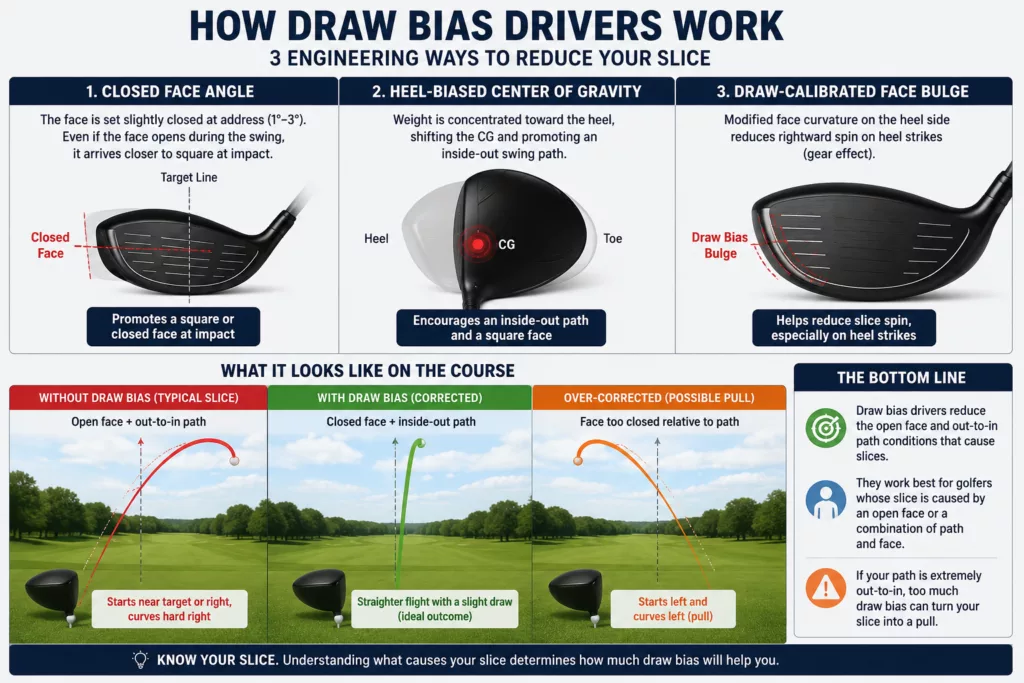
Draw bias drivers use one or more of three engineering mechanisms to reduce or eliminate slicing:
Closed face angle: The face is set 1-3° closed at address, meaning it starts pointing slightly left of target. At impact, even if the face opens slightly during the swing, it arrives closer to square than a neutral face would — reducing the open face condition that creates sidespin.
Heel-biased center of gravity: Weight concentrated toward the heel shifts the CG away from the face center, which promotes a more inside-out club path through the impact zone and makes the face more likely to be square or slightly closed at contact.
Draw-calibrated face bulge: Modified horizontal curvature on the heel side of the face adjusts the gear effect on heel strikes to reduce rightward spin from that specific impact location.
Each mechanism addresses a different aspect of the slice-causing conditions at impact. The most effective draw bias drivers — like the Performance Golf SF2 — combine multiple mechanisms simultaneously for a more comprehensive correction effect.
Higher loft also reduces sidespin independently — see our driver loft guide for slicers for how loft and draw bias work together
Who Draw Bias Drivers Work Best For
Profile 1 — The Open Face Slicer (Best Results)
This golfer has a reasonably neutral or only mildly out-to-in swing path, but consistently arrives at impact with an open face. Their slice is moderate-to-severe but relatively consistent — the ball starts roughly toward the target or slightly right, then curves further right.
For this golfer, draw bias equipment directly addresses the primary cause. A closed face angle and heel CG weighting combat the open face tendency, producing immediate and significant improvement. This is the profile most DTC anti-slice driver marketing is designed around, and for good reason — it’s where the technology delivers its most dramatic results.
See our full draw-bias driver rankings to compare the top options for this profile.
Profile 2 — The Combined Path and Face Slicer (Good Results)
This golfer — the most common type — has both an out-to-in swing path AND an open face at impact. Their slice is severe and starts significantly left before curving dramatically right, or starts at the target and curves hard right.
Draw bias equipment helps this golfer meaningfully but incompletely. The closed face and heel weighting correct the face angle contribution to the slice, but the out-to-in path remains. The result is typically a ball that still starts slightly left of target (path-induced) but curves much less to the right (corrected face angle).
Net result: a significant improvement in accuracy and distance, but not a perfectly straight shot. This golfer goes from losing the ball right on many drives to hitting manageable misses in the general direction of the fairway — which is a practical win even if it’s not a complete fix.
Profile 3 — The Path-Dominant Slicer (Partial Results, Risk of Pull)
This golfer has an extremely steep, severe out-to-in swing path as the dominant cause of their slice. Their face angle at impact may actually be only mildly open — the path is doing most of the damage.
For this golfer, draw bias equipment can be counterproductive if taken too far. Closing the face aggressively with a 3° closed-face draw bias driver may overcorrect the face angle contribution while the path remains severe. The result is a pull-left miss rather than a slice-right miss — the ball still doesn’t go where you’re aiming, it just goes the other direction.
This is why the pull-left warning appears in virtually every honest review of aggressive draw bias drivers. It’s not a product defect — it’s the correct result of closing a face when the path is already sending the ball left. For this golfer, swing path correction (through instruction) is more productive than equipment correction alone.
The Pull-Left Question: How Common Is It Really?
The pull-left risk with draw bias drivers is real but overstated in some reviews. Here’s a proportional perspective:
The vast majority of recreational golfers who slice have the Combined Path and Face profile (Profile 2 above). For these golfers, the draw bias correction reduces the face angle contribution enough to produce straighter flight without creating a pull problem, because the path is contributing some left-push component that offsets the face correction.
The pull-left outcome is most likely for golfers who:
- Have a very mild slice to begin with (suggesting the face angle contribution is already small)
- Have previously been told their swing path is actually quite neutral
- Find that moderate draw-bias OEM drivers already produce a slight draw or straight shot for them
If your slice is severe and has been for years, the pull-left risk from a draw bias driver is low — the path component of your miss is keeping the ball right enough that even aggressive face correction rarely overcorrects into a consistent pull.
If your slice is mild and inconsistent, aggressive draw bias correction (like the SF2’s 3° closed face) carries more pull risk than a more moderate OEM draw bias option.
What “Fixing” a Slice With Equipment Actually Looks Like on the Course
Setting realistic expectations before you put a draw bias driver in your bag is important, because the gap between marketing language and actual course results creates disappointment when golfers expect too much.
Here is what realistic improvement looks like for each profile:
Profile 1 (Open Face Slicer):
- Drives that previously sliced hard right now fly with a slight draw or straight ball flight on most swings
- Occasional pulls appear as the new miss when overcorrecting
- Distance gains of 15-30 yards are realistic because straightened ball flight converts lateral curve into forward carry
- Fairways hit percentage improves dramatically
Profile 2 (Combined Slicer — most common):
- Drives that previously went hard right now fly toward the right rough or right side of the fairway rather than deep right
- Some drives achieve the fairway, more than before
- The severe banana slice disappears and is replaced by a manageable fade on most swings
- Distance gains of 10-20 yards are realistic
- The slice isn’t gone but is dramatically less punishing
Profile 3 (Path-Dominant Slicer):
- Drives may shift from slicing right to pulling left
- If the driver is moderately draw-biased rather than aggressively so, some improvement in severity is likely
- Meaningful improvement requires combining equipment correction with swing path work
Draw Bias Equipment vs Swing Lessons: The Honest Comparison
This is the question recreational golfers eventually ask, and it deserves a direct answer.
Swing lessons address the root cause. A competent instructor who identifies your specific path and face angle issues can correct the mechanical source of your slice in a way that equipment cannot. A fixed swing produces straight shots with any driver. This is the permanent solution.
Draw bias equipment reduces the symptom without fixing the cause. The slice-producing swing mechanics remain unchanged — the equipment compensates for them at impact. If you put the draw bias driver back and pick up a neutral driver, the slice returns.
The practical reality for most recreational golfers: Many recreational slicers either don’t have access to quality instruction, don’t have time for the practice required to ingrain swing changes, or have tried lessons without achieving lasting results.
For these golfers, draw bias equipment provides a practical, immediate improvement to their on-course experience without requiring the time investment of swing reconstruction.
The most effective approach combines both — a draw bias driver that reduces the severity of the current miss while the golfer works on their path and face angle through instruction. Each reinforces the other: the equipment makes practice more enjoyable because misses are less severe, and the swing improvement gradually reduces reliance on the equipment’s correction.
Frequently Asked Questions
Does a draw bias driver work for everyone who slices? It works for most slicers to varying degrees. Golfers whose slice is primarily caused by an open face see the most dramatic improvement.
Golfers with severe out-to-in paths see meaningful but incomplete improvement. The rare golfer whose path is so severely out-to-in that even a closed face overcorrects to a pull may need swing correction before equipment correction is effective.
Will I always need a draw bias driver once I start using one? Not necessarily. Some golfers find that the visual feedback of hitting straighter shots with draw bias equipment accelerates their swing improvement, eventually allowing them to play a neutral driver with a corrected path.
Others find the equipment compensation permanent and preferable to rebuilding their swing — both outcomes are valid.
What is the difference between a draw bias driver and an offset driver? A draw bias driver uses internal CG positioning and face angle to promote a draw ball flight. An offset driver sets the hosel forward of the face, giving the hands more time to rotate the face closed through impact.
Both address the open face problem through different mechanisms, and some drivers use both approaches simultaneously.
Can a draw bias driver fix a shank or a topped shot? No — draw bias engineering specifically addresses the face-open sidespin condition that causes slicing. It has no meaningful effect on shanks (hosel contact) or topped shots (striking the top of the ball), which have different mechanical causes unrelated to face angle and path.
If draw bias drivers work, why don’t tour players use them? Tour players hit the ball with a neutral-to-slightly-inside-out path and a square face by default. They don’t slice — so the correction draw bias provides is irrelevant to their game.
Many tour players actually prefer a slight fade (the opposite of a draw) for control purposes. Draw bias equipment is specifically engineered for recreational golfers whose swing mechanics produce an open face at impact.
This article reflects general golf equipment principles and independent analysis of draw bias driver technology as of 2026. Individual results vary based on swing mechanics — consider a launch monitor session to identify your specific slice cause before selecting equipment.
Related Post

Best Affordable Golf Courses in Texas: Top Budget-Friendly Options for Every Golfer
Texas has a surprisingly wide range of quality golf courses that won’t empty your pockets. [...]
How Much Does It Cost to Start Golfing in 2026? (Real Numbers)
Golf has a reputation for being expensive, but that reputation is only partly earned — [...]