This website uses cookies to improve your experience. We\'ll assume you\'re ok with this, but you can opt-out if you wish. Read More
How to Measure Your Swing Speed Without a Launch Monitor
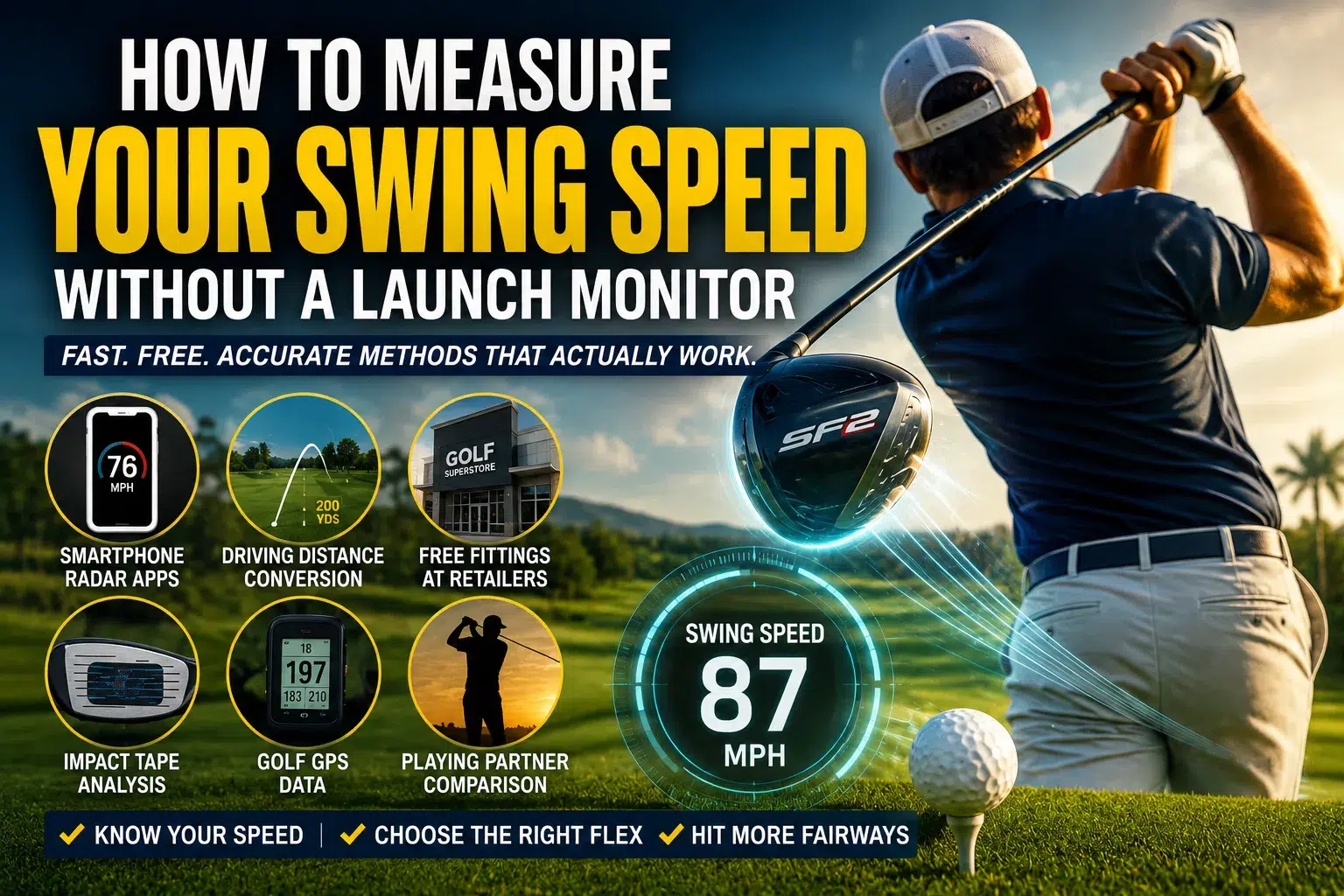
Quick answer: The most reliable free method for estimating your swing speed without a launch monitor is using your average driving distance as a proxy — every 2.3 yards of carry distance roughly equals 1 MPH of clubhead speed.
A golfer averaging 200 yards of carry is swinging approximately 87 MPH; one averaging 175 yards is around 76 MPH. Beyond distance estimates, smartphone radar apps, impact tape analysis, and free fitting sessions at major golf retailers all provide more precise readings without requiring you to own a launch monitor.
This guide covers every practical method ranked from most to least accurate.
Why Knowing Your Swing Speed Matters Before Buying a Driver
Most golfers shopping for a draw-bias driver like the Performance Golf SF2 encounter swing speed requirements on every product page — Ladies Flex for under 65 MPH, Senior Flex for 70-80 MPH, Regular Flex for 80-90 MPH, and so on.
Without knowing your actual swing speed, shaft flex selection becomes guesswork, and the wrong flex directly undermines the slice-correction technology you’re paying for.
Beyond driver shaft selection, swing speed affects:
- Which loft configuration produces maximum carry distance for your swing
- Whether a draw-bias driver will help straighten your miss or potentially overcorrect into a hook
- Which ball compression level matches your impact characteristics
- How to interpret distance claims in driver marketing materials
Getting an accurate swing speed reading is a 10-15 minute investment that affects every equipment decision you make going forward.
Method 1 — Free Fitting Session at a Golf Retailer (Most Accurate Free Option)
Accuracy: High Cost: Free or minimal Time required: 15-30 minutes
The single best way to measure your swing speed without owning a launch monitor is to walk into a Golf Galaxy, PGA Tour Superstore, or any golf retailer with an in-store hitting bay and ask for a driver fitting session.
These stores use professional-grade launch monitors — typically Trackman, Foresight GC Quad, or FlightScope — that measure clubhead speed, ball speed, launch angle, spin rate, and carry distance simultaneously.
Most locations offer basic sessions at no charge, particularly if you’re shopping for a driver. Even if you don’t end up purchasing anything, the swing speed reading you leave with is accurate, free, and directly usable for any online driver purchase.
What to bring: Your current driver, or ask to hit a demo club from their fitting inventory. Wear your normal golf shoes and bring your golf glove if you use one — consistency of setup matters for accurate measurement.
What to ask for: Tell the fitting staff you want to know your clubhead speed, ball speed, and average carry distance. You don’t need a full fitting session — just 8-10 swings with accurate measurement is enough to establish your reliable swing speed range.
Method 2 — Smartphone Radar Apps (Most Accurate Home Option)
Accuracy: Medium-High Cost: Free to $20 depending on app Time required: 10-15 minutes
Several smartphone applications use the phone’s camera or Doppler radar technology to estimate swing speed. The most established options in 2026 include:
Swing speed radar apps using camera: These apps use slow-motion video capture combined with algorithmic analysis to estimate clubhead speed through the impact zone. Accuracy varies by phone camera quality and lighting conditions but generally comes within 3-5 MPH of a professional launch monitor for consistent swingers.
Swing Caddie SC4 and similar personal launch monitors: While not a smartphone app, personal launch monitors priced at $150-$300 represent a meaningful step up in accuracy from pure app-based solutions and are worth mentioning here for golfers who want home measurement capability they’ll use repeatedly.
These devices use Doppler radar to measure actual clubhead and ball speed rather than estimating from video.
How to use camera-based apps accurately:
- Set up your phone on a stable surface or tripod at a consistent angle to the impact zone
- Hit 10-15 balls and use the average reading, not your best or worst
- Ensure good lighting — shadow or glare significantly reduces accuracy
- Use the same driver you plan to fit, since different heads and shafts affect speed readings
Method 3 — Driving Distance Conversion (Fastest Estimate)
Accuracy: Medium (±5-8 MPH) Cost: Free Time required: 2 minutes
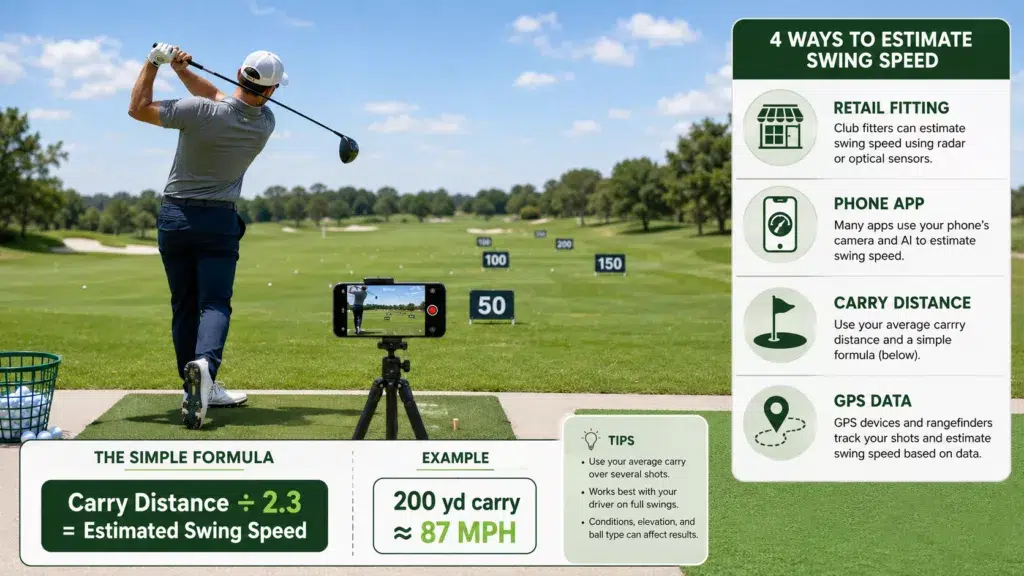
If you know your reliable average driving distance, you can estimate your swing speed using the standard industry conversion ratio. The relationship between clubhead speed and carry distance for a driver is approximately:
Carry distance ÷ 2.3 = estimated swing speed in MPH
This formula works best at average recreational swing speeds (65-105 MPH) and assumes reasonable center-face contact and a neutral ball flight. Heavy slicers will show artificially low distance for their actual swing speed because the slice is robbing them of carry — in this case, your true swing speed is likely higher than your current driving distance suggests.
| Average Carry Distance | Estimated Swing Speed | SF2 Flex Recommendation |
|---|---|---|
| Under 140 yards | Under 61 MPH | Ladies Flex |
| 140-160 yards | 61-70 MPH | Ladies or Senior Flex |
| 160-185 yards | 70-80 MPH | Senior / Soft Flex |
| 185-210 yards | 80-91 MPH | Regular Flex |
| 210-230 yards | 91-100 MPH | Stiff Flex |
| 230+ yards | 100+ MPH | X-Stiff Flex |
The slicer adjustment: If you slice consistently and severely, add 10-15 yards to your current driving distance before applying the formula. Your slice is converting forward distance into sideways curve, and your actual swing speed is generating more potential distance than your current ball flight shows.
A golfer driving the ball 185 yards with a severe slice may actually be swinging at 88-90 MPH — solidly in the Regular Flex range — rather than the 80 MPH that the raw distance suggests.
Method 4 — Playing Partner Comparison (Rough Calibration)
Accuracy: Low-Medium Cost: Free Time required: One round of golf
If you regularly play with someone whose swing speed is known — perhaps a golfer who has been fitted recently — you can use your relative driving distance to calibrate your own estimate.
How to use this method: On a calm day (minimal wind), hit your driver on three to four par-4 holes where both you and your reference golfer hit clean, solid drives. Measure the landing distance difference and apply the conversion ratio to estimate the speed gap.
For example, if your reference golfer swings at 85 MPH and consistently out-drives you by 20 yards on solid contact, your estimated swing speed is approximately 85 MPH minus (20 ÷ 2.3) ≈ 76 MPH — putting you in the Senior Flex range.
Limitations: This method requires both golfers to hit solid, representative drives on the same holes in the same conditions. Wind, elevation change, roll, and mishits all introduce noise that reduces accuracy. Use this as a rough directional guide rather than a definitive measurement.
Method 5 — Impact Tape Analysis (Miss Pattern Indicator)
Accuracy: Low for speed, High for contact pattern Cost: $5-$10 for impact tape Time required: 15 minutes at the range
Impact tape is a thin adhesive sheet that you apply to the face of your driver before hitting balls. Each ball strike leaves a clear imprint showing exactly where on the face contact was made.
While impact tape doesn’t directly measure swing speed, it provides two pieces of information relevant to driver fitting:
Contact pattern: If your strikes are consistently clustered in the heel area of the face, this reinforces that a draw-bias, heel-weighted driver like the SF2 is appropriate for your typical miss. If strikes are scattered across the face in multiple directions, this suggests a high-MOI 460cc option may serve you better than a more targeted 445cc design.
Consistency indicator: A tight cluster of impact marks — even slightly off-center — indicates a consistent swing that can benefit from targeted correction. A widely scattered impact pattern indicates a less consistent swing that benefits more from maximum forgiveness.
Impact tape won’t tell you your swing speed, but it will tell you what kind of miss you actually have — which is equally important for making the right draw-bias driver selection.
Method 6 — Golf Course GPS and Rangefinder Data (Contextual Estimate)
Accuracy: Low-Medium Cost: Free if you already use GPS or a rangefinder Time required: Ongoing over several rounds
If you use a GPS device or rangefinder during your rounds and track your tee shot positions, you can build a reliable average driving distance dataset over multiple rounds and conditions. This is more accurate than remembering your best drives because it includes the full range of your typical results — good swings, bad swings, and everything in between.
Most GPS golf apps (Golfshot, Arccos, Game Golf) track shot distances automatically and display your driving average after enough rounds. This average, applied to the distance conversion table above, gives a more statistically reliable swing speed estimate than any single memorable drive.
Which Method Should You Use Before Buying the SF2?
If you’re in the buying process right now and need a swing speed estimate to select the right SF2 flex:
Best single step: Drive to the nearest Golf Galaxy or PGA Tour Superstore and spend 15 minutes hitting into their launch monitor. This is free, accurate, and gives you the exact number you need with no guesswork.
If you can’t get to a store: Use your GPS app’s driving average from your last five to ten rounds and apply the conversion formula. If you slice consistently, add 10-15 yards to your measured distance before converting.
If you’re genuinely on the boundary between two flex options: Default to the softer flex. An overly soft shaft in the SF2 produces hooks or draws that overcorrect — a correctable outcome. An overly stiff shaft keeps the face open at impact and directly fights the SF2’s slice-correction mechanism — a worse outcome that undermines the whole point of the purchase.
How Swing Speed Changes Over Time
One underappreciated aspect of swing speed measurement is that it changes — and not always in the direction golfers expect.
Age-related decline: Swing speed typically peaks in a golfer’s 30s and declines gradually through the 40s and 50s, with more pronounced decline after 60. A golfer who played Stiff Flex at 45 may genuinely need Regular Flex at 55 and Senior Flex at 65, even if their technique and fitness haven’t dramatically changed.
Fitness and conditioning: Golfers who add targeted rotational strength and flexibility training can genuinely increase swing speed at any age. A measured baseline swing speed creates a benchmark for tracking improvement if physical conditioning is part of your golf improvement plan.
Equipment effects: Shaft weight, club length, and grip weight all affect swing speed independently of the golfer’s physical capacity. This is why measuring speed with your current driver provides your current baseline — not an absolute physical limit.
Seasonal variation: Many golfers swing slightly slower in cold weather due to reduced flexibility and heavier clothing restricting rotation. Measuring in conditions similar to when you play most frequently gives the most representative result.
Frequently Asked Questions
What is the average swing speed for a recreational male golfer? The average recreational male golfer swings between 83-93 MPH with a driver. This puts the majority of male recreational golfers in the Regular or Stiff Flex range for the SF2 shaft matrix.
What is the average swing speed for a recreational female golfer? The average recreational female golfer swings between 60-75 MPH, which corresponds to the Ladies or Senior Flex range in the SF2 lineup.
How accurate is the driving distance to swing speed conversion formula? Within approximately 5-8 MPH for golfers with a reasonably neutral ball flight and solid contact quality. The formula becomes less reliable for heavy slicers because severe curve reduces carry distance below what the swing speed would produce with a straighter ball flight.
Do I need to measure my swing speed with a driver specifically? Yes — shaft flex is matched to driver swing speed, which differs from iron swing speed. A golfer with 85 MPH driver speed might have 70 MPH 6-iron speed. Always use driver swing speed for driver fitting purposes.
Can I use a baseball radar gun to measure my golf swing speed? Standard baseball radar guns measure ball speed after release, not clubhead speed at impact, and are not calibrated for the golf swing arc. They will not give you a usable golf swing speed reading.
How many swings should I measure to get an accurate average? Hit at least 8-10 representative swings and average the results, excluding clear outliers (topped shots, thin shots). Your 3-5 most representative swings clustered together are more useful than a simple average that includes mishits.
This guide reflects general swing speed estimation methods and golf industry standards as of 2026. Launch monitor technology and app accuracy improve regularly — verify current options and availability before selecting a measurement method.
Related Post

Can You Wear Leggings Golfing? Yes — at Nearly Every Public Course
Leggings are acceptable at the large majority of public and municipal golf courses, and they’ve [...]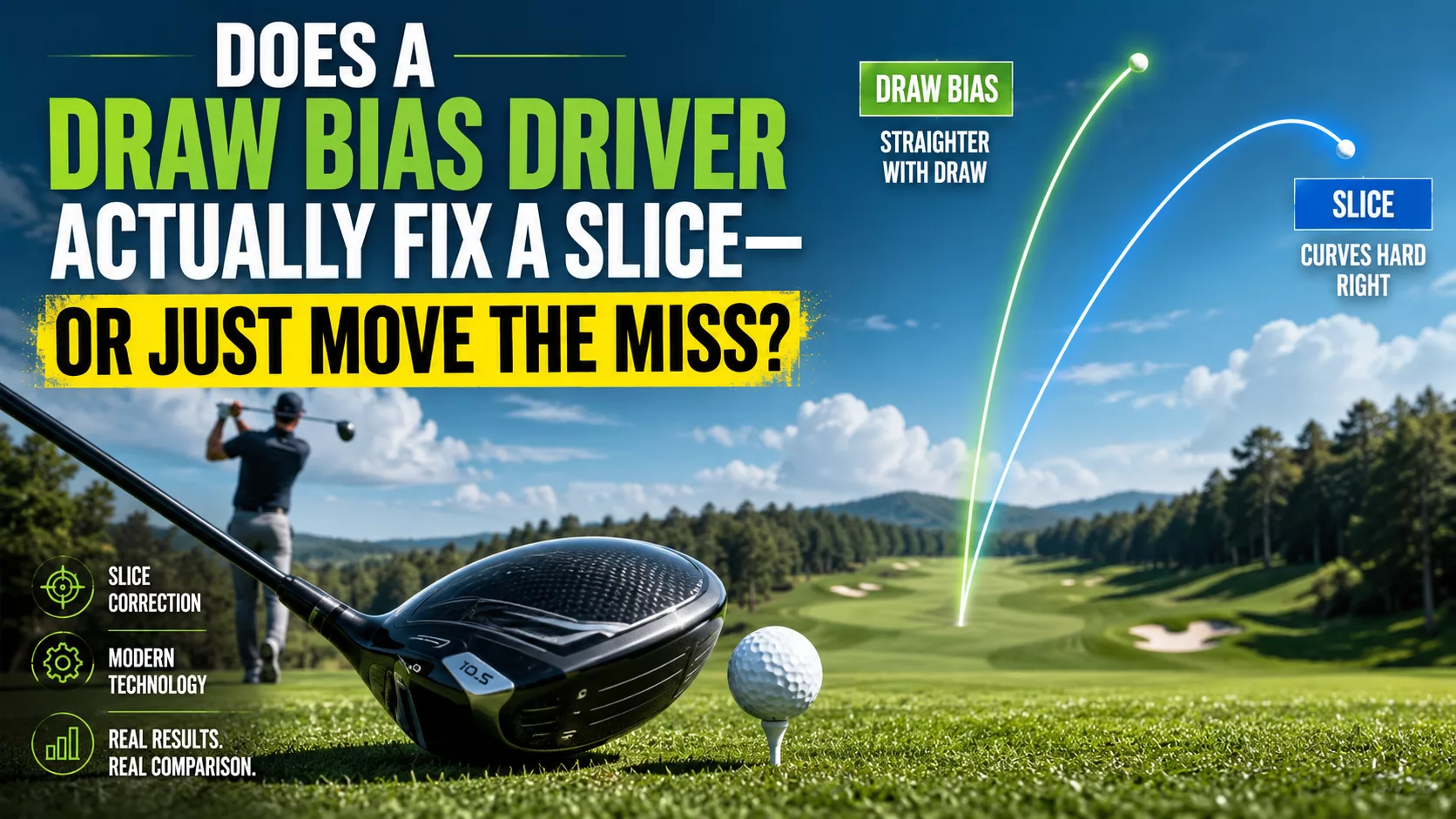
Does a Draw Bias Driver Actually Fix a Slice — Or Just Move the Miss?
Quick answer: A draw bias driver genuinely fixes a slice for most recreational golfers — [...]