This website uses cookies to improve your experience. We\'ll assume you\'re ok with this, but you can opt-out if you wish. Read More
What Swing Speed Do I Need for the SF2 Regular Flex? A Complete Fitting Guide
Categories :
Article At A Glance
- The SF2 Regular Flex is designed for golfers with driver swing speeds between 80–90 MPH, producing carry distances of 200–225 yards.
- Using the wrong shaft flex — even by one category — can cost you 8–20 yards and push your miss pattern in the wrong direction.
- Swing speed is the starting point, but tempo, transition speed, and ball flight pattern all influence which flex is truly right for you.
- The SF2 is built with a 57g premium shaft and a counter-slice geometry that works specifically with the energy of a regular flex load and release cycle.
- Golfers sitting right at the 80 or 90 MPH boundary have options — and there is a clear decision framework to help you pick the right side.
Getting your shaft flex wrong is one of the fastest ways to leave distance and accuracy on the table — and most golfers never realize it.
The SF2 driver from Performance Golf is built around a precise fitting philosophy. Every flex option maps to a specific swing speed range, a specific shaft weight, and a realistic distance window.
That is not marketing language — it is engineering. If you are shopping the SF2 and wondering whether Regular flex is right for you, this guide breaks it down completely, starting with the number that matters most: your swing speed.
Performance Golf designed the SF2 as what they call the longest slice-fix driver in golf, and the shaft flex selection is a core part of why it works. Getting the flex right means the club can do its job. Getting it wrong means you are fighting the club on every swing.
SF2 Regular Flex Is Built for 80–90 MPH Swing Speeds
The SF2 Regular Flex is the right choice if your driver swing speed falls between 80 and 90 MPH. At that speed range, golfers typically carry the ball 200 to 225 yards. The 57g premium shaft is engineered to load and release in sync with that swing speed, which is what allows energy to transfer efficiently into the ball at impact.
This is not a flex category for beginners by default — plenty of mid-handicap and even low-handicap golfers swing in the 80–90 MPH range. What matters is the number, not the label. If your swing speed falls in that window, Regular flex gives you the timing you need to maximize what the SF2’s forged titanium head and counter-slice geometry are built to do.
What Happens When Your Shaft Flex Does Not Match Your Swing
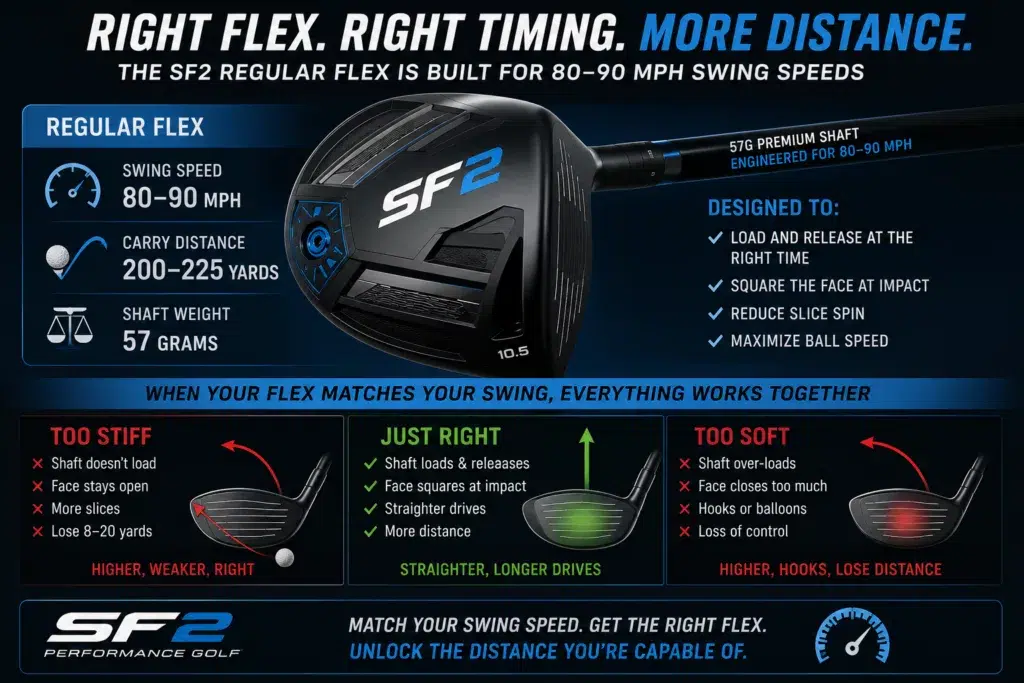
Shaft flex is not just about comfort or feel — it directly controls how the shaft stores and releases energy during the swing. When the flex is right, the shaft bends at the right moment and snaps back through impact in a way that adds speed and squares the face. When it is wrong, that timing breaks down, and so does your shot.
Too Stiff: Distance Loss and a Persistent Slice
If you play a shaft that is too stiff for your swing speed, the shaft never fully loads. That means it cannot release properly through the hitting zone, and the face stays fractionally open longer than it should. The result is a slice that feels baked into your swing — even when your mechanics are solid — and a consistent loss of 8 to 20 yards compared to a properly matched flex.
This is one of the most common fitting mistakes among recreational golfers. Players assume that a stiffer shaft means more control, when in reality, it means a shaft that is not responding to their swing at all.
Too Soft: Ballooning Shots and Loss of Control
Playing a shaft that is too soft creates the opposite problem. The shaft over-loads and releases too early, which launches the ball too high with too much spin. Shots balloon, carry distance drops, and the dispersion pattern widens. You may also notice a hook bias as the face closes too aggressively through impact.
Neither extreme — too stiff or too soft — gives you the ball flight you are capable of producing. The match between shaft flex and swing speed is where consistency lives.
The Right Flex: Straighter Ball Flight and More Distance
When flex and swing speed are matched correctly, the shaft loads through the backswing, stores energy at the top, and releases through impact in a way that adds effortless speed. Ball flight flattens out to an optimal launch angle, spin stabilizes, and the face arrives at impact in a more neutral position.
For SF2 Regular Flex players swinging 80–90 MPH, that means straighter drives and carry distances in the 200–225 yard window without changing anything about the swing itself.
The SF2 Shaft Flex Chart: Every Option at a Glance
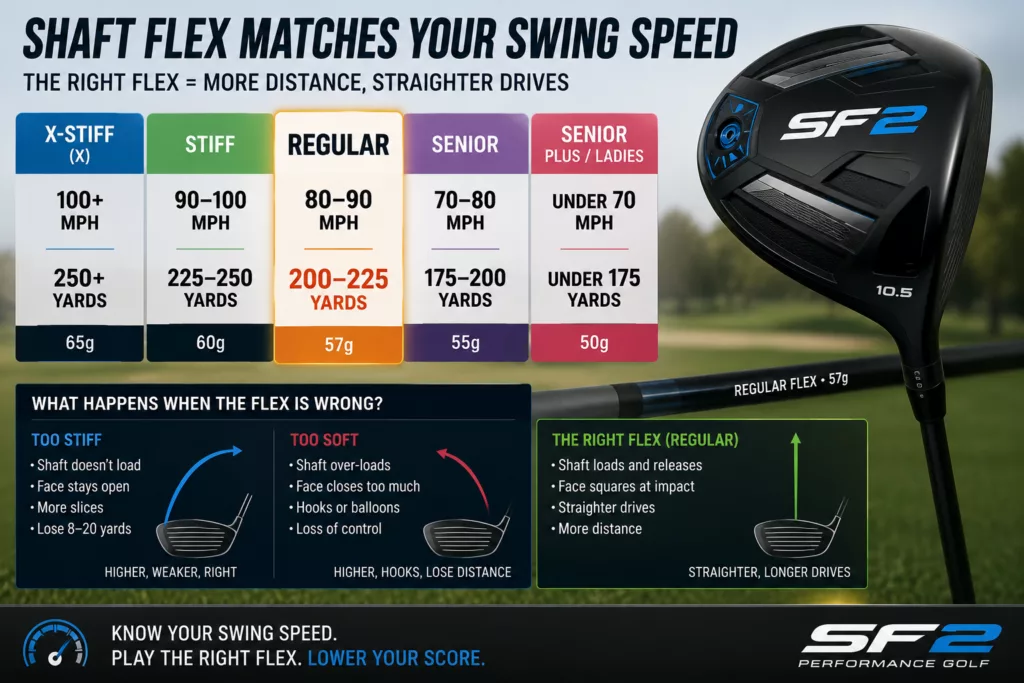
The SF2 comes in five flex options, each matched to a specific swing speed range and shaft weight. Here is the full breakdown so you can see exactly where Regular flex sits in the lineup.
| Flex | Shaft Weight | Swing Speed | Expected Distance |
|---|---|---|---|
| Extra Stiff (X) | 65g | 100+ MPH | 250+ yards |
| Stiff | 60g | 90–100 MPH | 225–250 yards |
| Regular | 57g | 80–90 MPH | 200–225 yards |
| Senior | 55g | 70–80 MPH | 175–200 yards |
| Senior Plus / Ladies | 50g | Under 70 MPH | Under 175 yards |
Ladies Flex: Under 70 MPH
The Ladies and Senior Plus flex — offered at 50g — is built for swing speeds under 70 MPH. The lighter shaft weight helps golfers with lower swing speeds generate club head speed more easily, which is the main limiting factor at this end of the spectrum.
Senior Flex: 70–80 MPH
At 55g, the Senior flex is calibrated for swing speeds between 70 and 80 MPH, with expected carry distances in the 175 to 200 yard range. This is a common flex for golfers who have lost swing speed with age but still want to maximize what their current speed can produce. For more details on choosing the right shaft flex based on swing speed, check out this guide on shaft flex.
- Shaft weight: 55g
- Swing speed range: 70–80 MPH
- Expected carry: 175–200 yards
- Best for: Golfers who have lost speed over time and need a shaft that loads at a lower threshold
Senior flex is not a step down in quality — it is a step toward better timing. A golfer swinging at 74 MPH playing a Regular flex shaft is making every shot harder than it needs to be.
Regular Flex: 80–90 MPH
This is the sweet spot for the majority of recreational golfers in the US. The 57g Regular flex shaft is designed to load fully at 80 MPH and still perform efficiently up to 90 MPH, giving it a useful range without compromising timing at either end.
The SF2 in Regular flex pairs this shaft profile with a 445cc forged titanium head and counter-slice geometry, which means it is correcting your miss pattern at the same time it is matching your swing speed.
If you are a golfer who typically hits drives in the 200–215 yard range and suspects your current driver setup is holding you back, there is a real chance shaft flex is part of the problem. Regular flex in the SF2 is built to unlock the carry distance your swing speed is already capable of producing.
Stiff Flex: 90–100 MPH
The Stiff flex sits at 60g and is designed for swing speeds between 90 and 100 MPH, producing carry distances in the 225 to 250 yard range. Golfers in this category generate enough speed that a softer shaft would over-load and cause timing issues through impact.
The extra 3g over the Regular flex may seem minor, but combined with a stiffer profile, it fundamentally changes how the shaft behaves at the top of the backswing. For more insights, you can explore this guide on shaft flex based on swing speed.
Stiff flex is also where a lot of golfers incorrectly end up after self-selecting based on ego rather than data. If you are swinging between 80 and 89 MPH and playing Stiff, there is a good chance you are leaking distance and fighting a slice that your equipment is partially responsible for.
Extra Stiff Flex: 100+ MPH
The 65g Extra Stiff shaft is built for swing speeds above 100 MPH and expected carry distances over 250 yards. At this speed, a softer shaft cannot handle the load without over-flexing, which creates unpredictable timing and an inconsistent face angle at impact.
Extra Stiff is a legitimate performance category — but it is only relevant to a small percentage of golfers. Most recreational players never need it, and playing it at a lower swing speed will cost them significantly in both distance and accuracy.
How to Measure Your Swing Speed Accurately
Your swing speed is the single most important data point in choosing the right shaft flex. The problem is that most golfers either guess it, remember a number from years ago, or base it on how hard they think they swing. None of those approaches are reliable. Getting an actual measurement — even a rough one — makes every other fitting decision more accurate.
Launch Monitor Testing: The Most Reliable Method
A launch monitor is the gold standard for measuring swing speed. Devices like the Trackman, FlightScope Mevo+, or Garmin Approach R10 give you real-time club head speed, ball speed, smash factor, launch angle, and spin rate — all in one session.
Many golf retailers, indoor hitting bays, and PGA professionals offer launch monitor sessions, sometimes at no charge if you are evaluating equipment. If you can access one, do it. The data will not just tell you which flex to pick — it will show you exactly what your current setup is doing to your ball flight.
When testing, take at least 8 to 10 swings with your driver and average the results. Single-swing readings can be skewed by an outlier in either direction. What you want is the number that represents your typical, repeatable swing — not your best swing of the day.
DIY Range Testing When a Monitor Is Not Available
If a launch monitor is not accessible, you can get a reasonable estimate using a swing speed radar like the Swing Speed Radar by Sports Sensors, which retails for around $100 and clips to any club shaft. It is not as comprehensive as a full launch monitor, but it gives you a real number to work with rather than a guess.
Another option is to use your average carry distance as a reference point — if you are consistently carrying drives 200 to 215 yards, you are almost certainly in the 80 to 87 MPH range, which puts you squarely in Regular flex territory for the SF2.
Swing Speed Is Not the Only Factor
Swing speed is the starting point — not the finish line. Two golfers with identical swing speeds can legitimately need different flex options based on how they swing, not just how fast. Tempo, transition aggression, and miss pattern all feed into the final fitting decision, and ignoring them means leaving real performance on the table even after getting the speed measurement right.
How Swing Tempo Affects the Right Flex Choice
Tempo refers to the overall rhythm and pace of your swing from takeaway to follow-through. A golfer with a smooth, flowing tempo gives the shaft more time to load gradually, which means a slightly softer shaft can work effectively even at the higher end of a speed range.
A golfer with a quick, aggressive tempo puts more demand on the shaft in less time, which can push them toward the firmer end of their flex category. If your swing speed sits right at 88 or 89 MPH but you have a fast, punchy tempo, the Stiff option may actually serve you better than Regular — and vice versa at 81 MPH with a smooth, unhurried pace.
Transition Speed and Its Impact on Shaft Load
Transition is the moment the swing changes direction from backswing to downswing. Golfers who make an aggressive transition — snapping the club aggressively into the downswing — generate significant shaft load in a very short time window. This aggressive loading demands a stiffer shaft to maintain control, even if the overall swing speed does not technically require it.
If you have been told you have a fast transition or you know your downswing is abrupt, factor that into your flex choice. It is one of the reasons a proper fitting consultation — rather than just a chart lookup — can be genuinely valuable.
Miss Pattern: What Your Ball Flight Tells You
Your consistent miss pattern is one of the clearest real-world signals about whether your current shaft flex is working. A persistent slice or weak fade that you cannot cure through swing adjustments often points to a shaft that is too stiff, preventing the face from squaring through impact.
A hook or a strong draw that you struggle to control often points to a shaft that is too soft, closing the face too aggressively. The SF2 is specifically engineered to correct slice bias through its counter-slice geometry — but that technology works best when the shaft flex matches your swing speed.
If your miss is a slice and your speed is 80 to 90 MPH, Regular flex in the SF2 gives the engineering the best possible conditions to do its job.
What Makes the SF2 Regular Flex Different From Other Shafts
Most driver shafts in the Regular flex category are designed as a middle-ground option — not too stiff, not too soft, built to satisfy as many golfers as possible without being optimized for any of them.
The SF2 takes a different approach. Every component of the shaft and head system is engineered to work together for a specific type of golfer: someone swinging 80 to 90 MPH who is losing distance and accuracy to a slice.
- 57g shaft weight — lighter than the Stiff option to match the load profile of an 80–90 MPH swing
- Premium counterbalanced construction — shifts weight distribution to improve stability through impact
- 3-piece forged titanium head — built for maximum ball speed at the legal COR/CT limit
- 445cc speed geometry head — aerodynamically shaped to reduce drag and increase club head speed at impact
- Counter-slice keel technology — engineered into the sole to resist the open-face tendency that creates slices
- Thin, fast face design — maximizes energy transfer at 80–90 MPH swing speeds where ball speed matters most
The counter-slice keel is where the SF2 diverges most sharply from a standard driver shaft setup. It is a weighted sole feature that works with the shaft’s flex profile to resist the face-open position that causes slices — not by changing how you swing, but by changing how the club responds when you do.
For Regular flex players, the 57g shaft is specifically chosen because it loads and releases at a timing that complements the keel’s corrective effect.
This is not a one-size-fits-all driver with a flex label slapped on it. The Regular flex SF2 is a system — shaft weight, head geometry, face design, and sole weighting — all calibrated for the 80 to 90 MPH golfer who wants to stop fighting their equipment and start hitting the ball the way their swing actually allows.
57g Premium Counterbalanced Shaft
The 57g shaft weight in the SF2 Regular flex is not an arbitrary number. It sits precisely between the 55g Senior flex and the 60g Stiff flex because that weight profile matches the load characteristics of an 80–90 MPH swing.
A shaft that is too heavy forces the golfer to work harder to generate speed, while a shaft that is too light can feel uncontrollable through the hitting zone. At 57g, the Regular flex hits the balance point that lets the swing work naturally without fighting the club.
The counterbalanced construction shifts the center of gravity slightly higher in the shaft, which stabilizes the club head through impact. For golfers in the 80–90 MPH range who tend to struggle with face angle consistency, this added stability is a meaningful performance advantage.
It reduces the amount of twist through the hitting zone, which directly supports a squarer face at impact and tighter shot dispersion.
What separates the SF2 shaft from a generic Regular flex option is that it is not designed in isolation. It is engineered as part of a complete driver system, where the shaft weight and flex profile are matched to the head design, face technology, and sole geometry.
Every component is calibrated for the same golfer — 80 to 90 MPH, fighting a slice, looking for more distance without overhauling their swing.
- 57g total shaft weight — optimized for the load and release cycle of an 80–90 MPH swing
- Counterbalanced design — raises the balance point to stabilize the head through the hitting zone
- Premium shaft construction — consistent flex profile from grip to tip, unlike budget shafts that vary in stiffness along the shaft
- Matched to the 445cc titanium head — shaft and head are designed together, not assembled from separate components
How the Counter-Slice Keel Works With Regular Flex
The counter-slice keel is a weighted sole feature built into the SF2 head that physically resists the open-face position responsible for slices. During the downswing and through impact, the keel’s weight distribution creates a closing bias in the head — meaning the club wants to square up rather than stay open.
For this to work effectively, the shaft flex has to release at the right moment. If the shaft is too stiff, the release is delayed and the keel’s corrective effect arrives too late. If the shaft is too soft, the face closes too early and the correction overshoots into a hook.
The 57g Regular flex is specifically calibrated so that the shaft releases in sync with the keel, producing a square face at the exact moment of contact for 80–90 MPH swingers.
This is why flex selection matters so much with the SF2 specifically. The counter-slice technology is not a passive feature — it is an active system that depends on proper shaft timing to function correctly.
A Regular flex golfer playing the Stiff option is not just slightly mismatched. They are actively working against the club’s built-in correction mechanism on every single swing.
You Are Between Two Flex Categories: Here Is What to Do
If your swing speed sits right at 80 or 90 MPH, you are at a decision point that a simple chart cannot fully resolve. At exactly 80 MPH, the question is whether Regular or Senior flex serves you better. At exactly 90 MPH, it is Regular versus Stiff.
The answer depends on three factors beyond the speed number itself: your tempo, your transition aggressiveness, and your dominant miss pattern.
A smooth tempo with a gradual transition at 90 MPH likely plays best in Regular flex. A fast, aggressive transition at the same speed may need Stiff to keep the shaft from over-loading.
When in doubt, err toward the softer option — and here is why. A shaft that is slightly too soft is generally more forgiving than one that is slightly too stiff, because an over-loading shaft still produces energy transfer, while an under-loading stiff shaft simply does not engage properly.
More importantly, the SF2’s counter-slice keel is designed to prevent over-closure from a softer flex, giving you a built-in safety net that a stiff shaft cannot provide for a slower swing. If you are genuinely unsure, Performance Golf offers free fitting recommendations to help you make the right call before you commit.
Considering the SF2 driver?
The full review covers whether the slice correction actually holds up for real golfers — not just what the marketing says — plus what the order page adds on at checkout that most buyers don’t see coming.
Read the full SF2 reviewFrequently Asked Questions
These are the questions that come up most often from golfers evaluating the SF2 Regular flex. If you have been going back and forth on whether this driver and flex combination is right for your game, the answers below should help bring clarity.
Most of the uncertainty golfers carry into a driver purchase comes from conflicting information about swing speed, flex categories, and what a specialty driver like the SF2 is actually designed to do. The goal here is to cut through that noise with direct, specific answers.
Is the SF2 legal for tournament play?
Yes, the SF2 is legal for tournament play. It is built to conform to the rules of golf as set by the USGA and R&A, including compliance with the maximum COR and CT limits for driver faces. The thin, fast face in the SF2 is engineered right to the legal performance ceiling — not beyond it.
- COR/CT compliance: The SF2 face is built to the maximum legal limit, not over it
- Head size: The 445cc head is within the 460cc maximum allowed under the rules of golf
- No banned technology: The counter-slice keel and forged titanium construction use no prohibited materials or mechanisms
The SF2 is a legal driver that performs at the boundary of what the rules allow — which is exactly where you want your equipment to be.
If you are playing in a competition governed by local or regional rules, it is always worth confirming the approved equipment list with your organizing body. But under standard USGA and R&A rules, the SF2 qualifies without issue.
What if my swing speed is right at 80 or 90 MPH?
At exactly 80 MPH, Regular flex is the right starting point. The shaft is designed to load fully at this speed, and the counter-slice keel is calibrated to work with a Regular flex release. Unless you have a notably aggressive transition or a strong hook miss pattern, Regular flex will serve you better than Senior at 80 MPH.
At exactly 90 MPH, the decision is closer. Regular flex is still within its designed range, but if you have a fast tempo and an aggressive downswing transition, Stiff may produce better timing.
The practical approach: try Regular flex first. If you are consistently over-drawing or hooking with the SF2 at 90 MPH, that is a signal the shaft is over-loading and Stiff may suit you better.
Can the SF2 Regular Flex help me gain distance?
Yes — and specifically in two ways that compound each other. First, if you have been playing a shaft that does not match your swing speed, correcting that mismatch alone recovers the 8 to 20 yards you have been losing to poor energy transfer.
Second, the SF2’s thin forged titanium face is built to the maximum legal COR limit, which means it generates maximum ball speed for whatever club head speed you bring to impact. For a golfer swinging 80–90 MPH, that combination can realistically add 10 to 25 yards compared to a mismatched or lower-performing driver setup.
The distance gains are not theoretical. They come from fixing two real problems simultaneously: shaft timing and face efficiency. When both are optimized for your swing speed, the ball simply goes farther with the same effort.
How is the SF2 different from the SF1?
The SF2 is the next generation of Performance Golf’s slice-fix driver line, built with a 3-piece forged titanium head construction compared to the SF1’s design.
The SF2 uses a 445cc speed geometry head that is aerodynamically optimized to reduce drag through the downswing, which helps generate more club head speed at impact without requiring a faster swing. The face technology is also upgraded to push right to the legal COR and CT limits, extracting maximum ball speed from every swing in the 80–90 MPH range.
The fundamental slice-correction philosophy is consistent across both models, but the SF2 refines the engineering with premium materials and tighter tolerances.
For golfers upgrading from the SF1, the SF2 Regular flex represents a meaningful step forward in both distance and consistency — not just a cosmetic update.
For more information on the difference you can read our complete guide on what changed between the SF1 and SF2..
What results can I realistically expect from the SF2 Regular Flex?
If your swing speed is genuinely in the 80–90 MPH range and you have been playing a mismatched shaft or a lower-performing driver, the SF2 Regular flex is designed to deliver carry distances in the 200 to 225 yard range.
For golfers at the lower end of that speed range — around 80 to 83 MPH — expect results closer to 200 to 210 yards. For golfers at the upper end — 87 to 90 MPH — the upper boundary of 215 to 225 yards is a realistic target.
Beyond raw distance, the most commonly reported improvement is shot shape. The counter-slice keel and matched shaft flex work together to reduce the open-face tendency that produces slices, which means straighter drives even without swing changes.
Tighter dispersion — fewer balls lost in the right rough — is often the first result golfers notice before they even start measuring distance gains.
The results compound over time. Straighter drives land in better positions, which leads to shorter approach shots, which leads to lower scores. The SF2 Regular flex is not a swing fix — it is an equipment optimization that removes one of the biggest obstacles between your current game and the scores you are capable of shooting.
Related Post
Best Golf Clubs for Beginners 2025: Complete Sets Under $500 (Wisconsin Course-Tested)
Starting your golf journey can feel overwhelming, especially when choosing your first set of clubs. [...]
Performance Golf SF2 vs Callaway Paradym Draw: Is the Price Difference Justified?
Quick answer: The Callaway Paradym Draw is a premium, confirmed USGA-conforming draw-bias driver built on [...]