This website uses cookies to improve your experience. We\'ll assume you\'re ok with this, but you can opt-out if you wish. Read More
Does a Counterbalanced Driver Shaft Actually Help Slower Swing Speeds?

Quick answer: Yes — for most recreational golfers with swing speeds under 90 MPH, a counterbalanced driver shaft produces measurable improvements in clubface control and consistency.
By adding weight near the grip end of the shaft, counterbalancing raises the balance point of the assembled club, making the head feel lighter and easier to square through impact without actually reducing head weight or ball speed.
The Performance Golf SF2 uses a counterbalanced shaft as part of its design specifically because its target buyers — recreational slicers with moderate swing speeds — benefit more from improved face control than from a heavier tip-heavy shaft. This article explains the mechanics, who benefits most, and what the real-world difference looks like on the course.
What Counterbalancing Actually Means in a Golf Shaft
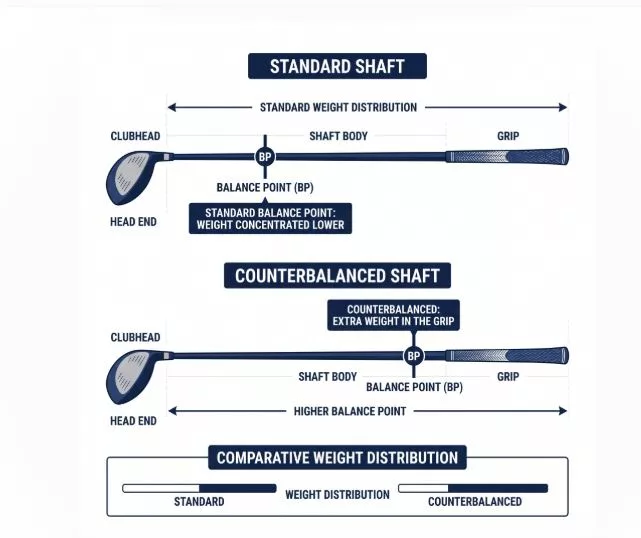
The term “counterbalanced” refers to a specific weight distribution inside a golf shaft where additional mass is added near the grip end — the top of the shaft — rather than being concentrated near the tip end where the clubhead attaches.
In a standard (non-counterbalanced) driver shaft, the weight distribution follows the natural taper of the graphite layers — slightly heavier toward the tip, lighter toward the grip. This tip-heavy balance point is what gives many golfers the feeling of “sensing the head” through the swing, which some players find helpful for timing.
In a counterbalanced shaft, a dense plug or wrap of material is added inside the grip section of the shaft — typically 4-10 grams of additional weight positioned near the top of the club.
This additional grip-end weight raises the balance point of the shaft upward, changing the swing weight and feel characteristics of the assembled club even when the head weight and shaft weight remain constant.
The Physics: Why Raising the Balance Point Helps Slower Swingers
To understand why counterbalancing helps slower swing speeds specifically, it’s useful to understand what happens during the downswing at different speed levels.
At faster swing speeds (95+ MPH): High-speed swingers generate enough centrifugal force through the downswing to load the shaft heavily and release it aggressively through impact.
The tip-heavy feeling of a standard shaft gives these players the lag feedback they want — they can feel the head lagging behind and time their release accordingly. More tip weight means more load, more lag, and more potential energy release through impact.
At slower swing speeds (under 85 MPH): Slower swingers don’t generate the same centrifugal load. A tip-heavy shaft at slower swing speeds doesn’t fully load and release — instead, the head can feel heavy and unwieldy, making it harder to consistently square the face through impact.
The timing challenge of controlling a tip-heavy head at slower speeds introduces more face-angle variation from swing to swing, which is a direct contributor to inconsistent contact and slicing.
What counterbalancing does for slower swingers: By raising the balance point, counterbalancing makes the head feel lighter relative to the grip without actually reducing head weight.
This lighter head feel gives slower swingers better awareness and control of the clubface position through the impact zone — they can feel where the face is pointing more clearly, which produces more consistent squaring at impact. The result is tighter dispersion and more consistent contact, even without any change in swing speed.
Swing Weight vs Balance Point: Understanding the Relationship
This is a technical concept worth clarifying because it affects how counterbalanced shafts are specified and discussed in fitting conversations.
Swing weight is a measure of how heavy the club feels when you swing it — specifically how head-heavy it feels. Swing weight is measured on a scale from A0 (very light) to G10 (very heavy), with most drivers falling in the D0-D4 range for recreational golfers. A higher swing weight means the head feels heavier relative to the grip.
Balance point is the physical point along the club’s length where the assembled club would balance horizontally if placed on a fulcrum. A lower balance point (closer to the head) produces a higher swing weight — the head feels heavier. A higher balance point (closer to the grip) produces a lower swing weight — the head feels lighter.
What counterbalancing does to these measurements: Adding grip-end weight raises the balance point and lowers the swing weight of the assembled club. If you take a standard D2 swing weight driver and add a counterbalance plug near the grip, the swing weight may drop to C8 or C9 — the head feels meaningfully lighter even though its physical weight hasn’t changed.
For slower swingers who struggle with face control, this lighter head feel translates directly to improved timing and more consistent face angle at impact.
The SF2’s Counterbalanced Shaft: Specific Numbers
The Performance Golf SF2 uses a counterbalanced shaft across all five of its flex options. The specific weight and counterbalance specifications vary by flex:
| Flex | Shaft Weight | Counterbalance Effect | Target Swing Speed |
|---|---|---|---|
| Ladies | 50-55g | Highest counterbalance ratio — maximum head feel reduction | Under 65 MPH |
| Senior / Soft | 50-55g | High counterbalance ratio for smooth tempo players | 70-80 MPH |
| Regular | 57g | Moderate counterbalance — balanced feel for average speeds | 80-90 MPH |
| Stiff | 60g | Lower counterbalance ratio — more feel for faster tempos | 90-100 MPH |
| X-Stiff | 65g | Minimum counterbalance — primarily for feel consistency | 100+ MPH |
The counterbalancing is most impactful at the lighter end of the flex spectrum — Ladies and Senior Flex — where the combination of a lighter shaft and grip-end weight produces the greatest improvement in face control for the slowest swing speeds.
At the heavier end (Stiff and X-Stiff), the counterbalancing contributes more to feel consistency than to dramatic swing weight reduction.
Who Benefits Most From a Counterbalanced Shaft
Maximum benefit — Swing speeds under 75 MPH: Senior golfers, women golfers, and any player whose swing speed has declined below 75 MPH see the most dramatic improvement from counterbalancing.

At these speeds, standard shafts often feel tip-heavy and difficult to control through the impact zone. Counterbalancing directly addresses the primary contact consistency problem for this speed bracket.
Significant benefit — Swing speeds 75-88 MPH: The largest segment of recreational golfers falls in this range, and counterbalancing provides meaningful improvement in face control consistency.
This is the core target group for the SF2’s counterbalanced design — golfers who are swinging at moderate speeds, slicing consistently, and struggling with the face-angle timing that a tip-heavy standard shaft makes harder.
Moderate benefit — Swing speeds 88-95 MPH: At this speed range, the benefits of counterbalancing become more subtle. Golfers with smooth, controlled tempos still benefit from the improved face awareness. Golfers with aggressive, lag-heavy tempos may actually prefer the feedback of a standard tip-heavy shaft and find the counterbalanced feel unfamiliar or “dead.”
Minimal benefit — Swing speeds over 95 MPH: High-speed swingers generally don’t benefit from counterbalancing for face control — they have enough centrifugal force to load and release any shaft effectively.
The grip-end weight may actually interfere with their preferred feel and timing. This is one reason why counterbalanced shafts are common in senior and game-improvement drivers but rare in premium player’s drivers.
The 57g Regular Flex Question: Is It Too Light Without Counterbalancing?
This is the most common technical concern raised by SF2 buyers comparing the Regular Flex specification to standard OEM drivers.
Most OEM regular flex driver shafts run 60-65g. The SF2 Regular Flex at 57g is 3-8 grams lighter. In a standard (non-counterbalanced) configuration, a 57g regular flex shaft at 85 MPH would feel noticeably softer and more difficult to control than a 62g equivalent — the timing window would be wider and the dispersion potentially looser.
The counterbalancing changes this calculation. The grip-end weight in the SF2’s Regular Flex effectively raises the swing weight feel toward where a standard 60-62g shaft would sit, despite the lower raw shaft weight.
The result is a shaft that feels more controlled than its 57g weight alone would suggest, while still being light enough to promote slightly faster swing speed for moderate-tempo swingers.
This is the engineering reason the SF2’s counterbalanced design is described as playing “more controlled than expected” at lighter weight specs — the counterbalancing is doing work that the raw weight number doesn’t capture.
Counterbalanced Shafts vs Standard Shafts: What Changes on the Course
Setting realistic expectations for what counterbalancing actually changes in your on-course experience helps avoid both over-expectation and under-appreciation of the technology.
What typically improves:
- Consistency of face angle at impact — fewer wildly open or closed faces producing unexpected misses
- Center-face contact percentage — the lighter head feel allows more precise positioning through the impact zone
- Dispersion tightness — shots cluster more consistently around a central trajectory rather than scattering widely
- Fatigue resistance through a round — lighter head feel reduces the muscular effort of squaring the face, which can improve consistency on the back nine
What doesn’t change:
- Raw swing speed — counterbalancing doesn’t add clubhead velocity; it improves what you do with the speed you already have
- Ball speed on perfect center strikes — the head weight and face technology determine ball speed, not the shaft balance point
- Swing mechanics — counterbalancing improves the outcome of your existing swing rather than changing the swing itself
The slice correction interaction: For SF2 buyers specifically, the counterbalancing works in combination with the 3° closed face and Counter-Slice Keel heel weighting.
The face control improvement from counterbalancing makes it more likely that the closed face and heel weighting arrive at impact as designed — if the face is varying wildly from swing to swing due to timing inconsistency, the static corrections of the closed face and heel weighting are less effective. The counterbalancing stabilizes the delivery of those corrections.
Considering the SF2 driver?
The full review covers whether the slice correction actually holds up for real golfers — not just what the marketing says — plus what the order page adds on at checkout that most buyers don’t see coming.
Read the full SF2 reviewHow to Tell if a Counterbalanced Shaft Is Right for You
If you’re unsure whether counterbalancing will help your specific game, here are the practical indicators:
You’ll likely benefit from counterbalancing if:
- Your miss pattern is inconsistent — sometimes slice, sometimes pull, sometimes straight — suggesting timing variation rather than a consistent swing fault
- You feel like you’re working hard to square the face through impact on every swing
- You’ve been told by an instructor that your release timing is inconsistent
- You’re over 55 and your swing speed has declined in recent years
- You find heavier driver heads feel difficult to control late in a round
You may not benefit significantly from counterbalancing if:
- Your miss is consistent and predictable — always the same type of slice on every swing — suggesting a consistent fault rather than timing variation
- You swing over 90 MPH with an aggressive, lag-heavy downswing
- You prefer the feel of a head-heavy club and find lighter head feel disconnected or unfamiliar
- You’ve previously played counterbalanced clubs and didn’t notice a difference
Frequently Asked Questions
Does a counterbalanced shaft add distance? Not directly — counterbalancing improves face control and contact consistency, not raw clubhead speed or ball speed on center strikes. However, tighter dispersion and more consistent center contact often produces more consistent carry distances, which can improve average performance even if peak distances don’t increase.
Can I add counterbalancing to my existing driver? Yes — a club fitter can add a counterbalance plug inside the grip or install a counterbalance grip (a grip with built-in additional weight near the top). This is a low-cost modification that changes the swing weight feel without replacing the shaft. Ask a local pro shop or club fitting service about counterbalance grip options.
Is the SF2’s counterbalanced shaft proprietary? The SF2 uses a proprietary shaft configuration that makes aftermarket replacement more complex than with adjustable-hosel OEM drivers. If the shaft itself needs replacement, consult Performance Golf’s customer service rather than a standard reshafting service.
How does counterbalancing affect the feel of the club at address? At address, a counterbalanced club feels lighter in the head and slightly heavier in the grip compared to a standard configuration.
Most golfers adapt to this feel within a few practice sessions. Some players initially find it unfamiliar — the lack of pronounced head weight feels disconnected — but typically adjust as they experience the improved contact consistency.
Do any major OEM draw-bias drivers use counterbalanced shafts? Some OEM game-improvement drivers and senior-focused lines incorporate counterbalancing in their stock shaft offerings, though it’s not as prominently featured as in the SF2’s design.
The Ping G430 SFT’s stock shaft options, for example, are selected for slower swing speed profiles but aren’t specifically marketed as counterbalanced in the same way.
Have you played a counterbalanced driver shaft before, or are you considering the SF2 based on what you’ve read here? Drop your swing speed and current driver in the comments — I’ll tell you whether counterbalancing is likely to make a noticeable difference for your specific game.
Related Post
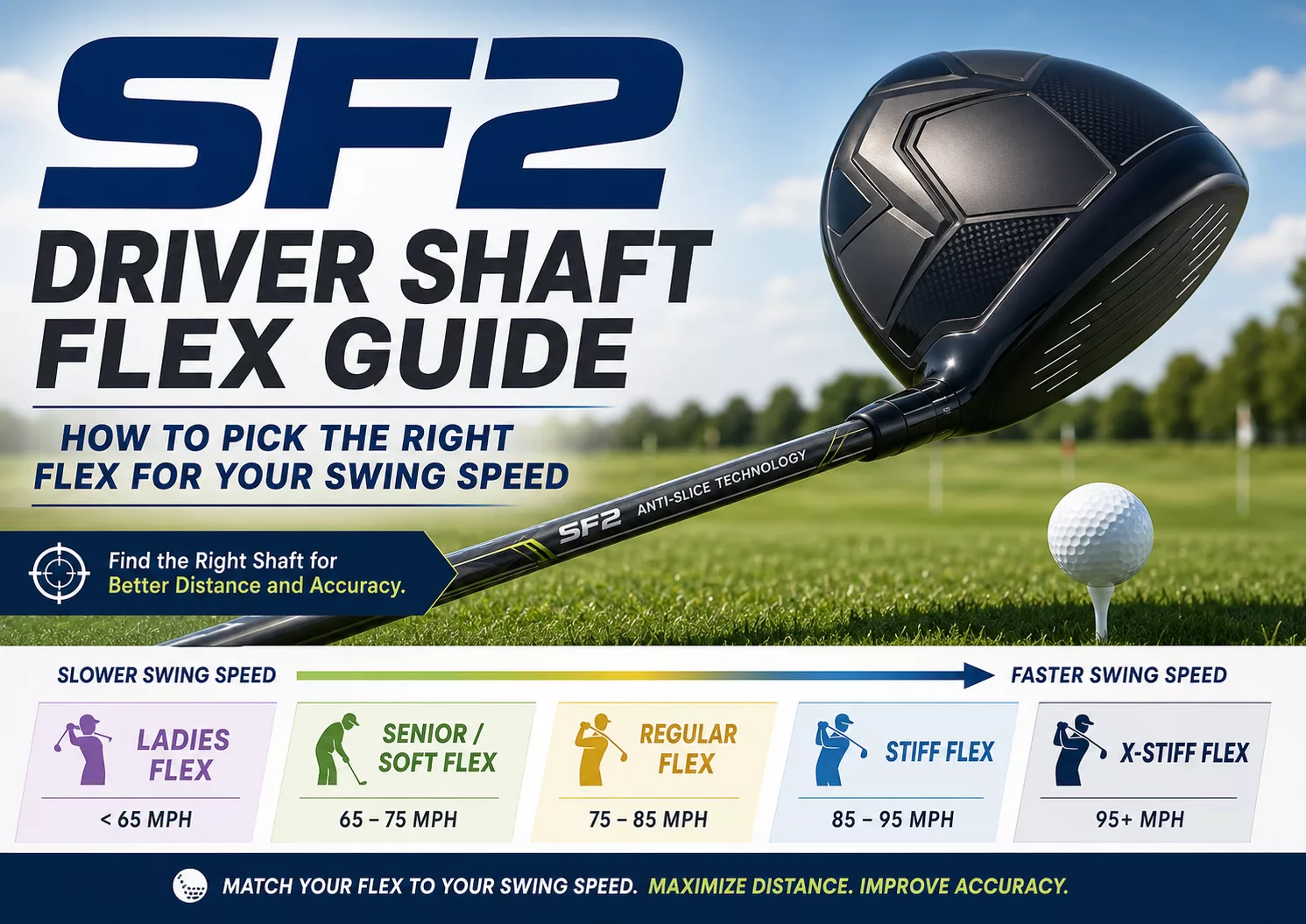
SF2 Driver Shaft Flex Guide: How to Pick the Right Flex for Your Swing Speed
Quick answer: The Performance Golf SF2 driver comes in five shaft flex options matched to [...]
The PG1 Subscription Charge Explained: How to Buy the Performance Golf SF2 Driver Without the $299 Billing Surprise
Quick answer: The Performance Golf SF2 driver itself does not include a hidden subscription. The [...]