This website uses cookies to improve your experience. We\'ll assume you\'re ok with this, but you can opt-out if you wish. Read More
Senior Golf Discounts: Most Courses Start Between 50 and 62 — Here’s How to Find Yours

There’s no standard senior age in golf. Most courses set the threshold somewhere between 50 and 62, with 55 and 62 being the most common cutoffs, and the discount typically saves $8–15 per round off the standard rate.
The bigger opportunity isn’t the published senior rate, though — it’s the rates courses have but don’t advertise. Here’s how the whole system works and exactly what to ask.
What age qualifies for senior golf rates?
It varies by course, with most falling between 50 and 62. Municipal courses often set it at 60 or 62 to align with other city senior services, while daily-fee and resort courses more commonly use 50 or 55 because they’re competing for the retiree market.
There’s no governing body setting this. Each course picks its own number, which means the course across town may have a lower threshold than yours. If you’re in your fifties and your home course says 62, it’s worth checking two or three others nearby — a few years of senior pricing across a full season is real money.
How much do senior golf discounts actually save?
Typically $8–15 per round, or roughly 20–35% off the standard rate. On a $38 weekday round, a senior rate commonly lands around $26–30.
Over a season, that compounds fast. A golfer playing twice a week for 28 weeks saves somewhere between $450 and $840 on green fees alone — before any of the stacking discounts below.
Do senior rates apply on weekends?
Usually not, or not until the afternoon. The most common structure is senior rates available Monday through Friday, sometimes with weekend availability after a cutoff time like noon or 1pm.
This is the single biggest limitation on senior pricing, and it’s why senior discounts are worth so much more to retirees than to seniors still working full time. If you’re in the latter group, ask specifically: “Is there a weekend senior rate, and does it kick in at a certain time?”
Do you have to prove your age?
Rarely. Most courses take you at your word, though some will ask for ID the first time, and courses with senior season passes or resident cards generally verify age at signup.
Nobody is going to make this uncomfortable. If a course asks, it’s a two-second look at a driver’s license at the counter.
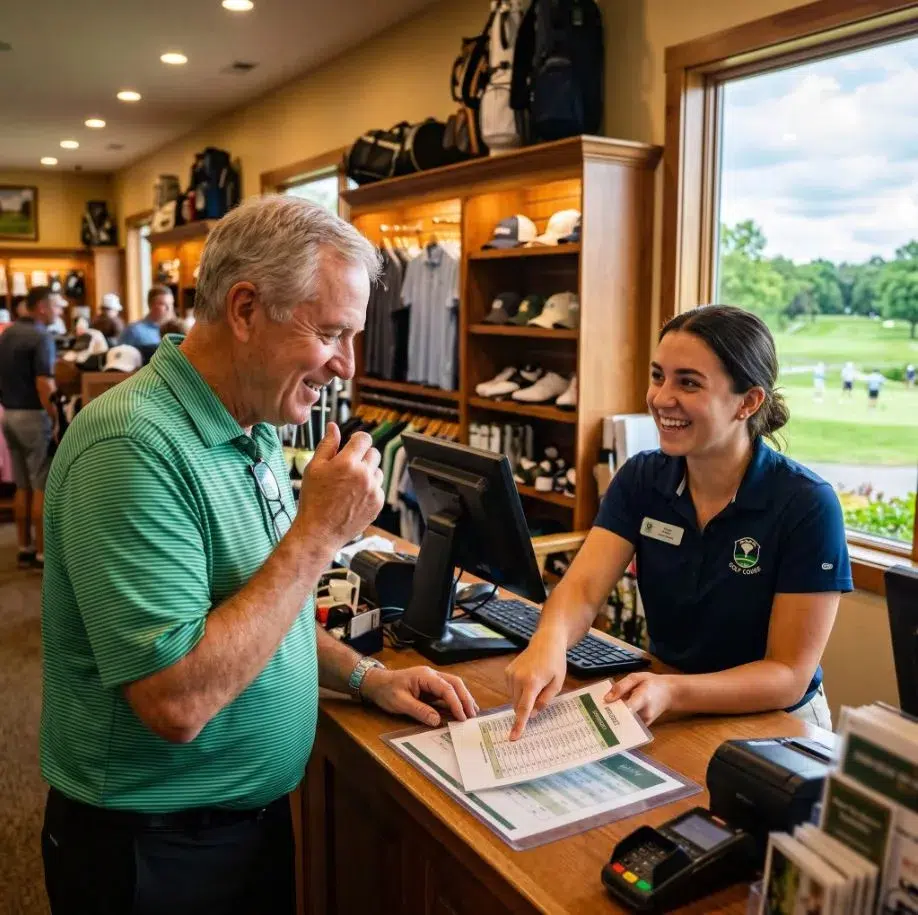
What’s the unadvertised senior rate, and how do you find it?
Many courses have senior pricing that isn’t published on their website — most often a senior twilight or senior afternoon rate that exists on the register but never made it onto the rates page.
The question that surfaces it: “Do you have a senior rate, and is there a senior afternoon or twilight rate too?” Ask both halves. Plenty of golfers know about the first and have never heard of the second.
This is especially common at courses in retiree-heavy markets, where the pro shop quietly offers deeper afternoon senior pricing to fill a slow tee sheet. It won’t be online, because it’s a lever they pull rather than a rate they commit to.
Which courses have the best senior rates?
Municipal and county courses, by a wide margin — and often with a resident senior rate that goes deeper still. A city resident over the age threshold can sometimes play for half what a non-resident under it pays at the same course.
Municipal courses are also where senior season passes are cheapest and senior leagues are most established. Our guide to judging municipal course quality covers how to tell whether a given muni is worth committing your season to.
Do courses offer senior season passes?
Yes, and they’re commonly 20–35% below the standard adult pass price — among the best values in public golf for anyone playing more than about twice a week.
The break-even math still applies, though: divide the pass price by your senior per-round rate, not the standard rate, since the senior rate is what you’d otherwise be paying. That raises your break-even round count meaningfully. Our season pass break-even guide walks through the formula and the fine-print questions that flip these decisions.
Are there senior discounts on carts?
Occasionally, but far less often than on green fees. Cart fees are high-margin and courses discount them reluctantly.
Worth knowing: if walking is realistic for you, it saves more than most senior discounts do — $15–22 per round versus the $8–15 a senior rate typically saves. Our cart fee vs. walking breakdown covers the season math and where a push cart fits in.
What other discounts stack with senior rates?
More than most golfers realize. Ask whether these combine at your course:
- Twilight and senior together — sometimes stackable, sometimes the course applies whichever is lower. Always ask; the answer varies by course and even by staff member. Our twilight rate guide covers the timing math so you still finish 18.
- Resident + senior — usually stackable at municipal courses, and the deepest combination available.
- Weekday + senior — nearly always the base combination.
- League rates — senior league green fees are often below the standard senior rate.
- Military or veteran discounts — sometimes stackable, sometimes not, and courses differ on whether they apply the better one or combine them.
Are there senior golf programs beyond individual courses?
Yes. Most state golf associations run senior programs, tournaments, and member benefits, and many offer senior membership tiers at reduced cost. Some also negotiate discounted rates at member courses.
Regional and local players cards frequently include senior tiers as well. Whether those pay off depends entirely on how many of the covered courses you’d actually drive to — the same break-even logic as a season pass applies.
How do you ask for a senior rate without feeling awkward?
Just ask plainly at the counter: “Do you have a senior rate?” Nobody at a pro shop finds this odd — they field it dozens of times a day, and staff frequently don’t volunteer it because they can’t tell who qualifies.
Two things worth knowing. First, if you don’t ask, you usually won’t get it. Senior rates are almost never applied automatically to online bookings. Second, booking online often means paying full price for a round you could have gotten cheaper by calling — one of the few situations where the phone beats the app.
Does booking online cost you the senior rate?
Frequently, yes. Many online booking systems and third-party apps don’t display or apply senior pricing at all, so a senior booking through an app can pay the standard rate for a tee time the pro shop would have discounted.
For seniors specifically, calling the course directly is often the cheapest booking method available. Compare the online total against a phone quote before you assume the app is saving you anything.
The Bottom Line
Senior golf discounts start between 50 and 62 depending entirely on the course, save $8–15 a round, and mostly apply Monday through Friday. Municipal courses offer the deepest senior pricing, especially with a resident discount, and senior season passes commonly run 20–35% below standard.
The two questions worth building a habit around: “Do you have a senior rate, and is there a senior afternoon or twilight rate too?” and, at any new course, “What age do senior rates start here?” The answers change from course to course, and the golfers who ask are the ones playing cheapest.
Have you found a course near you with a surprisingly good senior rate — or a low age cutoff worth knowing about? Leave a comment below and tell us where. Senior pricing varies so much from course to course that a tip from someone who plays in your area is often worth more than anything published online. Questions about a specific course’s policy are welcome too.
Frequently Asked Questions
What age qualifies for senior golf discounts? It varies by course, with most thresholds falling between 50 and 62. Municipal courses often set it at 60 or 62 to align with other senior services, while daily-fee and resort courses more commonly use 50 or 55. There’s no governing standard, so nearby courses may have different cutoffs.
How much do senior golf rates save? Typically $8 to $15 per round, or roughly 20 to 35 percent off the standard rate. On a $38 weekday round, senior pricing commonly lands around $26 to $30. A senior playing twice weekly across a 28-week season saves roughly $450 to $840 on green fees.
Do senior golf rates apply on weekends? Usually not, or only after a cutoff time such as noon or 1pm. The most common structure is senior pricing available Monday through Friday. Golfers should ask specifically whether a weekend senior rate exists and when it starts.
Do you need to prove your age for senior golf rates? Rarely. Most courses take golfers at their word, though some request ID on a first visit, and courses issuing senior season passes or resident cards typically verify age at signup.
Can you combine senior rates with other golf discounts? Often, yes. Resident plus senior is usually stackable at municipal courses and is typically the deepest combination available.
Twilight plus senior varies — some courses stack them, others apply whichever rate is lower. League rates for seniors are frequently below the standard senior rate. Always ask, since policies differ by course.
Related Post

Can You Wear Leggings Golfing? Yes — at Nearly Every Public Course
Leggings are acceptable at the large majority of public and municipal golf courses, and they’ve [...]
Municipal Golf Course Rankings: Top 10 City-Owned Courses in The New York Area
Municipal Golf Course Rankings: Top 10 City-Owned Courses in The New York Area – Expert [...]