This website uses cookies to improve your experience. We\'ll assume you\'re ok with this, but you can opt-out if you wish. Read More
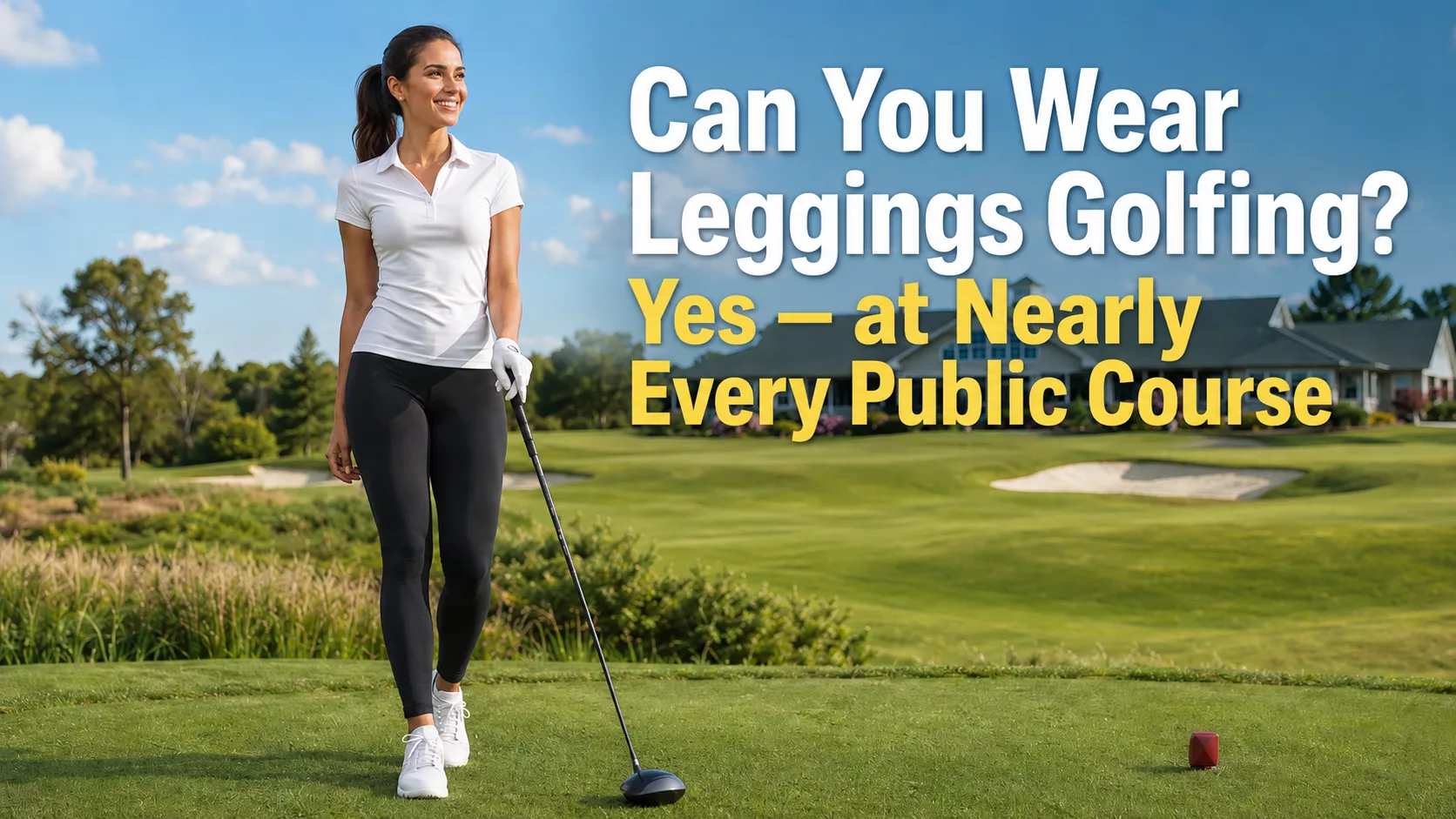
Can You Wear Leggings Golfing? Yes — at Nearly Every Public Course
Categories :
Leggings are acceptable at the large majority of public and municipal golf courses, and they’ve become standard women’s golf attire over the past decade. Where they’re still restricted is private clubs and upscale resort courses, some of which require golf-specific skorts, shorts, or trousers.
That’s the short answer. The longer answer is that golf dress codes are far more relaxed than their reputation — and the handful of rules that still bite are easy to check in sixty seconds before you leave the house. Here’s every question people actually ask, answered.
Can you wear leggings golfing?
Yes, at nearly every public and municipal course. Pair them with an athletic or golf top and you’re dressed appropriately for the overwhelming majority of courses in the country.
Two practical notes. First, opaque, athletic-weight leggings read better than thin or sheer workout pairs — the same standard you’d apply to a nice gym or a casual office. Second, some upscale daily-fee and resort courses ask for a longer top layer over leggings; if you’re playing somewhere expensive and unfamiliar, a tunic-length top removes all doubt.
At private clubs, assume nothing. Those dress codes are written by membership committees and vary enormously from one club to the next.
Can you wear jeans golfing?
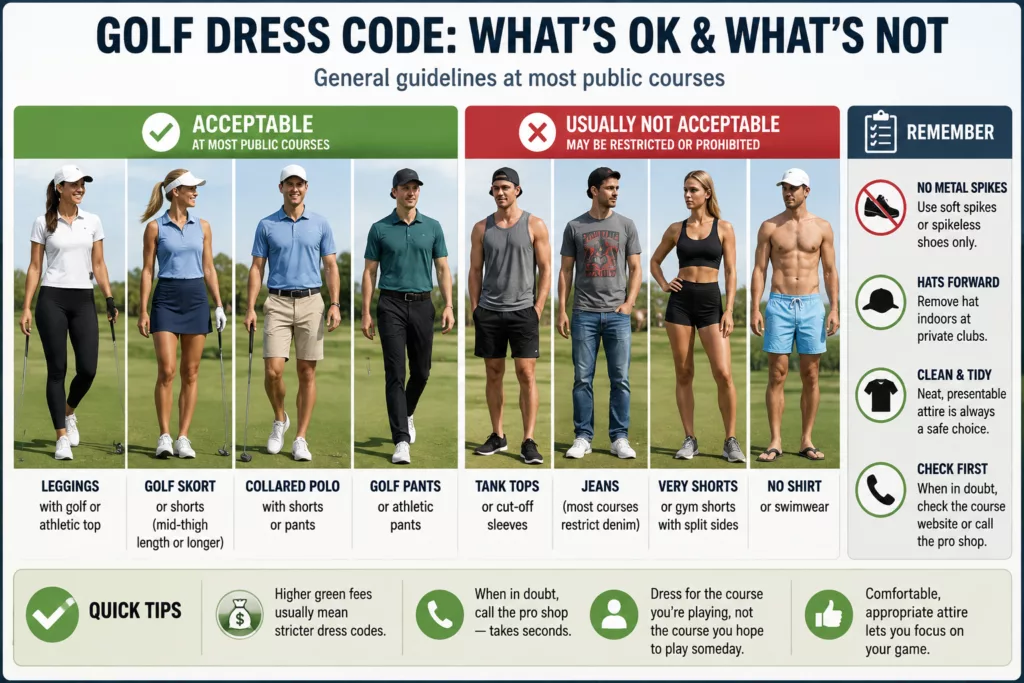
Usually not — denim is the single most commonly banned item in golf, and it’s restricted at far more courses than leggings are.
The reasoning is partly tradition and partly practical: denim doesn’t breathe, doesn’t stretch well through a swing, and stains greens when wet. Some rural and small-town municipal courses genuinely don’t care, but denim is the item most likely to get you a conversation at the pro shop. If you own literally anything else with a waistband, wear that instead.
Do you need a collared shirt to play golf?
Not at most public courses, but it’s still the safest choice anywhere. The collared-shirt rule is real at private clubs, resort courses, and higher-end daily-fee courses, and it’s enforced for men more consistently than for women.
For women, athletic tops, sleeveless tops with a collar, and mock necks are widely accepted even where the written policy mentions collars. For men, a collared polo is the universal safe answer — and used polos turn up at thrift stores constantly for a few dollars, so this isn’t an expensive box to check.
Commonly restricted for everyone: tank tops, cut-off sleeves, tee shirts with large graphics, and swimwear.
Do cheap golf courses enforce dress codes?
Mostly no. Municipal and budget public courses are the most relaxed in golf, because their whole purpose is public access rather than exclusivity. Athletic wear is routine at these courses, and enforcement is typically limited to obvious issues like no shirt or swimwear.
This is one more reason municipal courses are the friendliest entry point to the game — our guide to judging municipal course quality covers how to find the good ones near you. The general rule holds well: the higher the green fee, the stricter the dress code. A $28 muni almost certainly doesn’t care. A $180 resort course almost certainly does.
Are there rules about shorts and skorts?
Yes, and they’re mild. Most courses that address it ask for shorts or skorts of roughly mid-thigh length or longer — often phrased as “no shorter than a few inches above the knee.” Athletic shorts are fine at public courses; gym shorts with visible logos and running split shorts are the ones occasionally turned away.
Men’s shorts: cargo and athletic shorts are fine at munis; some upscale courses require tailored golf shorts specifically.
Do you need golf shoes?
No. Clean athletic sneakers with decent grip work fine at nearly every public course, and this is one of the best places for a new golfer to save money.
The only near-universal footwear rule is no metal spikes — those have been banned almost everywhere for two decades because they damage greens. Modern golf shoes use soft plastic spikes or spikeless soles, and both are fine.
If you eventually buy golf shoes, buy them for traction and comfort over four hours of walking, not because a course required them. Our real-numbers guide to starting golf covers what’s genuinely worth buying in your first season and what isn’t.
Can you wear a hat backwards on a golf course?
At public courses, generally yes. At private clubs, often no — many still require hats forward and removed indoors, which is one of the more traditional rules that’s stuck around.
Nobody at a municipal course is going to say a word about a backwards hat. It’s worth knowing the rule exists mainly so you’re not caught off guard if you ever play somewhere formal.
What actually gets you turned away?
Very little. In practice, the items that draw a conversation at the pro shop are: no shirt, swimwear, denim at courses that ban it, metal spikes, and tank tops at courses with a sleeve requirement.
What doesn’t get you turned away: not owning golf-branded clothing, mismatched gear, an old bag, or looking like a beginner. Nobody is inspecting your outfit. Courses want your green fee, and pro shop staff are far more concerned with pace of play than your waistband.
How do you check a specific course’s dress code?
Three options, in order of speed:
- The course website’s “policies,” “rates,” or “FAQ” page — most public courses state their dress code plainly, and munis often don’t list one at all, which is itself the answer.
- Call the pro shop — one question: “Is there a dress code I should know about?” Takes twenty seconds and settles it completely.
- Look at recent photos — golfer-posted photos on the course’s social media or review pages show you exactly what people actually wear there.
If you’re playing a private club as someone’s guest, ask your host rather than the club. Guest dress expectations are usually stricter than what’s published, and your host will know.
What’s the safe default outfit anywhere?
Women: golf polo, athletic top, or mock neck + leggings, golf skort, or shorts + clean sneakers or golf shoes.
Men: collared polo + chinos, golf shorts, or athletic pants + clean sneakers or golf shoes.
That combination is accepted at essentially every course in the country, private clubs included. Build one outfit like that and you never have to think about this again.
The Bottom Line
You can wear leggings golfing at nearly every public and municipal course, jeans are the item most likely to cause a problem, and metal spikes are the one near-universal ban. Everything else scales with price: cheap courses barely enforce anything, expensive ones enforce more.
Check the course website or call the pro shop if you’re unsure, and remember that nobody there is judging your clothes. If you’re more worried about the social side of your first round than the wardrobe side, our guide to what happens when courses pair you with strangers covers that too.
Frequently Asked Questions
Can you wear leggings golfing? Yes, at the large majority of public and municipal courses, where leggings have become standard women’s golf attire. Private clubs and some upscale resort courses may require golf-specific skorts, shorts, or trousers instead, and a few ask for a longer top layer over leggings.
Can you wear jeans golfing? Usually not. Denim is the most commonly banned item in golf and is restricted at far more courses than leggings. Some rural and small-town municipal courses permit it, but denim is the item most likely to prompt a conversation at the pro shop, so it’s best avoided.
Do you need a collared shirt to golf? Not at most public courses, though a collared polo is the safest choice anywhere and is more consistently enforced for men. Women’s athletic tops, mock necks, and sleeveless collared tops are widely accepted. Tank tops, cut-off sleeves, and graphic tee shirts are the items most often restricted.
Do cheap golf courses have dress codes? Municipal and budget public courses are the most relaxed in golf, with athletic wear routine and enforcement usually limited to obvious issues like no shirt or swimwear. As a general rule, the higher the green fee, the stricter the dress code.
Do you need golf shoes to play golf? No. Clean athletic sneakers with decent grip are acceptable at nearly every public course. The one near-universal footwear rule is no metal spikes, which have been banned at most courses for decades because they damage putting greens.
Related Post

Senior Golf Discounts: Most Courses Start Between 50 and 62 — Here’s How to Find Yours
There’s no standard senior age in golf. Most courses set the threshold somewhere between 50 [...]
Is GolfNow Worth It? Hot Deals, Cancellation Rules, and When to Book Direct
Ask five golfers about GolfNow and you’ll get five different answers. One swears he hasn’t [...]