This website uses cookies to improve your experience. We\'ll assume you\'re ok with this, but you can opt-out if you wish. Read More
How Much Does It Cost to Start Golfing in 2026? (Real Numbers)
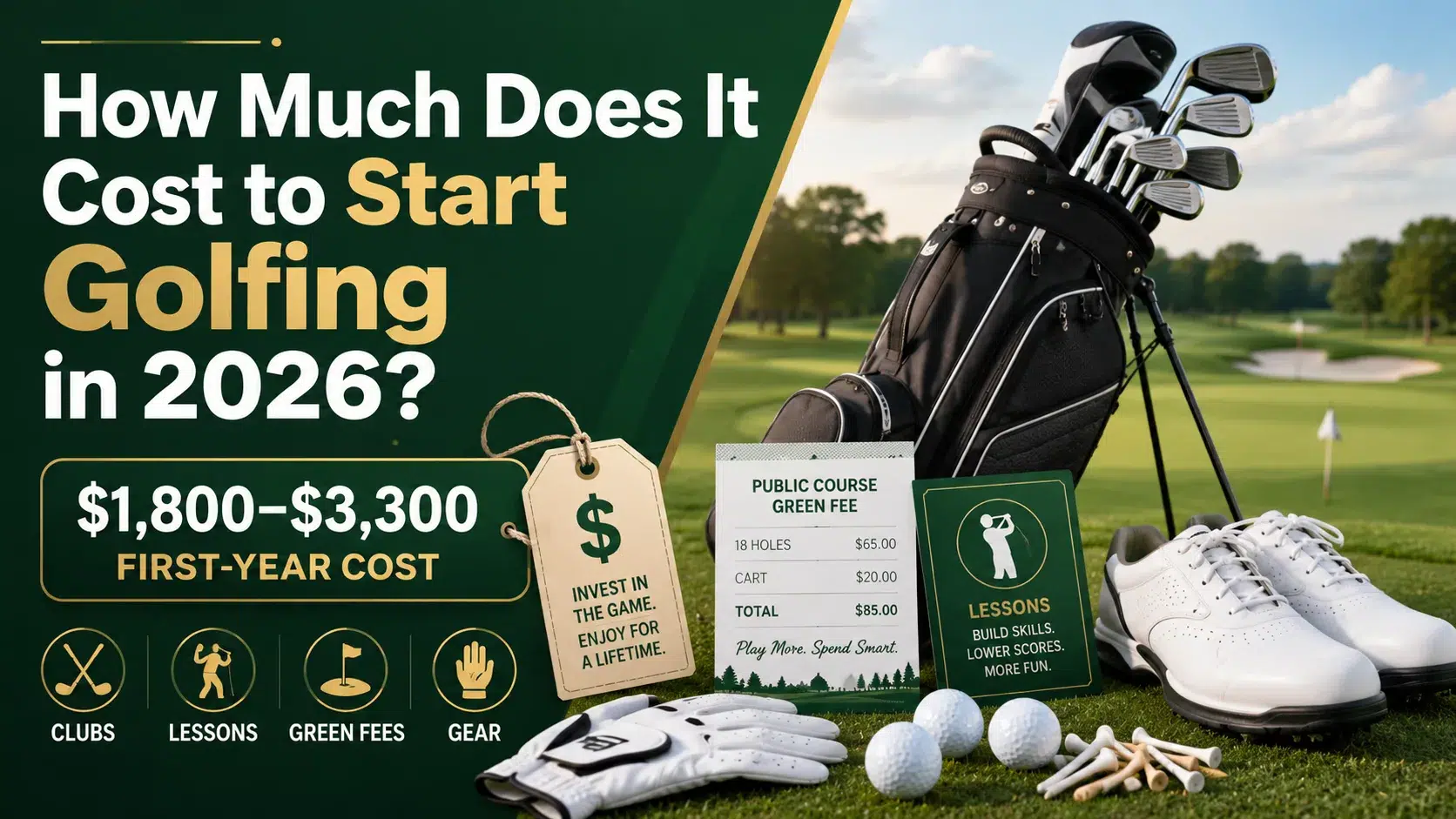
- Starting golf in 2026 costs between $1,800 and $3,300 in your first year — but smart buying decisions can bring that number down significantly.
- Used clubs, public courses, and group lessons are the three biggest levers for cutting your startup costs without sacrificing the experience.
- The PGA’s Get Golf Ready program offers five structured lessons for just $99 — one of the best deals in the sport for beginners.
- Junior golfers can get started for as little as $832, while adults who go the budget route can stay under $1,000 in year one.
- Keep reading to find out exactly where most beginners overspend — and the specific gear, courses, and programs that give you the most for your money.
Golf has a reputation for being expensive, but that reputation is only partly earned — where you start matters more than most people think.
Starting out, your first year of golf can run you anywhere from $850 to over $3,300. The difference usually comes down to three key decisions: where you buy your clubs, where you play, and whether you take group or private lessons. Resources for beginner golfers can help new players make these decisions without blowing their budget before they even figure out how to hold the club.
We’re giving you the real, specific numbers — from beginner golf clubs to green fees to the small, hidden costs that most guides overlook.
Expect to Spend Between $1,800–$3,300 in Your First Year of Golfing (Here’s What You’ll Spend It On)
At first, $1,800–$3,300 may seem like a lot to spend on golf in your first year. But when you break it down, it’s a reasonable amount for an adult who plans to play regularly at public courses, take a few lessons, and invest in a good set of new clubs.
Plus, when you consider that the cost is spread out over 12 months, it’s comparable to what you might spend on other recreational hobbies.
What Makes the Cost Fluctuate?
The primary factor that affects the cost is the equipment. A new mid-range beginner set can cost you between $500 and $700. However, you can also find a used starter set online that might cost you between $150 and $200, which could work just as well for a beginner.
Furthermore, the frequency of your games, whether you use a cart or walk, and the type of course you choose can significantly affect the annual cost.
Breaking Down the First-Year Estimate
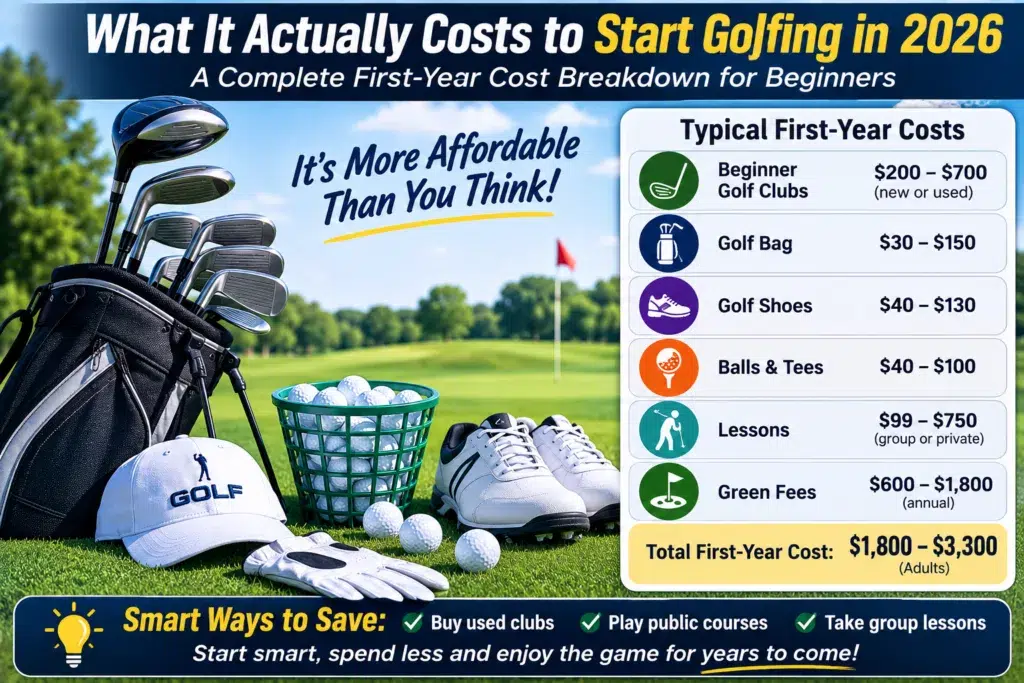
A practical budget for your first year of golfing should include the cost of clubs, a bag, balls, tees, a glove, shoes, green fees for regular rounds, and at least a few lessons. Here’s a quick overview of what these costs usually look like:
| Expense | Budget Option | Mid-Range Option |
|---|---|---|
| Club Set | $150–$300 (used) | $500–$700 (new) |
| Golf Bag | $30–$50 | $80–$150 |
| Golf Shoes | $40–$60 | $80–$130 |
| Balls & Tees | $40–$60 | $60–$100 |
| Lessons | $99 (group program) | $250–$750 (private) |
| Green Fees (annual) | $600–$1,000 | $1,200–$1,800 |
| Total (Est.) | ~$959–$1,569 | ~$2,270–$3,630 |
Beginner Golf Club Sets: What You’ll Actually Pay
Clubs are the first purchase most beginners think about, and they’re also where it’s easiest to overspend or underspend. A set that’s too cheap will frustrate you; one that’s too advanced will do the same. The good news is that the sweet spot for beginners is well-defined and genuinely affordable.
What to Expect from Budget Sets ($200–$300)
For this amount, you can typically find complete sets that include a driver, fairway wood, a couple of irons, a wedge, and a putter — basically everything you need to play a full round. Brands such as Wilson and Callaway offer beginner-friendly complete sets in this price range that are quite good for a beginner who is still learning the basic swing mechanics.
You shouldn’t expect top-tier feel or distance optimization, but you should expect a playable, functional set that will last through your learning phase.
One popular choice in this tier that often makes the beginner recommendation lists is the Callaway Strata Ultimate Set. This set comes with 16 clubs and a stand bag, so you don’t have to worry about buying individual clubs separately.
Mid-Range Sets ($300–$700): The Ideal Choice for Most Beginners
Investing $400–$600 in a new beginner set will provide you with noticeably superior club construction, more forgiving club heads, and enhanced consistency on off-center hits — which, as a beginner, will be most of your hits. This is the range where most golfers who intend to stick with the sport long-term find the best balance between investment and performance.
Sets from Cleveland, Adams, and TaylorMade in this range provide real quality without entering the realm where the clubs are better than your swing can take advantage of.
How Purchasing Pre-Owned Clubs Can Halve Your Expenses
Pre-owned clubs are an often neglected money-saving strategy for beginner golfers. A kit that initially sold for $500-$600 can be found on sites like Golf Avenue, eBay, or even Facebook Marketplace for $150-$250 in good shape.
This is a reasonable move for a beginner who is unsure whether golf will become a regular pastime — you get the right gear without a big financial investment upfront.
You can find used clubs at your local thrift store or golf-specific resale shops, and many golf retailers offer certified pre-owned options with basic quality checks already done.
The only real downside to buying used as a beginner is that you won’t have the experience yet to evaluate club condition carefully — so sticking to reputable resellers or asking a more experienced golfer to look things over before you buy is worth doing.
Junior Sets Are More Affordable: $72–$249 for Beginners
Parents who want their kids to try golf will be relieved to know that junior club sets are much more affordable than adult sets. Good-quality junior sets can be bought for $72–$249 from brands such as US Kids Golf, which designs clubs based on height instead of age — a much more practical method for growing kids.
With this price range, junior sets come with suitably sized clubs that make it easier for kids to hit the ball properly and actually have fun while learning.
It’s important to remember that kids grow fast. So, it’s a good idea to buy cheaper golf sets and replace them as necessary. It’s not as smart to buy a high-end junior set that your child might outgrow in a year or two.
Costs of Green Fees, Memberships, and Range
Once you’ve got your gear, the most significant recurring expense for many new golfers is the green fees. The amount you’ll need to shell out per round is largely determined by where you decide to play and what time you arrive.
Expect to Pay Around $40–$50 Per Round at Public Courses
If you’re just starting out, municipal and public golf courses are a great place to begin, with typical 18-hole green fees costing $40–$50 at most places. This is the simplest method to get a game in without having to buy a membership.
Some public courses in areas with a lower cost of living are even less expensive — you can play a 9-hole round for as little as $15–$25 — making them perfect for beginners who want to get some real course practice without the stress or expense of a full round.
Playing During the Week and at Twilight Can Save You Money
One simple way to reduce the cost of green fees is to change when you play. Tee times during the week are usually less expensive than weekend slots, sometimes by $10–$20 per round. Twilight rates — generally tee times in the late afternoon when courses are trying to fill up remaining slots — can lower prices by 30–40% compared to peak morning rates.
If you’re a novice golfer who plays once a week, you could save $600-$800 in green fees over the course of a year by opting for weekday twilight tee times instead of weekend mornings. That’s not chump change – you could buy a full set of mid-range clubs with the money you save by simply tweaking your schedule.
Per-Round Costs Can Be Reduced to $19–$25 with Monthly Memberships
Monthly or annual membership programs are offered by some public and semi-private courses, and they can significantly reduce what you pay per round. For example, a membership at a municipal course can reduce weekday rounds to as low as $19 and weekend rounds to around $25. This is a significant saving for anyone who plays more than once or twice a month.
Before you start your first season, it’s worth calculating whether a membership or pay-as-you-go green fees will be more cost-effective if you’re planning on playing regularly throughout the year.
A golfer who plays twice a week at a cost of $45 per round will spend about $3,600 on green fees alone in a year. A municipal membership at many courses reduces that amount by over half. Most memberships reach the break-even point at around 20–25 rounds per year.
The Price Tag of Golf Lessons: Group or Private?
Many newbies to golf either totally ignore or splurge too much on lessons. Ignoring them is not a good idea because it’s a lot harder to correct bad habits than to learn the right way from the beginning. However, it’s not always necessary to pay for private lessons right away, especially when structured group lessons can teach you the basics for a lot less money.
Lesson Cost Comparison at a Glance:
📌 PGA Get Golf Ready (Group) — 5 lessons for $99
📌 Group Lessons (General) — $20–$50 per session
📌 The First Tee Program — seasonal programs around $120
📌 Private Lessons — $50–$150 per hour
📌 Golf Academy Programs — $200–$500+ for multi-day formats
The right choice depends on how seriously you want to take the game and how quickly you want to improve. For most beginners, starting with a structured group program and then transitioning to private lessons once you have the basics down is the most cost-efficient path.
Group lessons also offer a great social benefit — you’re learning with other beginners, which can make the process less daunting and often more fun. When you’re new and finding golf difficult, it can feel like you’re on your own, and being in a group setting can make the early stages of learning feel more normal.
Private lessons really start to pay off once you’ve developed a basic swing and can identify particular problems you’d like to correct. A skilled teacher working with a student who has clear, defined problems will make much more progress per lesson than one trying to build everything from the ground up at $100 per hour.
PGA’s Get Golf Ready Program: 5 Lessons for $99
The PGA’s Get Golf Ready program is an excellent starting point for structured golf instruction. For $99, adult beginners receive five group lessons from a PGA Professional, covering grip, stance, swing basics, chipping, and putting — basically everything you need to function on a real golf course.
The program is designed specifically for adults who have never played before, so there’s no assumed knowledge and no pressure.
There are golf courses all over the nation, so no matter where you live, you can find a place to play. For a beginner who wants to keep their first-year costs down, investing $99 in lessons is one of the smartest choices you can make. It’s a much better decision than buying expensive clubs before you’ve even learned how to swing consistently.
One-on-One Lessons Cost Between $50 and $150 Per Hour
The cost of private golf lessons generally ranges from $50 to $150 per hour. The price can vary based on factors such as the instructor’s qualifications, the facility, and where you live.
For example, a PGA-certified instructor at a highly rated club in a big city will likely charge towards the higher end of the range, while a certified local pro at a city-owned course might charge between $50 and $70 per lesson.
Most golf newcomers will need between 5 and 10 lessons to develop a reliable, consistent swing. At an average rate of $75 per lesson, that’s $375–$750 for a basic instruction series. This is a significant part of the first-year budget, but it’s an investment that will pay off in the form of quicker improvement and fewer bad habits to correct later on.
It’s a good idea to book a single session with an instructor before committing to a series of private lessons. This gives you the chance to evaluate their teaching style and communication. It’s important to remember that not every instructor will be a good fit for every student. Finding the right fit is more important than finding the cheapest rate.
- Find out if the instructor records your swing, as video feedback can significantly speed up your progress.
- Seek out instructors who specialize in teaching beginners rather than competitive players.
- Make sure to ask whether the lesson fee includes range balls or if you’ll have to pay extra for them.
- See if the course offers lesson packages at a reduced rate per session.
- Consider instructors who are affiliated with the PGA or LPGA to ensure they have verified teaching credentials.
For most beginners, one session per week is enough. This gives you time to practice between lessons, which can make each subsequent session more productive and help you get more out of your instruction budget.
Small Expenses That Quickly Accumulate
While equipment and green fees are often the most prominent items in a beginner golfer’s budget, it’s the smaller, more frequent costs that can quietly push your spending over the limit. Items like balls, gloves, tees, and cart rentals are often overlooked in the budgeting phase, but together, they can add an additional $300–$500 to your first-year total before you even realize it.
Beginner golfers tend to lose more balls than seasoned players, often several in a single round, especially on courses with water hazards or dense rough. Those losses can add up quickly when you’re buying premium balls.
It’s a sensible strategy to start with more affordable options and save the better balls for when you’ve improved your game, a strategy that most experienced golfers would endorse.
Golf Balls: $40–$50 for a 24-pack
For a beginner-friendly 24-pack of golf balls — such as Titleist TruFeel or Callaway Supersoft — you’re looking at around $40–$50. As a novice, it’s more cost-effective to buy in bulk at a reasonable price than to shell out $50 for a dozen Pro V1s that will likely end up in a water hazard by the fourth hole.
Another option is to go for recycled or refurbished balls, which usually go for $20–$30 per dozen and perform just as well at a beginner level.
Essential Accessories: Gloves, Tees, and Bags
When it comes to golf gloves, you can expect to spend around $10–$20 per glove. The lifespan of a glove can vary, but generally, you’ll need a new one every 15–20 rounds. As a beginner, you’ll probably go through two or three gloves in your first season.
It’s not a huge expense, but it’s something to keep in mind. Tees are a minor expense, usually costing $3–$5 for a large pack. Plus, many golf courses provide free tees at the first hole.
You can get a decent stand bag for $30-$50 that does everything a beginner needs. It has organized club storage, a stand that keeps the bag upright on the course, and enough pockets for balls, a glove, tees, and a water bottle. There’s no need to spend more on a bag at the beginning; you can upgrade later when you know exactly what features are important to you.
It’s worth investing a bit more than the absolute minimum in golf shoes, which are the one non-club piece of equipment that can make a difference.
Golf shoes with soft spikes provide the traction and lateral stability that directly affects the consistency of your swing. FootJoy or Skechers Golf offer entry-level options starting at around $60–$80, which are more than adequate for your first year of play.
Renting a Cart or Walking the Course
Expect to pay an additional $15–$20 per round for a cart rental, which can add up to an extra $500–$800 per year for a regular golfer. If you choose to walk the course instead, not only will you save money, but you’ll also get some exercise in the process.
Most public courses that cater to beginners are walkable, and carrying or pushing a lightweight bag on a stand is entirely doable. Plus, walking is a traditional part of golf that’s worth getting used to early on.
How to Start Golfing Without Breaking the Bank
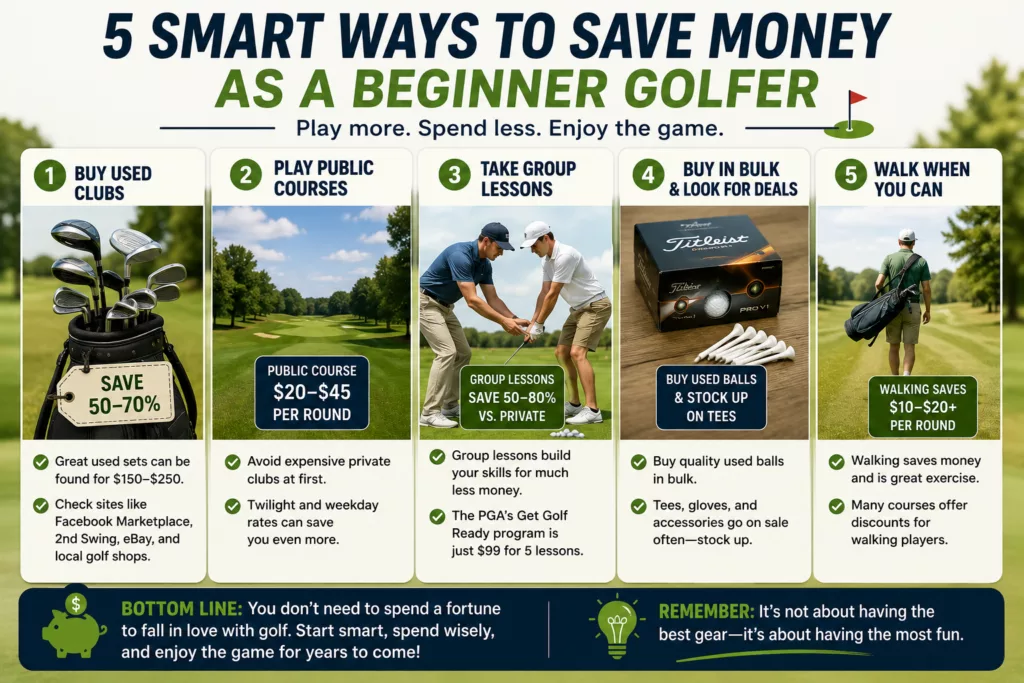
You don’t need to empty your savings account to start golfing — you just need to be smart about it. The golfers who spend the least in their first year are usually the ones who didn’t rush out to buy top-of-the-line gear before they needed it, picked affordable courses instead of the most prestigious ones, and opted for group lessons instead of private coaching from the start.
1. Purchase Secondhand Clubs From Internet Marketplaces or Thrift Stores
Websites like Golf Avenue, eBay, Facebook Marketplace, and even your local Goodwill stores often have secondhand clubs in great condition. A complete set that initially sold for $500 can often be found for $150–$200 secondhand, and for a novice still honing their swing, the performance difference is negligible.
The money you save here can go straight toward more games, more lessons, or simply keeping your first-year expenses under control.
For those who are hesitant about buying used items online, you can decrease your risk by choosing sellers who provide detailed photos and return policies.
Golf-specific resale platforms like 2nd Swing Golf also offer condition ratings and some form of quality assurance, which gives beginners more confidence in what they’re purchasing without needing expert knowledge of club construction.
2. Try Public Courses Before Private Clubs
Private club memberships can cost anywhere from $1,500 to over $5,000 per year. This is a lot of money to spend if you’re not sure you’ll enjoy golf in the long run. Public and municipal courses offer the same basic experience – fairways, greens, bunkers, and the satisfaction of finishing a full round – at a much lower cost.
This is where most golfers of all skill levels play on a regular basis.
3. Choose to Walk Instead of Renting a Golf Cart
One of the easiest ways to reduce the ongoing costs of golf is to forgo the golf cart. With rentals costing between $15 and $20 per game, the costs can add up to hundreds of dollars over a full season.
Not only does walking save you money, but it also allows you to experience the game at a more natural pace and rhythm. Many seasoned golfers will tell you that this can actually improve your approach to each shot.
4. Start with Group Lessons Before Investing in Private Instruction
Group lessons provide beginners with comprehensive foundational training at a significantly lower cost per session than private coaching. The PGA’s Get Golf Ready program — five lessons for $99 — is the best illustration of this cost-effectiveness.
Master the fundamentals in a group setting first, then spend money on private lessons when you have specific swing issues that warrant paying a professional to address individually.
5. Take Advantage of a Youth on Course Membership for Young Golfers
The Youth on Course initiative is a little-known gem in the world of junior golf. For a mere $25 annually, young members can play on thousands of golf courses throughout North America for a maximum of $5 per round in green fees.
This membership is a great option for parents who want to expose their children to golf without breaking the bank, essentially eliminating the obstacle of green fees.
With a junior club set from US Kids Golf costing between $72-$150 and a few group lessons, a junior golfer can have a full, practical first year of golf for less than $300. That’s an impressive value for a sport that many people believe is not affordable for budget-conscious kids.
Comparing the Start-Up Costs for Juniors and Adults
It’s important to note that there’s a significant difference in cost when it comes to starting golf as an adult compared to introducing a child to the game. Junior equipment is cheaper, junior programs are cheaper, and programs like Youth on Course make green fees almost non-existent. Here’s a direct comparison of what you can realistically expect to pay in your first year, if you’re on a budget:
| Expense | Junior (Budget) | Adult (Budget) |
|---|---|---|
| Club Set | $72–$150 | $150–$300 |
| Lessons | $99–$120 | $99 |
| Green Fees (Annual) | $25–$100 (Youth on Course) | $600–$1,000 |
| Balls, Tees, Glove | $30–$50 | $50–$80 |
| Shoes | $30–$50 | $60–$80 |
| Total (Est.) | $256–$470 | $959–$1,559 |
The numbers make a strong case for introducing kids to golf early — the financial barrier is genuinely low when you use the right programs, and the habits and love for the game built in those early years tend to stick for life.
Why Golf Is Worth Every Penny
Unlike many other sports, golf is a lifelong pursuit. It’s a game that teaches you skills, manners, and mental toughness that will stay with you forever. You can start playing golf at 30 and still be playing — and loving — the game at 70.
Not many sports offer that kind of staying power. When you consider the cost of getting started in golf over the many years you’ll be playing, it’s not much of an investment at all.
Aside from the game itself, golf offers opportunities that few other pastimes can. Business connections are forged on the green, friendships are formed over games, and the blend of outdoor activity, physical exertion, and mental concentration makes it one of the most authentically satisfying ways to spend a few hours.
There is a cost to starting golf — but the returns are just as tangible, and for most people who give the sport a fair shot, it turns out to be one of the best investments they’ve ever made in themselves.
Commonly Asked Questions
Here are the questions that newbies ask the most when they’re trying to determine if golf is within their budget — answered with precise figures instead of vague approximations.
What Is the Least Amount of Money Needed to Start Golfing?
The bare minimum to begin is approximately $500–$600 for an adult. This includes a used set of clubs ($150–$200), a basic bag ($30–$50), balls and tees ($40–$60), a beginner pair of golf shoes ($60), the PGA Get Golf Ready group lesson program ($99), and a few rounds at a public municipal course.
It’s a tight budget, but it’s honestly enough to start playing real golf on a real course and figure out if the sport is for you.
Should Beginners Buy New or Used Golf Clubs?
For those just starting out, used clubs are typically the most cost-effective option. A set that was originally priced at $500-$600 can be found in good condition for $150-$250 on websites like Golf Avenue, 2nd Swing Golf, or Facebook Marketplace. At a beginner level, the difference in performance is negligible – it’s more about your swing technique than the club technology.
The only time you should consider buying new clubs as a beginner is if you find a great deal on a new beginner set like the Wilson Profile SGI or Callaway Strata series. They often go on sale and can compete with used club prices. In these cases, buying new with a warranty is a smart choice. But in general, start with used clubs and upgrade later.
What is the Cost of Golf Lessons for an Absolute Novice?
The cost of golf lessons for novices can vary greatly, starting at $99 for a structured five-lesson group course (PGA Get Golf Ready) and going up to $50–$150 per hour for private one-on-one instruction.
Most novices will need between 5 and 10 lessons to get a functional swing, which means the total cost of instruction can range from $99 to $1,500 depending on the type of course you choose. For most new golfers, the most cost-effective way to learn is to start with a group course and then move on to private lessons once you’ve mastered the basics.
What is the Price of a Round of Golf at a Public Course?
Usually, a standard 18-hole round at a public or municipal golf course will set you back $40–$50. If you opt for a nine-hole round, you can expect to pay about half of that, or $20–$25.
This is a great, affordable option for beginners who are still working on their stamina and focus. If you choose to golf during the week or during twilight hours, you can save 20–40% on fees. This can lead to substantial savings over a full season of regular play.
Is it Possible to Begin Golfing for Less Than $1,000?
Absolutely — and for the majority of newcomers, keeping the first year’s expenses under $1,000 is entirely feasible with a few wise decisions. The four strategies that make this possible are purchasing used clubs, playing on public courses, taking group lessons, and choosing to walk instead of renting a cart.
An adult golfer who adopts this strategy and plays once or twice a week can realistically keep their total spending for the first year between $850 and $1,200 without compromising the quality of their golfing experience.
It’s important to resist the temptation to invest in top-of-the-line equipment before you’ve developed your skills. A $1,500 driver won’t improve a swing that’s still a work in progress.
However, $99 spent on structured group lessons can immediately improve your game. Focus your initial budget on what will help you improve most quickly, and upgrade your equipment as your skills improve.
Despite what you may have heard, golf isn’t as exclusive or costly as it seems. You just need to approach it the right way. Check out these resources and advice for golf beginners to get started on the green with a solid game plan and newfound self-assuredness.
Related Post

Best Affordable Golf Courses in Texas: Top Budget-Friendly Options for Every Golfer
Texas has a surprisingly wide range of quality golf courses that won’t empty your pockets. [...]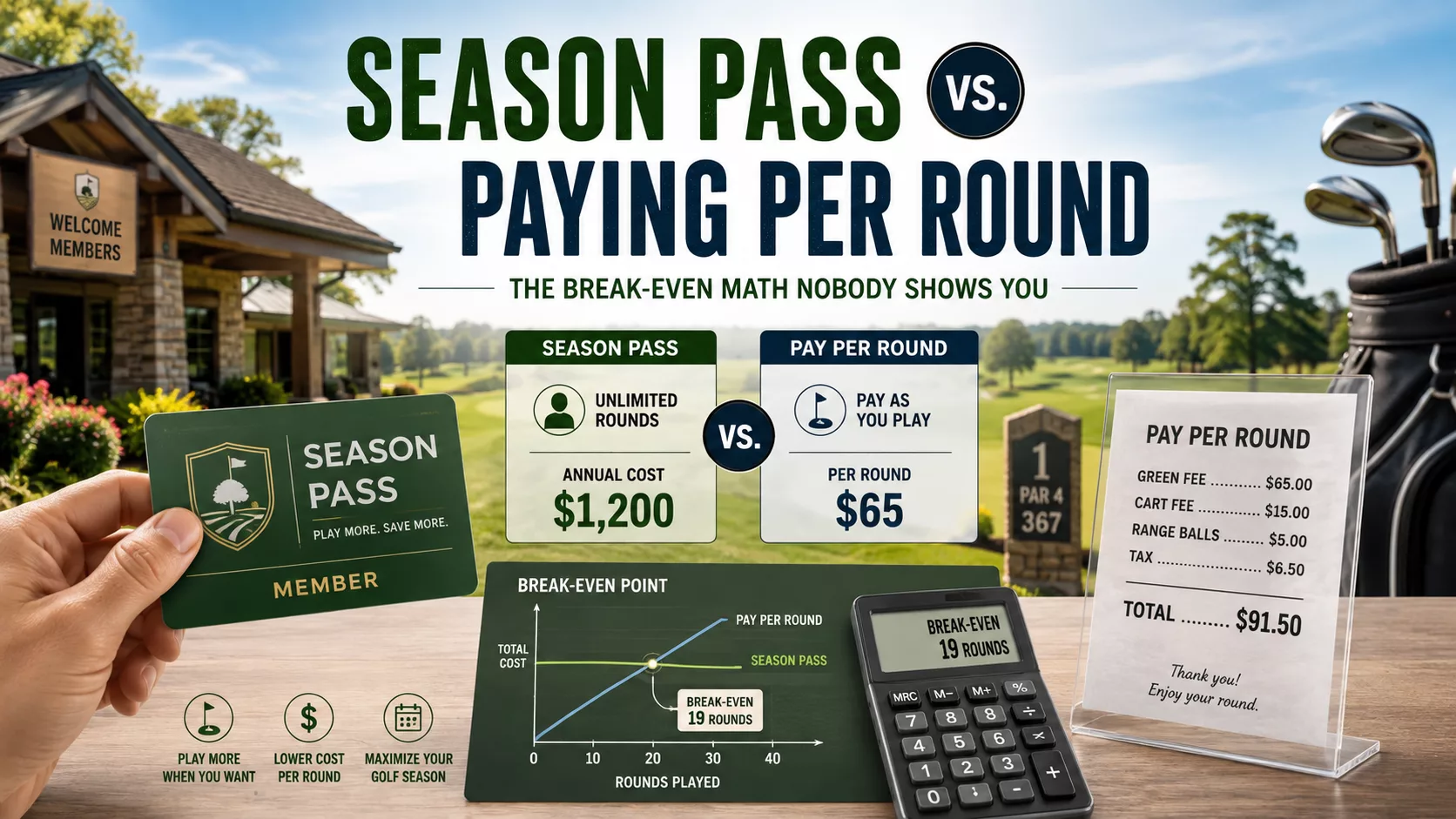
Golf Season Pass vs. Pay Per Round: The Break-Even Math
Season Pass vs. Paying Per Round: The Break-Even Math Nobody Shows You A public course [...]