This website uses cookies to improve your experience. We\'ll assume you\'re ok with this, but you can opt-out if you wish. Read More
Golf Season Pass vs. Pay Per Round: The Break-Even Math
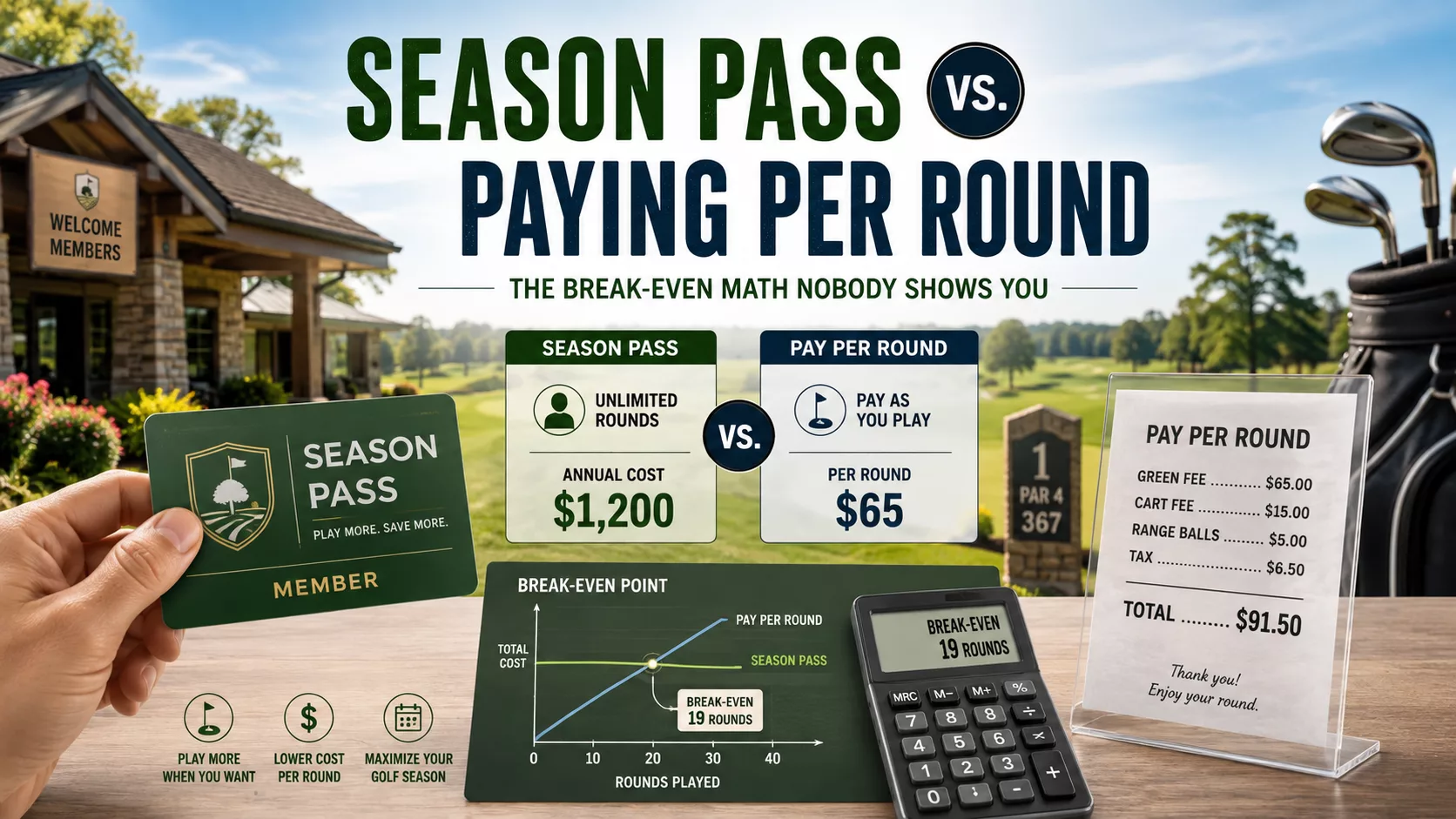
Season Pass vs. Paying Per Round: The Break-Even Math Nobody Shows You
A public course season pass pays for itself at a specific, calculable number of rounds — and almost nobody runs the number before buying. The pro shop quotes you $1,400, you think “well, I play a lot,” and you either save $900 or donate $600 to the parks department depending on facts you never checked.
The math takes ninety seconds. Here it is, along with the seven fine-print questions that turn a good pass into a bad one.
The Formula
Break-even rounds = Pass price ÷ (Your typical per-round rate − Any per-round costs still charged to passholders)
That second term in the denominator is where most golfers go wrong. Many passes still charge for carts, and some charge a small per-round fee even for passholders. If your pass doesn’t include a cart and you always ride, your real savings per round is the green fee only — not the green fee plus cart.
Worked example: A $1,400 weekday pass. You normally pay $34 to walk 18 on weekdays. Break-even = 1,400 ÷ 34 = 42 rounds. Play 60 rounds and you’ve saved about $640. Play 30 and you’ve lost $380.
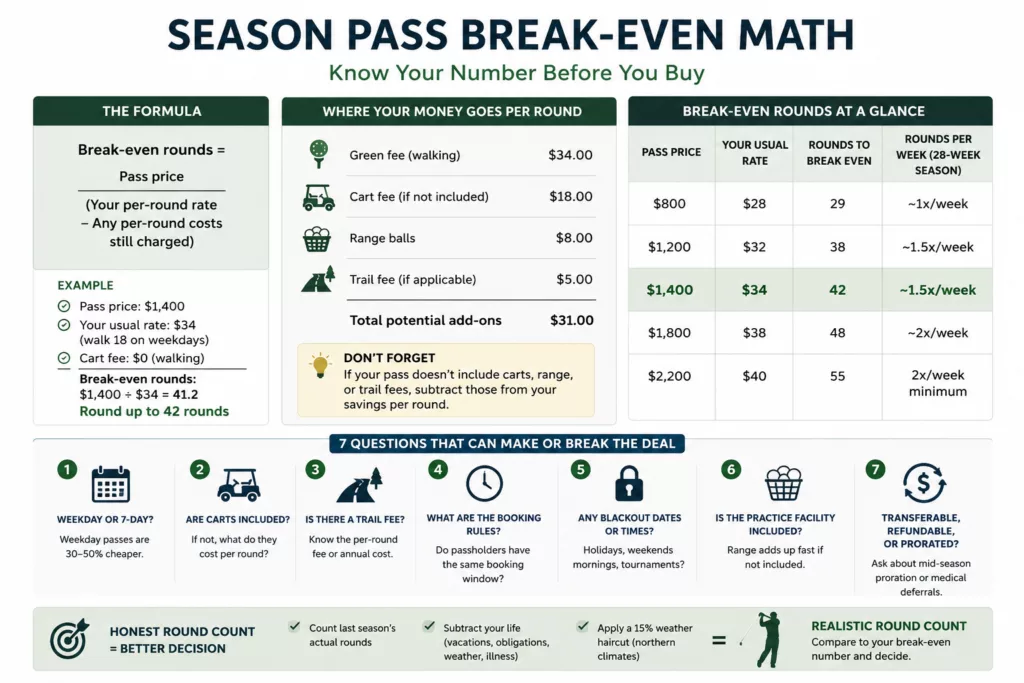
Break-Even at a Glance
| Pass Price | Your Usual Rate | Rounds to Break Even | Verdict for a 28-Week Season |
|---|---|---|---|
| $800 | $28 | 29 rounds | Pays off at ~1x/week |
| $1,200 | $32 | 38 rounds | Pays off at ~1.5x/week |
| $1,400 | $34 | 42 rounds | Pays off at ~1.5x/week |
| $1,800 | $38 | 48 rounds | Needs ~2x/week |
| $2,200 | $40 | 55 rounds | Needs 2x/week minimum |
Northern-climate golfers: your season is roughly 26–30 playable weeks (April through October), and weather will erase some of them. Build in a 15% weather haircut on your honest estimate.
Be Honest About Your Round Count
This is where the math breaks down — not in the arithmetic, in the input. Golfers overestimate future play by a wide margin, because we budget for the season we imagine rather than the one we’ve historically had.
Three ways to get a real number:
- Count last season’s actual rounds. Check your scorecards, your GPS app history, or your bank statements. That number, not your ambition, is your input.
- Subtract your life. Vacations, family obligations, weather washouts, the two weeks you were sick. A “three times a week” golfer usually lands near twice a week in practice.
- Use the 15% weather haircut on top, in northern markets.
If your honest number lands within about 10 rounds of break-even, buy the pass anyway for a different reason: passes change behavior. When rounds feel free, you play the Tuesday twilight nine you’d otherwise skip — which is both more golf and faster improvement.
The 7 Questions to Ask Before You Buy
Run every pass through these. Any one of them can flip the math:
1. Is it weekday-only or 7-day? Weekday passes run 30–50% cheaper. If you work Monday–Friday, a weekday pass is a trap no matter how attractive the price.
2. Are carts included, and if not, what do they cost? A pass with $18 carts and you riding 50 rounds means $900 in fees the pass never covered. This is the single most common miscalculation.
3. Is there a trail fee? If you own a cart, courses often charge $5–10 per round to use it, or an annual trail fee. Ask which, and add it to the pass price.
4. What are the booking rules for passholders? Some courses restrict passholders to booking 2–3 days out while the public books 7–14 days out. If you can’t get the times you want, the pass is worth less than its price. Ask directly: “Do passholders have the same booking window as the general public?”
5. Are there blackout dates or times? Holidays, weekend mornings before a cutoff, and tournament days are common exclusions.
6. Does it include the practice facility? Range balls at $8–12 a bucket add up fast. Some passes include unlimited range, which can be worth several hundred dollars on its own.
7. Is it transferable, refundable, or prorated? Almost never refundable. But ask about proration if you buy mid-season, and about medical deferrals — many courses will credit a season lost to surgery if you ask before the season ends, not after.
Where Passes Are Cheapest
Municipal and county courses offer the most affordable season passes by a wide margin, often with an additional resident discount that non-residents don’t get.
If you live in the municipality, that’s frequently a few hundred dollars off the sticker. Our guide to judging municipal course quality covers how to make sure the course you’re committing a whole season to is one you’ll actually enjoy playing 40 times.
Also worth asking about at munis: senior and junior pass rates, which are commonly 20–35% below the standard adult price and are among the best values in public golf.
The Hidden Cost of a Pass (And the Hidden Benefit)
The hidden cost: a pass narrows your golf. You’ll play one course 40 times instead of eight courses five times each, because every round elsewhere now feels like paying twice. If variety is part of why you love the game, price that in honestly.
The hidden benefit: it kills the twilight calculation. Right now you weigh whether a late-afternoon nine is worth $22. With a pass, you just go — and twilight rounds become the easiest golf on your calendar rather than a spending decision. Passholders reliably report playing more short, casual rounds, which is exactly the kind of golf that improves your scoring.
Who Shouldn’t Buy a Pass
- Anyone playing under 25 rounds a season. Pay per round and use twilight and last-minute discounts instead…or look at a local discount card, which suits variety-players better than a pass does
- Weekend-only golfers looking at weekday passes. Obvious in writing, easy to rationalize in a pro shop.
- Golfers new to the game. Your first season should sample many courses and formats — par 3s, executive courses, 9-hole rounds. Our real-numbers guide to starting golf breaks down what that first season actually costs, and a pass isn’t in it.
- Anyone whose home course is over 25 minutes away. Drive time silently reduces your round count, and your break-even was calculated on rounds you won’t play.
The Bottom Line
Divide the pass price by your real per-round cost, subtract anything the pass doesn’t cover, and compare that break-even number to your honest round count from last season — not your optimistic one for next season. Then run the seven questions, because carts, booking windows, and weekday restrictions flip more of these decisions than the sticker price does.
Get within 10 rounds of break-even and the pass is worth it for the behavior change alone. Fall well short and you’ve bought a very expensive way to play the same golf you were already playing.
Frequently Asked Questions
How many rounds does it take for a golf season pass to pay off? Divide the pass price by your typical per-round rate, subtracting any costs still charged to passholders such as carts. A $1,400 pass against a $34 walking rate breaks even at about 42 rounds. Most public passes break even somewhere between 29 and 55 rounds depending on price and your usual rate.
Is a golf season pass worth it? It’s worth it if your honest round count from last season exceeds the break-even number, or comes within about 10 rounds of it, since passes tend to increase how often you play. It’s not worth it for golfers playing under 25 rounds a season, weekend-only golfers considering weekday passes, or beginners who benefit from sampling different courses.
How much does a public golf course season pass cost? Public and municipal season passes commonly range from about $800 to $2,200 depending on the market, the course, and whether the pass covers weekdays only or all seven days. Municipal courses are typically cheapest, often with additional resident, senior, and junior discounts.
What should you ask before buying a golf season pass? Ask whether it’s weekday-only or 7-day, whether carts are included and what they cost if not, whether trail fees apply to personal carts, whether passholders have the same booking window as the public, what blackout dates apply, whether the practice range is included, and whether the pass can be prorated or deferred.
Are weekday-only golf passes a good deal? Weekday passes run 30 to 50 percent cheaper than full passes and are excellent value for retirees, shift workers, and anyone with weekday flexibility. They’re a poor choice for golfers working a standard Monday-to-Friday schedule, since the restricted access eliminates most of the rounds they’d actually play.
Related Post

Best Draw Bias Drivers 2026: Ranked and Reviewed for High Handicappers
Quick answer: The best draw bias drivers for high handicappers in 2026 are the Ping [...]
Golf Equipment Checklist for Complete Beginners Under $300
Last Updated: Julyy 21, 2025 Starting your golf journey doesn’t have to break the bank. [...]