This website uses cookies to improve your experience. We\'ll assume you\'re ok with this, but you can opt-out if you wish. Read More
Counter-Slice Keel Technology Explained: How Heel Weighting Actually Works
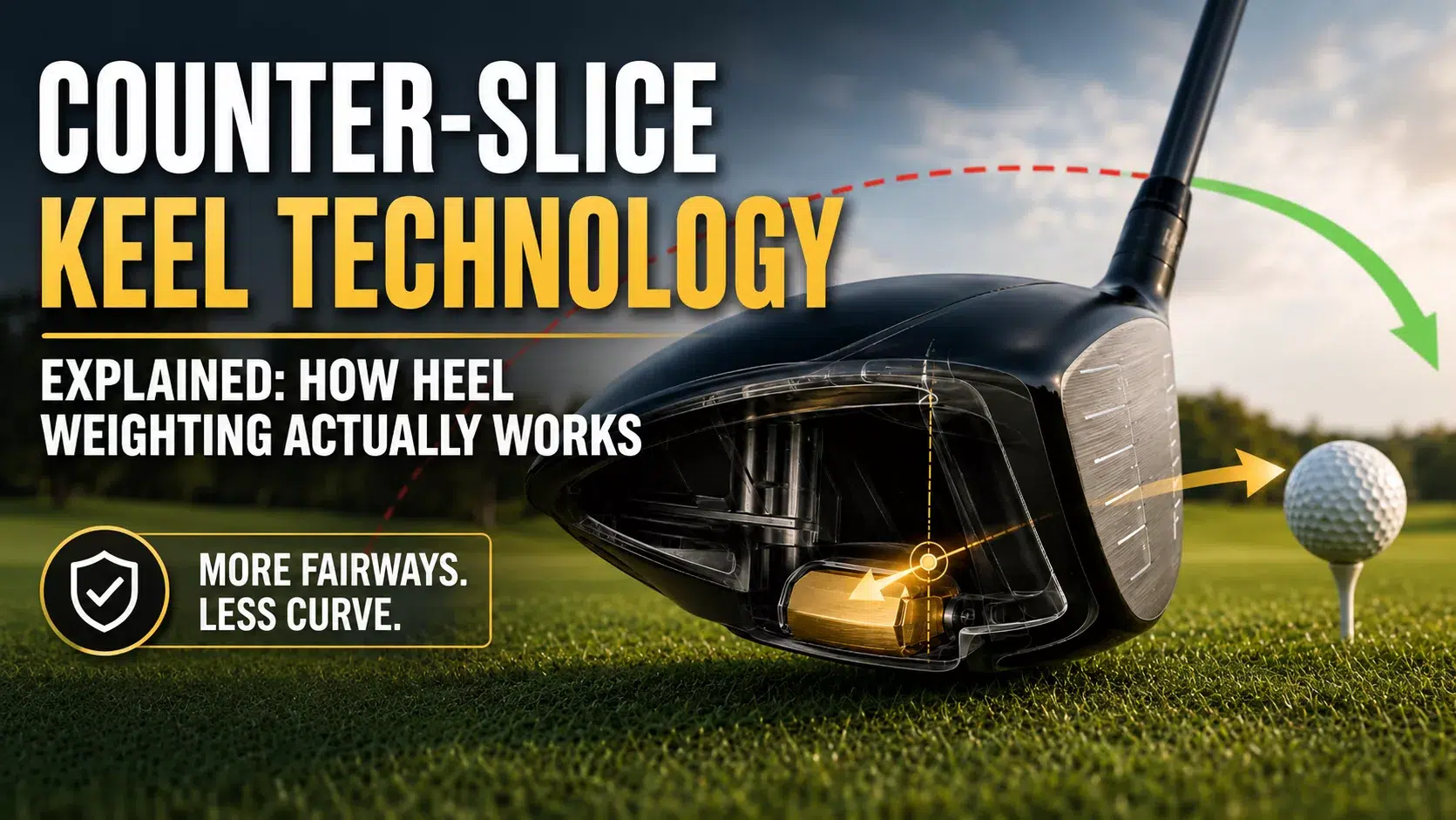
Quick answer: The Counter-Slice Keel is the internal heel weighting system built into the Performance Golf SF2 driver.
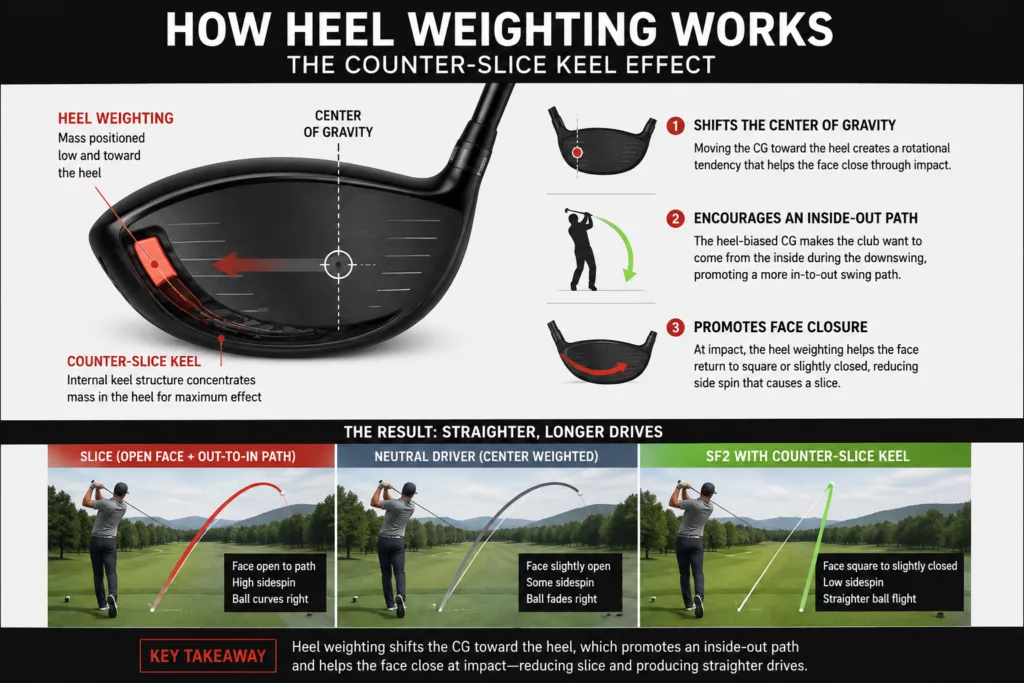
It works by shifting the center of gravity (CG) toward the heel of the clubhead, which does two things simultaneously: it promotes a more inside-out club path through the impact zone, and it makes the face more likely to be square or slightly closed at the moment of contact.
Combined with the SF2’s 3° closed face angle, the Counter-Slice Keel creates a dual-mechanism correction system that addresses both face angle and swing path — the two variables that cause a slice. This article explains the physics behind heel weighting, how it differs from other draw-bias approaches, and what it actually does to your ball flight.
Why Understanding This Technology Matters Before You Buy
Most golfers shopping for a draw-bias driver read the word “heel weighting” in a product description and nod along without fully understanding what it means mechanically. That’s understandable — golf equipment marketing tends toward vague claims rather than engineering explanations.
But understanding what heel weighting actually does — and doesn’t do — helps you evaluate whether the SF2‘s specific approach matches your specific slice problem. Not all heel weighting is equal, and not all slices respond to it the same way.
Center of Gravity: The Foundation of the Concept
To understand the Counter-Slice Keel, you first need to understand what center of gravity (CG) does in a golf driver.
The CG is the point inside the clubhead where the total mass of the head is effectively balanced. When the ball strikes the face, the clubhead reacts by rotating around the CG — not around the face, and not around the hosel. The location of the CG determines how the head rotates at impact and what kind of spin the ball receives.
CG positioned toward the center of the face: The head rotates relatively neutrally at impact. Ball flight is neutral — no particular draw or fade bias from the head geometry itself.
CG positioned toward the heel: The head is weighted so that when the face strikes the ball, the heel-side mass creates a rotational tendency that closes the face through impact. This is the mechanical basis of all heel-weighted, draw-bias driver design — including the Counter-Slice Keel.
CG positioned toward the toe: The opposite effect — the head tends to rotate open through impact, producing a fade or slice bias. Most beginner drivers avoid this configuration deliberately.
The Counter-Slice Keel shifts the SF2’s CG toward the heel more aggressively than a mild draw-bias OEM driver, which is why its correction effect is described as more targeted toward severe slicers.
What “Keel” Means in the Counter-Slice Keel Design
The word “keel” in the Counter-Slice Keel name is descriptive of the physical shape of the internal weighting structure. Just as a ship’s keel runs along the bottom centerline of the hull to provide directional stability, the Counter-Slice Keel is a structural weight element running along the heel-bottom portion of the SF2’s interior.
This keel-shaped structure achieves two engineering goals simultaneously:
1. Mass concentration: By shaping the internal weight as a continuous structural element rather than discrete weight ports, Performance Golf concentrates mass precisely where it has the most influence on CG position — deep in the heel, as low as possible in the head, and as far from the face as structurally achievable.
2. Structural integrity: The keel design distributes the weight in a way that maintains the structural integrity of the 445cc titanium head while concentrating the corrective mass as aggressively as the design allows.
This is the engineering reason the SF2 uses a 445cc rather than 460cc head — the smaller footprint allows the keel structure to position mass with more precision relative to the total head volume than a larger 460cc shell would allow.
How Heel Weighting Affects Your Swing Path
This is the most counterintuitive part of how draw-bias CG positioning works, and it’s worth explaining carefully because most golfers assume the heel weighting only affects what happens at impact rather than during the swing.
When a driver has a heel-biased CG, the weight distribution affects the club’s moment of inertia around the shaft axis during the swing — not just at impact. Specifically:
The heel-biased CG makes the head want to rotate closed during the downswing. As you swing the club down, the heavier heel side of the head creates a slight rotational tendency toward a more closed face position.
Your hands and arms naturally respond to this tendency by swinging slightly more from the inside — producing a more inside-out path — because that path is the one that feels most natural with a heel-heavy head.
This is subtle but real. Experienced club fitters and teaching professionals who have worked with draw-bias equipment consistently note that golfers swing with a slightly more inside-out path with heel-weighted clubs than with neutral or toe-weighted clubs, even when consciously trying to maintain the same swing.
The practical effect: The Counter-Slice Keel is doing two jobs at once — correcting the face angle at impact AND subtly encouraging a better swing path during the swing. This is why Performance Golf’s “Slice-Fix SpeedTech” system is described as addressing multiple components of the slice simultaneously rather than just flipping the face closed at address.
Heel Weighting vs Closed Face Angle: What’s the Difference?
The SF2 uses both heel weighting (Counter-Slice Keel) and a closed face angle (3°). Understanding what each does separately helps explain why combining them is more effective than either alone.
Closed face angle (3°): This is a static correction — the face is simply set pointing slightly left of target at address. At impact, even if the face rotates open slightly during the swing, it arrives closer to square because it started closed. This directly reduces the open face condition that creates sidespin.
Heel weighting (Counter-Slice Keel): This is a dynamic correction — it influences the club’s behavior during the swing rather than just at address. It promotes a more inside-out path and encourages natural face closure through the impact zone. It’s working throughout your downswing, not just at the moment the ball leaves the face.
Combined effect: The 3° closed face provides a guaranteed baseline correction regardless of swing — even if the golfer does nothing differently, the face arrives slightly more closed than a neutral driver.
The Counter-Slice Keel adds a dynamic correction that works with the golfer’s natural swing tendencies to reinforce the path and face angle improvements the static correction started.
This dual-mechanism approach is why the SF2 is described as more aggressively corrective than draw-bias drivers that use only one of these mechanisms — they’re addressing the face angle problem from two different directions simultaneously.
How the Counter-Slice Keel Compares to Other Heel Weighting Approaches
Not all heel weighting is built the same, and comparing the Counter-Slice Keel to other approaches on the market clarifies what makes it distinctive.
Ping Straight Flight Technology (SFT): Ping’s draw-bias approach uses a combination of heel weighting through mass redistribution enabled by their Dragonfly crown technology, which removes weight from the crown and repositions it toward the heel and sole.
The correction is engineered and precise but calibrated for mild-to-moderate slice correction within a 460cc maximum-MOI framework. Less aggressive than the Counter-Slice Keel by design — Ping is targeting a broader range of golfers including those who only slightly fade the ball.
TaylorMade SuperFast 2.0 Draw Edition: The Draw Edition uses internal heel weighting similar in concept to the Counter-Slice Keel but without the combined closed face angle. It’s a single-mechanism correction rather than the dual-mechanism SF2 approach, which makes it less aggressive for severe slicers but also less likely to overcorrect for moderate slicers.
Callaway Paradym Draw / TaylorMade Qi10 Max D-Type: Both use heel-biased CG repositioning enabled by advanced crown materials (Triaxial Carbon for Callaway, similar for TaylorMade) that free mass from the crown and redistribute it for draw bias. These are sophisticated, multi-technology approaches within 460cc frames.
The correction is meaningful but calibrated for the broader market rather than specifically targeting severe slicers.
The Counter-Slice Keel distinction: Performance Golf’s approach is the most aggressively targeted heel weighting on this list, combined with the closed face angle as a second mechanism, within a 445cc head that allows more precise mass positioning than a 460cc frame.
This is why it’s the choice recommended most specifically for severe, consistent slicers rather than mild-to-moderate ones.
What the Counter-Slice Keel Cannot Do
Honest evaluation of any technology requires clarity about its limits, not just its capabilities.
It cannot fix a swing path problem on its own. The Counter-Slice Keel subtly encourages a more inside-out path, but it cannot fully correct a severely out-to-in path if that path is deeply ingrained in the golfer’s mechanics.
A golfer who comes dramatically over the top on every swing will see some path improvement from the heel weighting but may still produce pulls or pull-fades rather than straight draws.
See our full breakdown of who draw bias drivers actually work for before purchasing.
It cannot produce consistent draws from inconsistent swings. The Counter-Slice Keel works most effectively when the golfer’s swing is reasonably consistent shot to shot.
A very inconsistent swing — varying significantly in path, tempo, and face angle from swing to swing — produces inconsistent results even with draw-bias correction, because the correction is calibrated for a consistent input.
It does not add ball speed. The Counter-Slice Keel is a mass-positioning feature, not a face technology enhancement. Ball speed comes from face design, material quality, and swing speed — not from where the internal weight is placed.
Distance gains from the SF2 come from straighter ball flight recovering distance lost to slice curvature, not from the heel weighting adding energy transfer.
Real-World Expectations: What You Should Notice on the Course
If the Counter-Slice Keel is working correctly for your swing profile, here is what you should notice in the first few rounds with the SF2:
At address: The face may look slightly different than a neutral driver at setup — the 3° closed angle is designed to appear square but some golfers notice a slight difference from their previous driver. This is normal and adjusts within a few sessions.
Through impact: The club should feel like it wants to release naturally through the hitting zone rather than requiring active hand manipulation to square the face. If you’ve previously been working hard to hold the face square through impact, the heel weighting should reduce that effort noticeably.
Ball flight: Initial shots typically show a clear reduction in rightward curve compared to your previous driver. Some golfers see a slight draw immediately; others see a straight or minimal fade as the first improvement stage. Occasional pulls indicate the correction is working — the face is actually closing now, and as you adjust your path awareness, the pulls reduce.
Direction of misses: Your miss pattern shifting from right to slightly left is a positive indicator that the technology is engaging correctly with your swing. This is the pull-left outcome that most new draw-bias driver users experience briefly before their swing adapts to the new feedback.
Frequently Asked Questions
What is the Counter-Slice Keel in the SF2 driver? The Counter-Slice Keel is an internal heel weighting structure in the Performance Golf SF2 driver that shifts the center of gravity toward the heel of the clubhead.
This promotes a more inside-out swing path and encourages the face to close naturally through impact, working in combination with the SF2’s 3° closed face angle to correct a slice.
How does heel weighting fix a slice? Heel weighting shifts the clubhead’s center of gravity toward the heel, which makes the face naturally want to rotate closed through the downswing and impact zone. This reduces the open face condition at impact that causes sidespin — the rotational force that makes a slice curve to the right.
Is heel weighting the same as an offset hosel? No. Heel weighting refers to internal mass positioning inside the clubhead that shifts the CG toward the heel side.
An offset hosel sets the hosel forward of the face, giving the hands more time to rotate the face closed. Both reduce the open face at impact but through entirely different mechanisms, and some clubs use both approaches simultaneously.
Does the Counter-Slice Keel work for left-handed golfers? The SF2 is currently only available in right-handed configuration, so the Counter-Slice Keel in its current form is exclusively designed for right-handed golfers whose slice curves left-to-right.
Will I feel the Counter-Slice Keel working during my swing? Not directly — you won’t feel the internal weight structure itself. What you will notice is that the club feels more inclined to release naturally through impact, requiring less active hand manipulation to square the face. The correction is felt as an absence of effort rather than a physical sensation.
This article is based on publicly available Performance Golf SF2 specifications and general golf equipment engineering principles as of 2026. Verify current product specifications directly with Performance Golf before purchasing.
Related Post
SF2 Driver Shaft Flex Guide: How to Pick the Right Flex for Your Swing Speed
Quick answer: The Performance Golf SF2 driver comes in five shaft flex options matched to [...]
Best Golf Drivers 2025: Wisconsin Course-Tested Reviews Under $400
Finding the perfect golf driver can transform your game, but with dozens of options available, [...]