This website uses cookies to improve your experience. We\'ll assume you\'re ok with this, but you can opt-out if you wish. Read More
Will a Slice-Correcting Driver Fix My Slice, or Do I Need Lessons?
Categories :
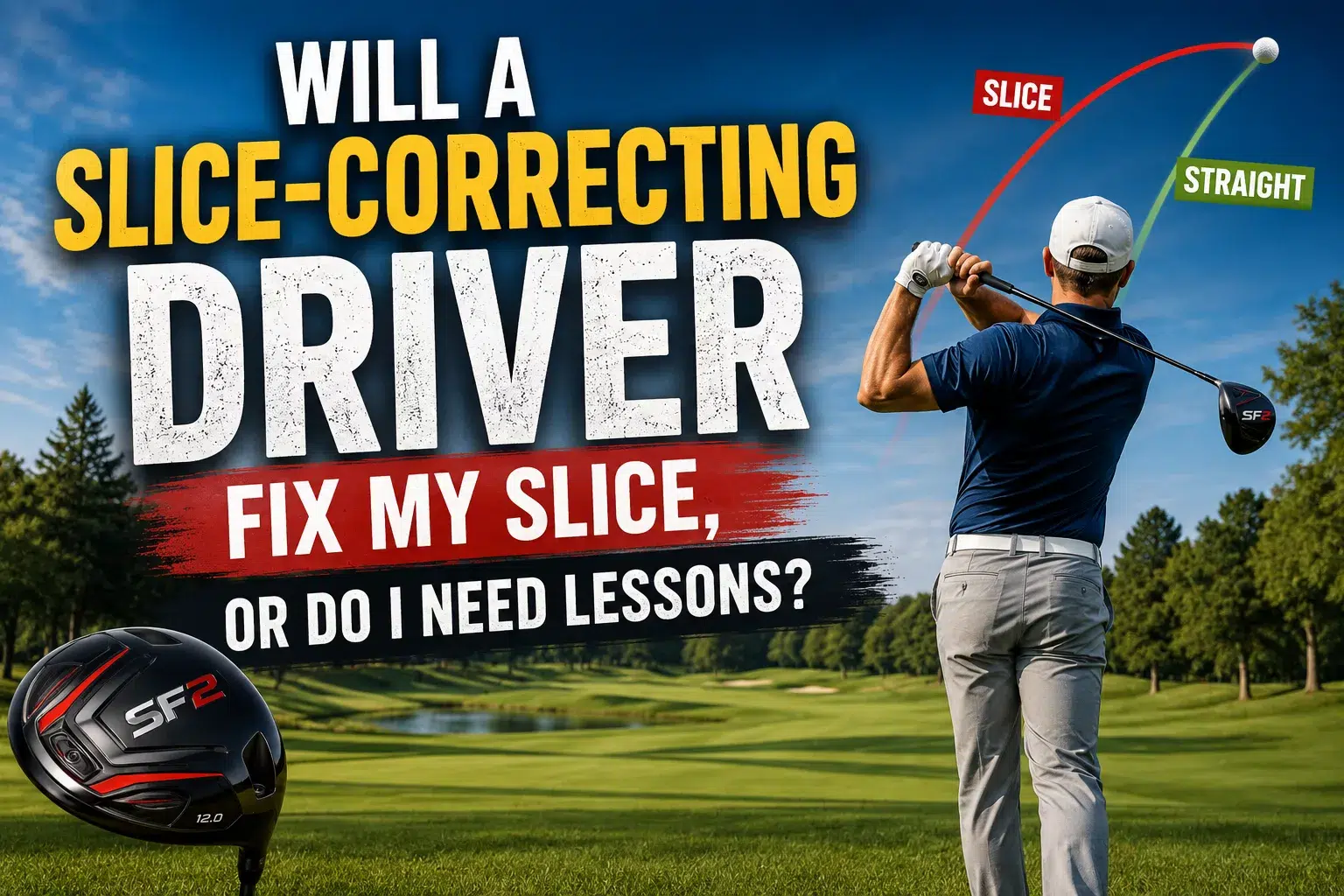
A slice-correcting driver will reduce your slice, but it will not fix it. The club changes where the face points at impact. It does not change what your hands, arms, and body are doing to get it there — which means the slice is still in your swing, waiting for you in every other club in the bag.
That is not a reason to skip the driver. For a lot of golfers, buying one first is the smarter move. But it is a reason to be clear about what you are actually buying.
This article gives you a decision framework rather than a verdict, because the right answer genuinely depends on two things: how severe your slice is right now, and whether you are realistically going to practice. Be honest with yourself on both and the choice gets a lot easier.
What Actually Causes a Slice
A slice is caused by the clubface being open relative to your swing path at impact. Path alone does not cause it. Face alone does not cause it. It is the gap between them.
This matters more than it sounds, so it is worth slowing down on.
Face angle controls where the ball starts. Modern ball flight data puts it at roughly 75 to 85 percent of start direction, with path making up the rest. Where your ball begins its journey is essentially a readout of where the clubface was pointing at impact.
The gap between face and path controls the curve. If the face is open relative to the path, the ball curves right for a right-handed golfer. Closed to the path, it curves left. The wider the gap, the more the ball moves.
Here is the part that surprises most golfers: an out-to-in swing path — the classic “over the top” move everyone blames for slicing — does not produce a slice on its own. If your path is out-to-in and your face is square to that path, you hit a straight pull. The ball goes left and stays left. Annoying, but it does not curve.
Add an open face to that same path and now you have the banana ball. The open face is what turns a pull into a slice.
So when we ask whether equipment or lessons will fix your slice, we are really asking: which one addresses the clubface?
What a Slice-Correcting Driver Actually Does
A slice-correcting driver addresses the clubface directly, using four design choices that all push the same direction.
A closed face angle. The face is manufactured pointing left of the target at address. The Performance Golf SF2, for example, is set 3 degrees closed. If your swing delivers a face 3 degrees open, a 3-degree closed face brings you to square without you changing a thing.
Heel-biased weighting. Moving mass toward the heel encourages the toe to rotate through impact faster, helping the face close on its own during the downswing rather than hanging open.
A shorter shaft. The SF2 plays at 45 inches, slightly shorter than many drivers. Shorter shafts are easier to control and easier to square, at a small cost in potential clubhead speed.
Higher loft. The SF2 is fixed at 12 degrees. Higher loft produces more backspin relative to sidespin, and since sidespin is what curves the ball, more of one and less of the other means a straighter flight.
These are real engineering decisions, not marketing language. A driver built this way will move your ball flight left. That part is not in dispute.
What is worth understanding is where the distance gains come from. A slice-correcting driver is not adding clubhead speed. It is recovering yardage you were already losing to sidespin and to shots that finished in the rough or out of play. That is a more modest claim than most advertising makes, and it is also a more believable one.
What a Slice-Correcting Driver Can’t Do
Four limitations, and the third one is the one nobody mentions in the ads.
It doesn’t change your swing. Your path, your grip, your sequencing, your transition — all identical the day after you buy it. The club compensates for the problem rather than removing it.
It doesn’t transfer to your irons. This is the big one. If your slice comes from an open face, you are slicing your 7-iron too. You are probably slicing your hybrids and fairway woods. A slice-correcting driver fixes exactly one club in your bag, and you carry thirteen others.
It can’t rescue a badly weak grip. If your hands are rotated well to the left on the handle (for a right-handed golfer), you may be delivering a face so open that 3 degrees of built-in correction barely dents it. In that case you have spent real money on a partial fix.
It can mask a problem while it looks like progress. This is the subtle one. A slice-correcting driver may leave you starting the ball well left of your target and curving it back to the middle.
The ball finishes in the fairway, so it feels solved — but you are now depending on the curve to bring it home. If your swing improves later and the slice spin drops, nothing offsets that leftward start, and you begin missing left.
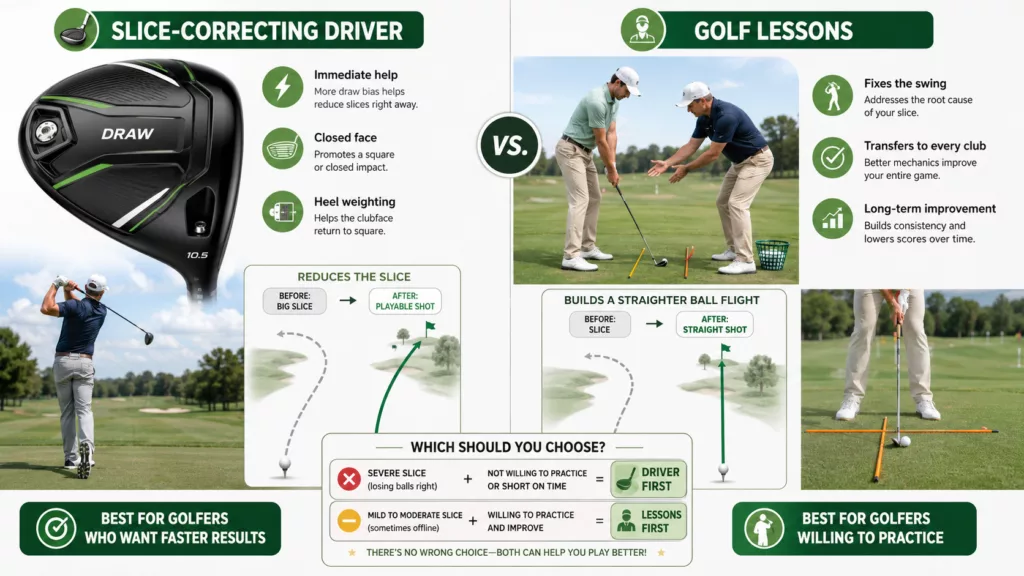
Should You Buy the Driver First or Take Lessons First?
Find yourself in the left column.
| Your situation | Start with |
|---|---|
| Severe slice costing you two or three fairways a round, and you are not planning on lessons | Driver |
| Mild to moderate slice, and you are willing to practice | Lessons |
| You slice every club, not just the driver | Lessons |
| You play a handful of times a year and want the round to be fun | Driver |
| Your handicap is dropping and you are actively working on your swing | Lessons |
| Physical limitations make significant swing changes unrealistic | Driver |
Notice that the split is not about which option is better. It is about severity and commitment. A golfer who plays four times a summer and a golfer grinding toward single digits should make opposite choices, and both would be right.
The Case for Buying the Driver First
You get results the same day. No adjustment period, no ingraining phase, no getting worse before you get better. You tee it up and the ball goes straighter.
The psychological effect compounds, and it is easy to underestimate. When you are not dreading every tee shot, you enjoy the round. When you enjoy the round, you play more often. When you play more often, you are in a far better frame of mind to actually work on your swing. A driver that keeps the game fun can be the thing that keeps you in golf long enough to improve.
Lessons are a slow burn, and a lot of golfers quit on them. Swing changes usually feel worse before they feel better, and if you are still getting punished on the course every weekend while you rebuild, the temptation to abandon the whole project is enormous. Plenty of golfers take three lessons, get frustrated, and go back to their old swing anyway.
Cost is one-time. You buy the driver once. Lessons are recurring if you want the changes to stick.
The Case for Lessons First
A fix transfers to all fourteen clubs. Correcting a grip or a path problem improves your irons, your fairway woods, and your hybrids at the same time. That is a much better return than fixing one club.
You then buy your driver for the swing you have, not the swing you are escaping. Choose a driver after your slice straightens out and you can pick a neutral head that will still suit you in five years.
The cost gap is smaller than people assume. Lesson rates vary by market, but in most areas a few sessions with a good instructor land in the same neighborhood as a new driver. You are frequently choosing between two comparable expenses rather than a cheap option and an expensive one.
You avoid the outgrowing problem. A driver with a built-in closed face is helping you only as long as you slice. Straighten the swing out and that same closed face starts producing hooks. You are shopping again — this time for a driver you would have bought in the first place if you had done the lessons first.
If You Take Lessons, Here’s What to Actually Work On
“Work on your swing” is useless advice on its own. Here is where the time actually goes.
Start with the grip. It is the least glamorous fix in golf and it corrects more slices than any drill. A grip that is too weak — hands rotated too far left on the handle for a right-handed player — makes an open face at impact nearly unavoidable no matter what your path does. Strengthening it feels wrong for about two range sessions, and then it feels like nothing at all.
Understand why the popular fixes backfire. Most self-taught slice work goes after the path. Swing more from the inside. Drop the trail shoulder. Feel like you are hitting it right. All reasonable-sounding, and all aimed at the smaller variable.
Here is what happens when you fix the path and leave the face open: the ball now starts right and curves right. You have made it worse. It is a genuinely discouraging outcome, and it arrives right when the golfer thinks they are doing everything correctly.
That moment is the single most common reason golfers conclude that practice does not work and go buy a driver instead. If you know it is coming, it is much easier to push through — or better, to avoid entirely by having an instructor look at your face angle before you touch your path.
Get on a launch monitor if you can. Face angle and path are close to impossible to self-diagnose by watching ball flight alone, because the two variables produce overlapping results. One session with numbers in front of you is worth a month of guessing.
How to Tell If the Driver Is Actually Working
If you buy the driver, test it properly inside the return window. And test the right thing.
Do not judge it by your best drive. Judge it by your worst five.
Keep a simple two-column note for fifteen to twenty tee shots. For each one, write down the start line (left, on target, or right) and the curve (left, straight, or right). Two separate observations, because they mean two different things. Start line tells you about your face angle. Curve tells you about the gap between face and path.
Then read the pattern:
- Starts left, curves right, finishes near the target. Working as designed. The club is offsetting your slice. Just know that you are relying on the curve.
- Starts on line, curves less than before. Best case. Genuinely straighter, not just rerouted.
- Starts left, curves left. Warning sign. This is a pull-hook, and it means the correction has taken you past neutral for your swing. If you see this regularly, the club is overcorrecting and it is not the right fit.
- Starts right, curves right. The correction is not enough for your slice. Worth looking at your grip before spending more money on equipment.
Do this on the course, not the range. Range mats and vague targets make start direction almost impossible to judge honestly, and start direction is half the data you need.
Twenty tee shots is roughly four or five rounds. Plan your return window around that.
The Honest Answer: Do Both, In the Right Order
The golfers who make lasting improvement almost always do both. The equipment keeps the game playable and enjoyable while the fundamentals develop underneath it, and neither one is doing the other’s job.
What actually varies is the order, and the order comes down to a question only you can answer: are you going to practice?
If yes, take the lessons first and buy your driver afterward for the swing you have earned. If no — and there is nothing wrong with no, most golfers play for fun rather than for a handicap — buy the driver, keep the ball in play, and enjoy your Saturday.
The wrong move is buying a slice-correcting driver while telling yourself you will get around to the lessons eventually, and then treating the driver as the fix. That is how a golfer ends up five years later with a bag full of compensations and the same open clubface they started with.
FREQUENTLY ASKED QUESTIONS
Will a new driver fix my slice?
No. A slice-correcting driver will reduce your slice, sometimes substantially, but it does not fix the swing that causes it. It changes where the clubface points at impact through a closed face angle and heel-biased weighting. Your path, grip, and sequencing stay exactly the same, which is why you will still slice your irons.
Do anti-slice drivers actually work?
Yes, within limits. The design elements are real: a closed face angle, weight positioned toward the heel, a shorter shaft, and higher loft all push the ball flight left and reduce sidespin. Most golfers with a moderate slice see a straighter ball flight immediately. Golfers with a severe slice caused by a very weak grip may find the correction is not enough on its own.
Is it better to buy a slice-correcting driver or take golf lessons?
It depends on how severe your slice is and whether you plan to practice. If your slice is severe and you are not taking lessons, the driver gives you immediate playable golf. If your slice is mild to moderate and you are willing to practice, lessons are the better investment because the fix transfers to all fourteen clubs rather than one.
How many lessons does it take to fix a slice?
Many golfers see meaningful change in two to four sessions when the cause is a grip or setup issue, since those are quick to identify and correct. Slices rooted in swing path or sequencing take longer, often several months of consistent practice between lessons. The instruction itself is fast. The ingraining is what takes time.
Will a slice-correcting driver make me hook the ball?
It can, if your slice straightens out later. A closed face angle helps only while you are delivering an open face. Improve your swing and that same built-in correction can take you past square into a pull-hook. Watch for drives that start left and curve further left — that is the signal the club has become too much correction for your swing.
Will I still slice my irons if I buy an anti-slice driver?
Yes. A slice-correcting driver only changes the driver. If an open clubface is causing your slice, it is causing it in every club you swing. This is one of the strongest arguments for putting your money into lessons first if you are willing to practice.
Can I fix a slice without lessons?
It is possible, and grip is the place to start, since a grip that is too weak makes an open face very difficult to avoid. The risk of going it alone is that most self-taught slice fixes target the swing path while leaving the face open, which produces a shot that starts right and curves right — worse than the original slice. If you work on it yourself, address the clubface before the path.
Related Post

What Time Does Twilight Golf Start? (And When It’s Actually a Deal)
Twilight golf typically starts between 1:00pm and 4:00pm, but there is no industry-standard time — [...]
Golf Equipment on a Budget: 2025 Buying Guide Under $900
Build a complete, competitive golf bag without breaking the bank Bottom Line Up Front: You [...]