This website uses cookies to improve your experience. We\'ll assume you\'re ok with this, but you can opt-out if you wish. Read More
Where Can You Play Affordable Golf in South Carolina? A County-by-County Guide
Categories :
You can play golf in South Carolina for $12 or for $200, and the difference has less to do with course quality than with which part of the state you’re standing in.
A nine-hole round in the Upstate costs less than a bucket of range balls on the Grand Strand. A municipal course in the Midlands charges $28 for all-day play while a course in the Charlotte suburbs charges $75 for eighteen.
South Carolina is one of the best golf states in America for a budget golfer, but only if you know where to look. This guide covers what golf actually costs in each region of the state, the pricing patterns that repeat everywhere, and links to our detailed county-by-county guides with real published green fees.
What Does Golf Actually Cost in South Carolina?
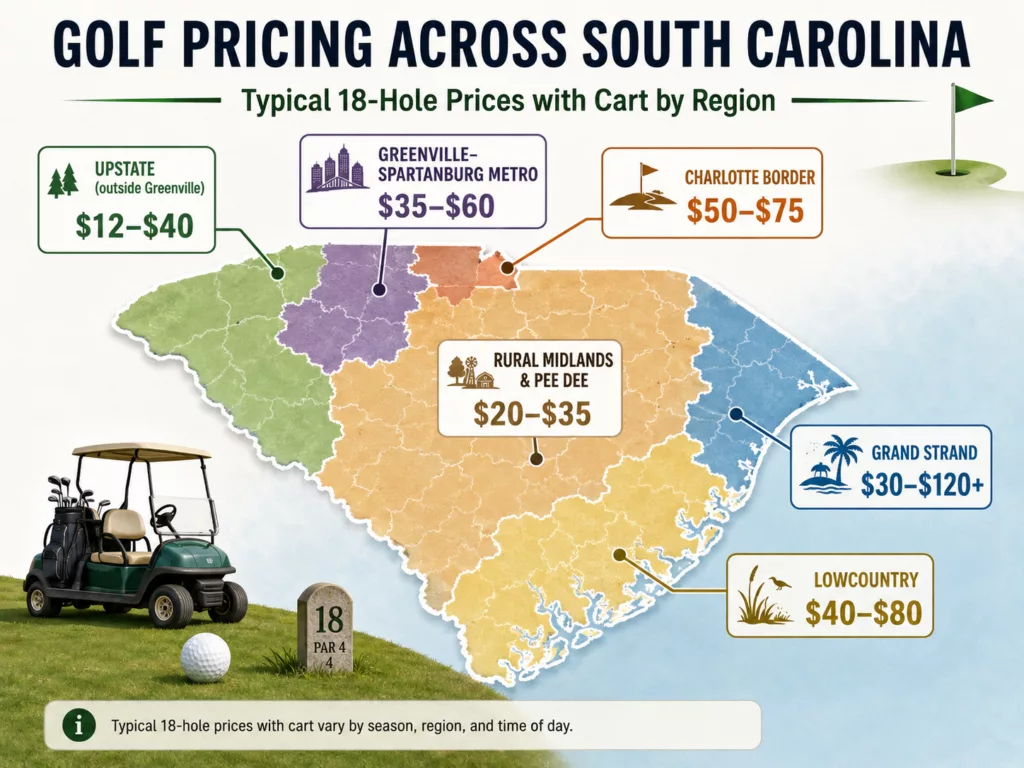
Prices cluster by region far more than by course quality. Here’s the honest lay of the land.
| Region | Typical 18 w/ Cart | What Drives the Price |
|---|---|---|
| Rural Midlands & Pee Dee | $20–$35 | Small municipal and family-owned courses, low demand |
| Upstate (outside Greenville) | $12–$40 | Old mill-town courses, thin maintenance budgets |
| Greenville–Spartanburg metro | $35–$60 | Suburban growth, better conditioning |
| Charlotte border (Indian Land, Fort Mill) | $50–$75 | Charlotte commuter demand, dynamic pricing |
| Lowcountry (Charleston, Beaufort) | $40–$80 | Year-round play, tourism |
| Grand Strand (Myrtle Beach) | $30–$120+ | Enormous supply, wild seasonal swings |
The single biggest lever is season, not location. Myrtle Beach in January and Myrtle Beach in April are different economies. The Grand Strand has more than 80 courses competing for winter play, and shoulder-season rates there can undercut rural Midlands courses that never discount at all.
The second biggest lever is the clock. Almost every course in the state prices in tiers by time of day, and the drop is steeper than most golfers realize. At one Donald Ross course we priced out in Lancaster County, a weekday morning round runs $59 and the same round after 3pm runs $39 — a 34% discount for showing up later on the same day.
Four Things We’ve Learned Covering South Carolina County by County
After working through counties across the state, the same patterns keep surfacing. These will save you money and frustration anywhere you play here.
1. “Country Club” Usually Doesn’t Mean Private
This is the most expensive misunderstanding in South Carolina golf. Small-town courses across this state were built as community clubs in the mid-20th century and kept the name long after the access model changed.
We’ve now found Bishopville Country Club (Lee County) operating as a public course, and Lakeside Country Club (Laurens County) selling public tee times while every directory lists it as private. The reverse also happens — courses that sound public and aren’t.
The rule: in South Carolina, the name tells you nothing. Call and ask. Golfers skip perfectly playable courses every week because the word “country club” scared them off.
2. Golf Directories Are Frequently Wrong About This State
Third-party golf databases carry stale data for years, and South Carolina’s small courses are the worst affected. Real examples we’ve documented:
- A course renamed under new ownership years ago is still listed under its old name at the old address.
- A public 18-hole course that converted to a private 12-hole club is still listed as public at its old green fee.
- A course listed as “private” that actively sells public tee times.
- A senior discount advertised on multiple listing sites that the course says it has never offered.
Verify by phone before you drive. In rural South Carolina especially, one call saves a wasted hour.
3. County Lines Are Not Where You Think
South Carolina county names and town names overlap in confusing ways. Kershaw Golf Club is in Lancaster County, not Kershaw County — the town of Kershaw sits five miles past the line, and the county boundary once ran through the middle of town. Directories have been filing it wrong for years.
If you’re searching by county, cross-check the actual town. You may be missing a course sitting fifteen minutes away.
4. The Cheapest Round Is Almost Never Advertised
Punch cards, locals’ rates, all-day play deals, and off-season memberships are real and widespread in this state — and they’re rarely published online. A municipal course in Lancaster County offers all-day Tuesday play for $28. A small course near Laurens has advertised monthly memberships in the $35–$40 range.
Ask at the counter. The posted rate card is for visitors.
South Carolina Golf by Region
The Grand Strand & Coast
The highest concentration of golf in the state, and the widest price range. Enormous supply means real bargains in the off-season, but peak spring rates climb fast.
- Horry County — Myrtle Beach and the heart of the Grand Strand
- Georgetown County — Pawleys Island, Murrells Inlet, and the Waccamaw Neck
- Charleston County — municipal value alongside resort-level courses
- Berkeley County — Moncks Corner and the northern Lowcountry
- Dorchester County — Summerville and the western Charleston suburbs
- Jasper County — Hardeeville, Ridgeland, and the Hilton Head approach
- Colleton County — Walterboro and the ACE Basin
- Hampton County — rural Lowcountry value
The Pee Dee
I-95 country. Consistently among the best value in the state, with courses used to serving both locals and travelers passing through.
- Florence County — the region’s hub, with easy interstate access
- Marion County — small-town courses and genuine bargains
- Dillon County — including municipal golf at some of the state’s lowest rates
- Williamsburg County — Kingstree and the surrounding countryside
The Midlands
The middle of the state, and the region where the “country club that isn’t private” pattern shows up most often. Municipal golf here is some of the cheapest in the Southeast.
- Kershaw County — Camden, with a Donald Ross private club and a public course mid-renovation
- Lee County — one course in the whole county, and it’s open to the public
- Orangeburg County — municipal golf along the Edisto River
The Upstate & Piedmont
Old mill-town courses, low prices, and thin maintenance budgets. The best raw value in the state if you can live with imperfect greens — and a few genuine surprises.
- Lancaster County — a 1935 Donald Ross layout and a huge north-to-south price gap
- Laurens County — where the county’s only public course recently went private
- Cherokee County — Gaffney and the I-85 corridor
When Should You Play Golf in South Carolina?
Best value months: January and February. Cold enough to soften demand, warm enough to play most days. Coastal courses discount hard.
Best conditions: April through May, and late September through October. Bermuda grass is healthy, temperatures are reasonable, and the greens are at their best.
Most expensive: March and April on the coast. Spring break plus the Masters plus perfect weather. Grand Strand rates roughly double.
Sneaky good: July and August afternoons. Brutal heat means courses across the state discount steeply after 1pm to fill empty tee sheets. If you can handle the humidity and hydrate properly, midsummer twilight is the cheapest quality golf in South Carolina.
Watch for aeration and renovation. Most South Carolina courses aerate greens in late summer, and many post reduced rates during recovery. Some courses disclose this clearly at booking and some don’t — golfers regularly report prepaying full price and arriving to find temporary greens. Always ask: “are the greens in normal condition right now?”
Frequently Asked Questions
What is the cheapest golf course in South Carolina?
Small nine-hole courses in rural areas offer the lowest rates in the state, with some advertising green fees as low as $12 to $15 on weekdays. Municipal courses in the Midlands and Pee Dee regions typically run $20 to $30 for 18 holes with a cart. Rates vary significantly by season and time of day, so check our county guides for current published pricing in specific areas.
Is golf cheaper in Myrtle Beach or inland South Carolina?
It depends entirely on the season. Myrtle Beach has more than 80 courses competing for play, so off-season rates in January and February can be lower than inland courses that never discount. During peak spring months, Grand Strand rates can be double what you’d pay at an inland municipal course. Inland golf is more consistently priced year-round.
Does “country club” mean private in South Carolina?
Frequently not. Many South Carolina courses built as community clubs in the mid-20th century kept the “country club” name after their access model changed, and now welcome public play.
Bishopville Country Club in Lee County and Lakeside Country Club in Laurens County both accept outside play despite their names and despite directory listings suggesting otherwise. Always call to confirm rather than assuming.
When is the cheapest time to play golf in South Carolina?
January and February offer the lowest seasonal rates statewide, particularly on the coast. Within any given day, afternoon and twilight tee times are substantially cheaper than mornings — discounts of 30% or more off the morning rate are common. Summer afternoons combine both effects, as courses discount heavily to fill tee sheets during extreme heat.
Are South Carolina golf directory listings accurate?
Often not, especially for small rural courses. We have repeatedly found stale course names, outdated green fees, incorrect public and private designations, incorrect county assignments, and advertised discounts that courses say they do not offer. Confirm current rates, conditions, and access policy by phone before making a drive.
How many golf courses does South Carolina have?
South Carolina has roughly 350 golf courses statewide, with the heaviest concentration along the Grand Strand around Myrtle Beach, which alone accounts for more than 80. The Lowcountry around Charleston and Hilton Head is the second-largest cluster. Many rural counties in the Midlands and Upstate have only one or two courses.
What is the best golf value in South Carolina?
The best value combinations tend to be weekday twilight rounds at established older courses in the Midlands and Upstate, where a well-regarded layout can be played for under $40 with a cart. All-day play deals at municipal courses, which let you play unlimited holes on a single green fee, offer the lowest cost per round available in the state.
Related Post
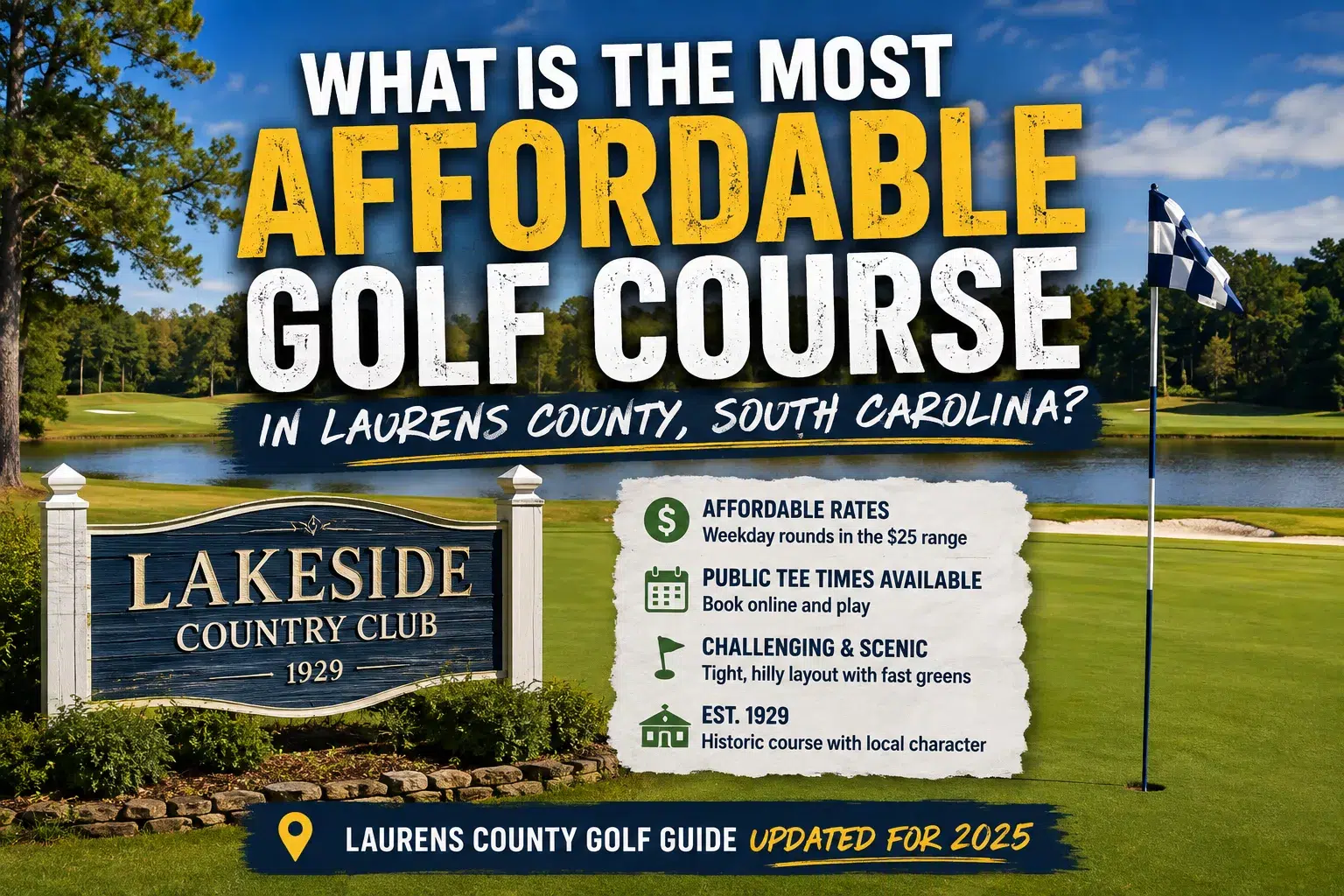
Most Affordable Golf Courses in Laurens County, South Carolina: Your Questions Answered (2026)
What Is the Most Affordable Golf Course in Laurens County, South Carolina? Lakeside Country Club [...]
Best Affordable Public Golf Courses in Williamsburg County, South Carolina
Best Affordable Public Golf Courses in Williamsburg County, South Carolina: Top Budget-Friendly Options for Every [...]