This website uses cookies to improve your experience. We\'ll assume you\'re ok with this, but you can opt-out if you wish. Read More
SF2 Driver Shaft Flex Guide: How to Pick the Right Flex for Your Swing Speed
Categories :
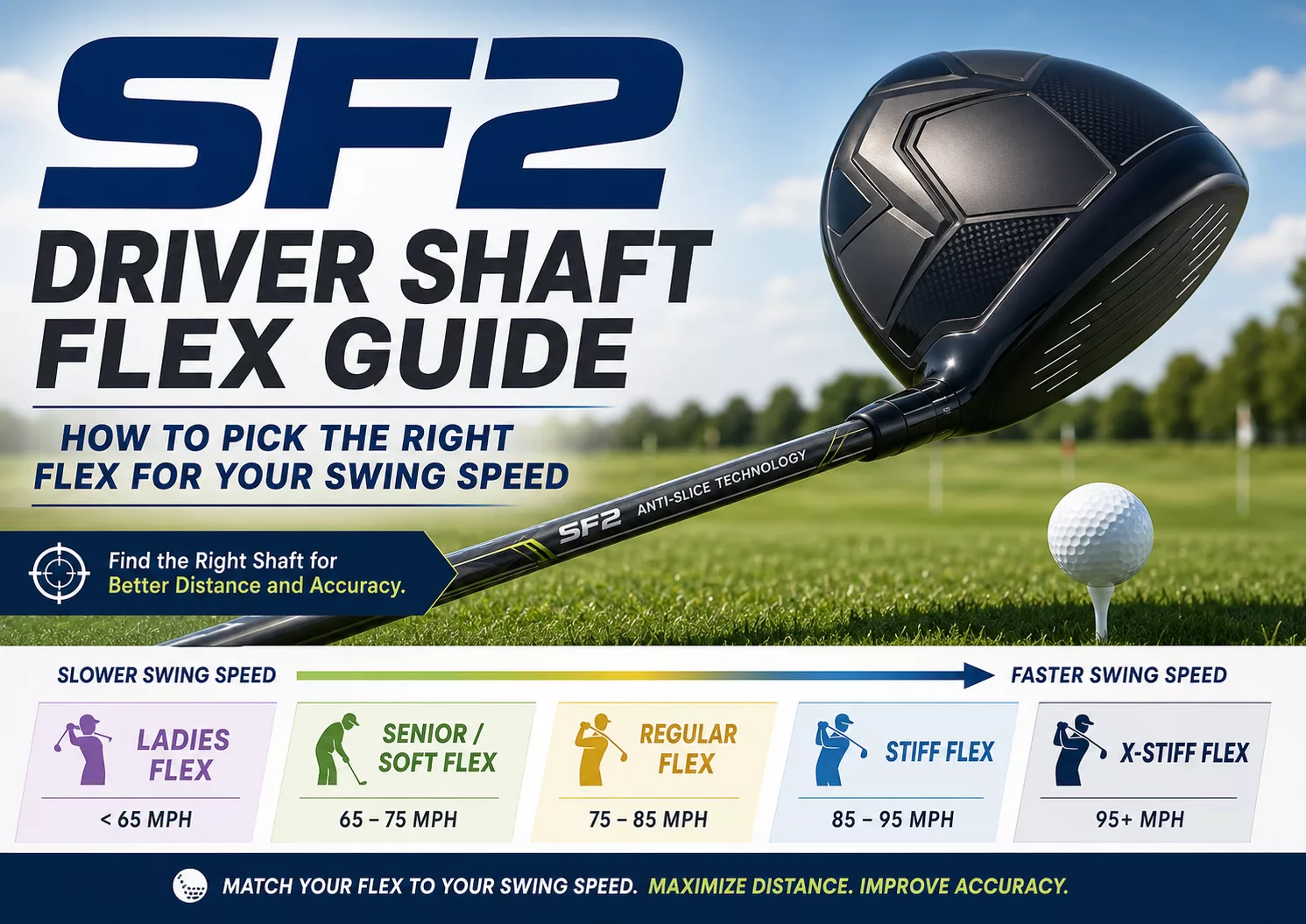
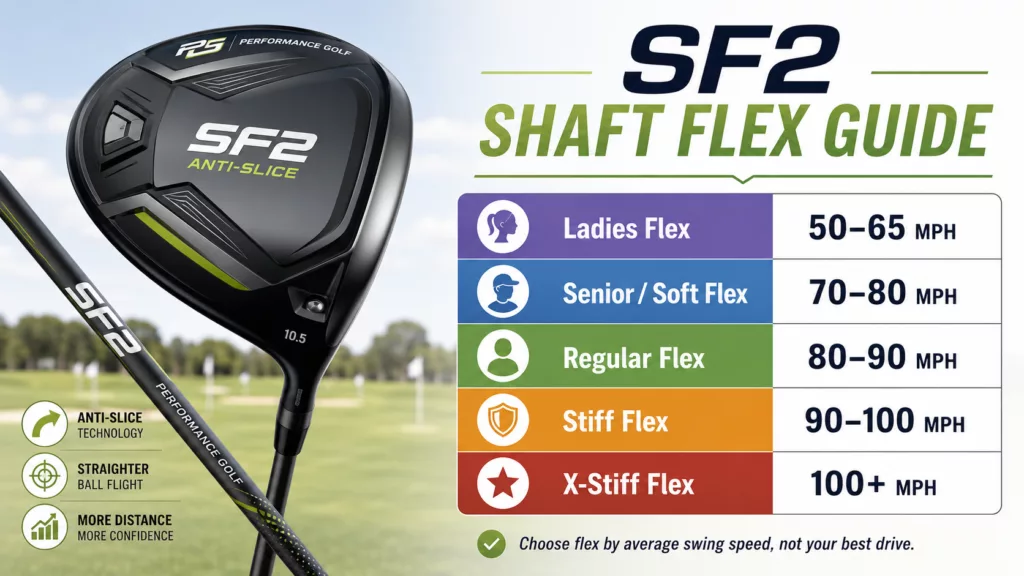
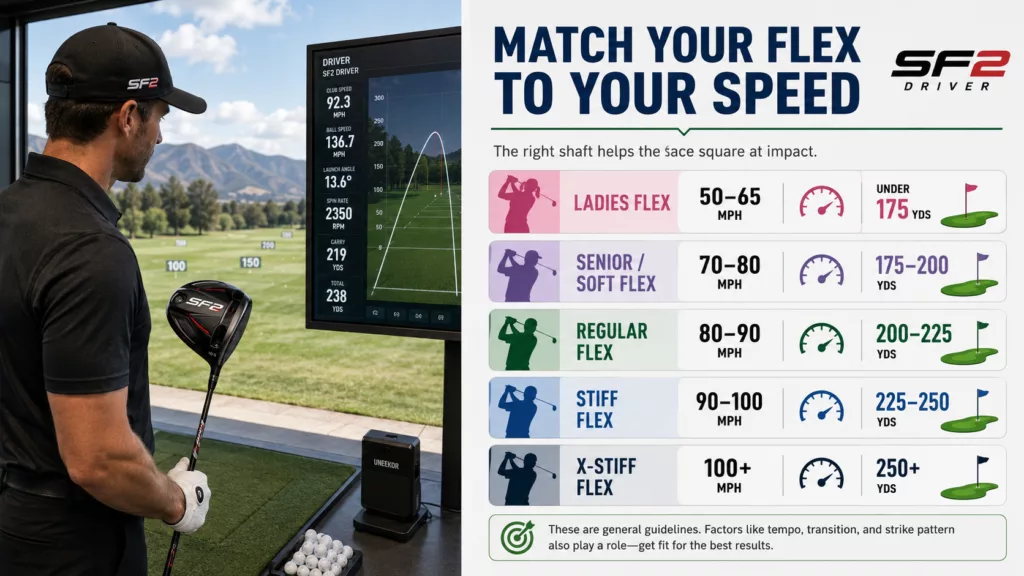
Quick answer: The Performance Golf SF2 driver comes in five shaft flex options matched to swing speed tiers: Ladies Flex (50-65 MPH), Senior/Soft Flex (70-80 MPH), Regular Flex (80-90 MPH), Stiff Flex (90-100 MPH), and X-Stiff Flex (100+ MPH).
The vast majority of recreational golfers who slice fall into the Regular or Senior/Soft Flex category. Picking the wrong flex — especially going too stiff — is one of the most common reasons a draw-bias driver underperforms even when the correction technology is well-matched to your swing. This guide walks through exactly how to identify your correct flex tier.
Why Shaft Flex Is the Most Underestimated Variable in Driver Fitting
Most golfers shopping for a draw-bias driver spend all their research time on the head — closed face angle, heel weighting, MOI, head size. These are important. But shaft flex is equally important and far more commonly wrong in recreational golfers’ bags.
Here’s why it matters specifically for slice correction:
A shaft that is too stiff for your swing speed doesn’t load and unload properly through the downswing. The face arrives at impact slightly more open than it would with the correct flex — which directly works against the SF2’s slice-correction design.
You’re paying for a 3° closed face and Counter-Slice Keel heel weighting, and then partially negating both with a shaft that keeps the face open at impact.
A shaft that is too soft for your swing speed loads too early, causing the face to close too aggressively through impact — producing a hook or a pull-left miss rather than a straight shot.
The correct shaft flex allows the club to work as designed: loading during the downswing and releasing through impact with the face squaring naturally at the moment of contact.
The SF2 Shaft Flex Matrix: Complete Breakdown
Ladies Flex (50g-55g)
Swing Speed Range: 50-65 MPH Average Driving Distance: Under 175 yards Target Player: Women golfers or any player with a very slow swing tempo and minimal wrist hinge through the downswing. This is the lightest, most flexible option in the SF2 lineup, designed to maximize launch angle and carry distance for the slowest swing speeds.
Key characteristic: At swing speeds under 65 MPH, a stiffer shaft simply will not flex enough to help the face square at impact. The Ladies Flex is designed to produce the maximum face rotation through impact for players who need it most.
Who gets this wrong: Men who feel uncomfortable selecting a Ladies Flex even when their swing speed genuinely falls in this range. Ego-based flex selection is one of the most common fitting mistakes in recreational golf. If your swing speed is 55-60 MPH, the Ladies Flex will outperform a Senior Flex regardless of your gender.
Senior / Soft Flex (50g-55g)
Swing Speed Range: 70-80 MPH Average Driving Distance: 175-200 yards Target Player: Senior golfers, players with smooth or moderate tempo swings, or any golfer whose swing speed has declined due to age, injury, or reduced physical conditioning.
Key characteristic: The Senior Flex provides enough flex to produce a high launch angle and maximum carry for players in this speed range without the excessive release timing issues that come from going too soft (Ladies Flex) at higher swing speeds.
Identifying your fit: If you’re a male golfer over 60 who drives the ball 180-195 yards on average, this is almost certainly your correct flex. Many male golfers in this category default to Regular Flex out of habit from when they swung faster — and then wonder why their driver performance has declined.
The tempo consideration: Swing speed is the primary fitting variable, but tempo matters too. A 75 MPH swinger with an aggressive, fast-transitioning downswing may be better served by Regular Flex than Senior Flex even at the same speed.
A smoother, more patient transition at 82 MPH may actually benefit from Senior Flex. When in doubt, err toward the softer option — it’s easier to correct a hook tendency from too-soft flex than it is to correct the slice-amplifying effect of a too-stiff shaft.
Regular Flex (57g)
Swing Speed Range: 80-90 MPH Average Driving Distance: 200-225 yards Target Player: The most common recreational golfer profile — average swing speed, consistent slice tendency, drives the ball somewhere between 195 and 225 yards on good contact.
Key characteristic: At 57g, the SF2’s Regular Flex is slightly lighter than the 60-65g regular flex shafts found in most OEM drivers.
This lighter weight is a deliberate SF2 design choice, paired with the counterbalancing grip-end weight to maintain control at a lower overall shaft weight. The counterbalancing raises the balance point of the club, making the head feel lighter and easier to square through impact.
The most asked-about flex: Regular Flex generates the most pre-purchase questions about the SF2 because it covers the largest single segment of recreational golfers. If you drive the ball 200-220 yards on average, slice consistently, and have never had your swing speed formally measured, Regular Flex is the statistically correct starting point for most buyers in this situation.
Boundary case — 88-90 MPH swingers: Golfers at the top of the Regular Flex range should consider whether their tempo pushes them toward Stiff Flex.
A 90 MPH swinger with an aggressive transition may find Regular Flex produces slightly inconsistent timing — the shaft releases slightly early, producing draws that occasionally turn into hooks rather than straight shots. If you’re finding the SF2 in Regular Flex overcorrects your miss and produces pulls, the Stiff Flex is the adjustment to make.
Stiff Flex (60g)
Swing Speed Range: 90-100 MPH Average Driving Distance: 225-250 yards Target Player: Mid-to-low handicappers with faster tempos, or recreational golfers who have maintained strong swing speed and are experiencing a slice despite hitting the ball a reasonable distance.
Key characteristic: At 60g, the SF2 Stiff Flex is at the lighter end of the stiff flex weight range used by major OEM brands, which typically run 65g+ in stiff configurations. The slight weight difference reflects the SF2’s overall design philosophy of prioritizing control and face-squaring over raw shaft weight for stability.
The unusual profile this flex serves: A stiff-flex slicer is a somewhat unusual profile — most golfers with 90+ MPH swing speeds have enough natural club speed to avoid the severe slice that the SF2’s aggressive correction is designed for.
The stiff flex SF2 buyer is typically a golfer who has developed a swing fault (usually an over-the-top move) despite having good natural athleticism and swing speed.
The SF2’s correction mechanics work for this profile, but if the slice is being driven primarily by swing path rather than face angle, pairing the stiff flex SF2 with basic path correction instruction will produce better results than equipment alone.
X-Stiff Flex (65g)
Swing Speed Range: 100+ MPH Average Driving Distance: 250+ yards Target Player: High-speed players with a genuine slice tendency — a relatively rare combination but one that exists, typically in younger athletic golfers who generate significant speed but have an open face at impact.
Key characteristic: This is the heaviest shaft in the SF2 lineup at 65g, designed for players who generate enough swing speed that a lighter shaft would produce timing inconsistency and reduced accuracy.
At this speed range, the SF2’s aggressive draw bias carries a meaningful hook risk for players whose swing path is already neutral — verify that a draw-bias driver is actually appropriate before purchasing at this flex level.
Honest note for X-Stiff buyers: Golfers swinging 100+ MPH who slice are relatively uncommon, and for this profile, a properly fitted premium OEM option (Ping G430 SFT, Callaway Paradym Draw) with professional fitting may be a better long-term investment than the SF2’s direct-to-consumer approach, since the marginal difference in face technology and adjustability has more impact at higher swing speeds.
How to Estimate Your Swing Speed Without a Launch Monitor
The most accurate way to determine your swing speed is a launch monitor session — available free or at low cost at Golf Galaxy, PGA Tour Superstore, or most golf courses with a simulator. This takes about 10 minutes and removes all guesswork.
If you don’t have access to a launch monitor, use your average driving distance as a proxy:
| Average Driving Distance | Estimated Swing Speed | Recommended SF2 Flex |
|---|---|---|
| Under 150 yards | Under 60 MPH | Ladies Flex |
| 150-175 yards | 60-70 MPH | Ladies or Senior Flex |
| 175-200 yards | 70-80 MPH | Senior / Soft Flex |
| 200-225 yards | 80-90 MPH | Regular Flex |
| 225-250 yards | 90-100 MPH | Stiff Flex |
| 250+ yards | 100+ MPH | X-Stiff Flex |
Important: Use your average driving distance, not your best drive of the year. The club that fits your consistent, repeatable swing speed — not your peak — will outperform a club fit to your most optimistic estimate.
The Counterbalancing Factor: What Makes the SF2 Shaft Different
One specification that separates the SF2 shaft from standard driver shafts at the same flex ratings is counterbalancing. The SF2 shaft has additional weight built into the grip end, which raises the balance point of the assembled club higher up the shaft.
In practical terms, counterbalancing makes the head feel lighter relative to the grip without actually reducing head weight. This gives the golfer better awareness of the clubface position through the swing — particularly through the impact zone — which helps the club’s draw-bias design do its job more effectively.
For recreational golfers, the main benefit is improved clubface control through impact. The head feels less “whippy” even in softer flex options, which reduces the timing variability that produces inconsistent misses. This is why the SF2’s 57g Regular Flex can feel appropriately controlled at 85 MPH despite being lighter than most OEM regular flex shafts at the same speed range.
Common Flex Mistakes and How to Avoid Them
Mistake 1 — Selecting flex based on what you used to swing: Swing speed declines with age. A golfer who played Stiff Flex at 40 may genuinely need Regular Flex at 55 and Senior Flex at 65. Use your current swing speed, not the one from a decade ago.
Mistake 2 — Going stiffer because it feels more “powerful”: A shaft that is too stiff for your swing speed does not add power — it reduces it. The face arrives slightly open, you lose ball speed on the slice, and the SF2’s correction system is partially undermined. Stiffer is not better unless your swing speed genuinely requires it.
Mistake 3 — Ignoring tempo in favor of speed alone: Two golfers at 85 MPH can have very different optimal flex choices based on how fast they transition from backswing to downswing. A smooth, deliberate transition at 85 MPH benefits from softer flex than an aggressive, fast-transitioning player at the same speed.
Mistake 4 — Not accounting for the counterbalancing effect: Because the SF2 shaft is counterbalanced, it plays slightly stiffer than a standard shaft at the same rated flex. If you’re on the boundary between two flex options, the SF2’s counterbalancing means the softer option may play more like the middle of the standard range than the soft end.
Frequently Asked Questions
What shaft flex should I choose for the SF2 if I don’t know my swing speed? Use your average driving distance as a guide. If you drive the ball 200-225 yards on average, Regular Flex is the correct starting point for most golfers in that distance range.
Is the SF2 Regular Flex too light for an 88 MPH swing speed? The 57g Regular Flex is lighter than the 60-65g regular flex shafts in most OEM drivers at the same speed range. However, the SF2’s counterbalancing adds grip-end weight that raises the balance point, making the shaft play more controlled than the raw gram weight suggests. Most 85-90 MPH swingers find Regular Flex appropriate, though players at the top of that range with aggressive tempos should consider Stiff Flex.
Can I upgrade the shaft on the SF2 after purchasing? The SF2 uses a proprietary construction that makes aftermarket shaft upgrades more complex than with adjustable-hosel OEM drivers. If shaft upgradeability is important to you, this is a meaningful limitation to factor into your purchase decision.
What happens if I pick the wrong flex for the SF2? A shaft that is too stiff will leave the face slightly open at impact, reducing the effectiveness of the SF2’s slice correction and potentially producing a weak fade or thin slice despite the draw-bias design. A shaft that is too soft will cause the face to close too aggressively, producing pulls or hooks. Either way, performance is reduced — which is why taking the time to accurately assess your swing speed before ordering is worth the effort.
Does the SF2 shaft flex affect the draw bias of the club? Yes, indirectly. The shaft flex affects how the face presents at impact, which interacts with the SF2’s closed face angle and heel weighting. The correct flex allows the face to present as designed at impact; the wrong flex either reduces or amplifies the correction beyond its intended effect.

This guide is based on publicly available Performance Golf SF2 specifications and general shaft fitting principles as of 2026. Always verify current flex options and specifications directly with Performance Golf before purchasing, as product configurations can change.
Related Post

Top 20 Most Affordable Public Golf Courses in The United States
Top 20 Most Affordable Public Golf Courses in The United States: Discover Budget-Friendly Options for [...]
Golf Equipment Checklist for Complete Beginners Under $300
Last Updated: Julyy 21, 2025 Starting your golf journey doesn’t have to break the bank. [...]