This website uses cookies to improve your experience. We\'ll assume you\'re ok with this, but you can opt-out if you wish. Read More
What Loft Driver Should a Slicer Use? The Complete Guide for High Handicappers
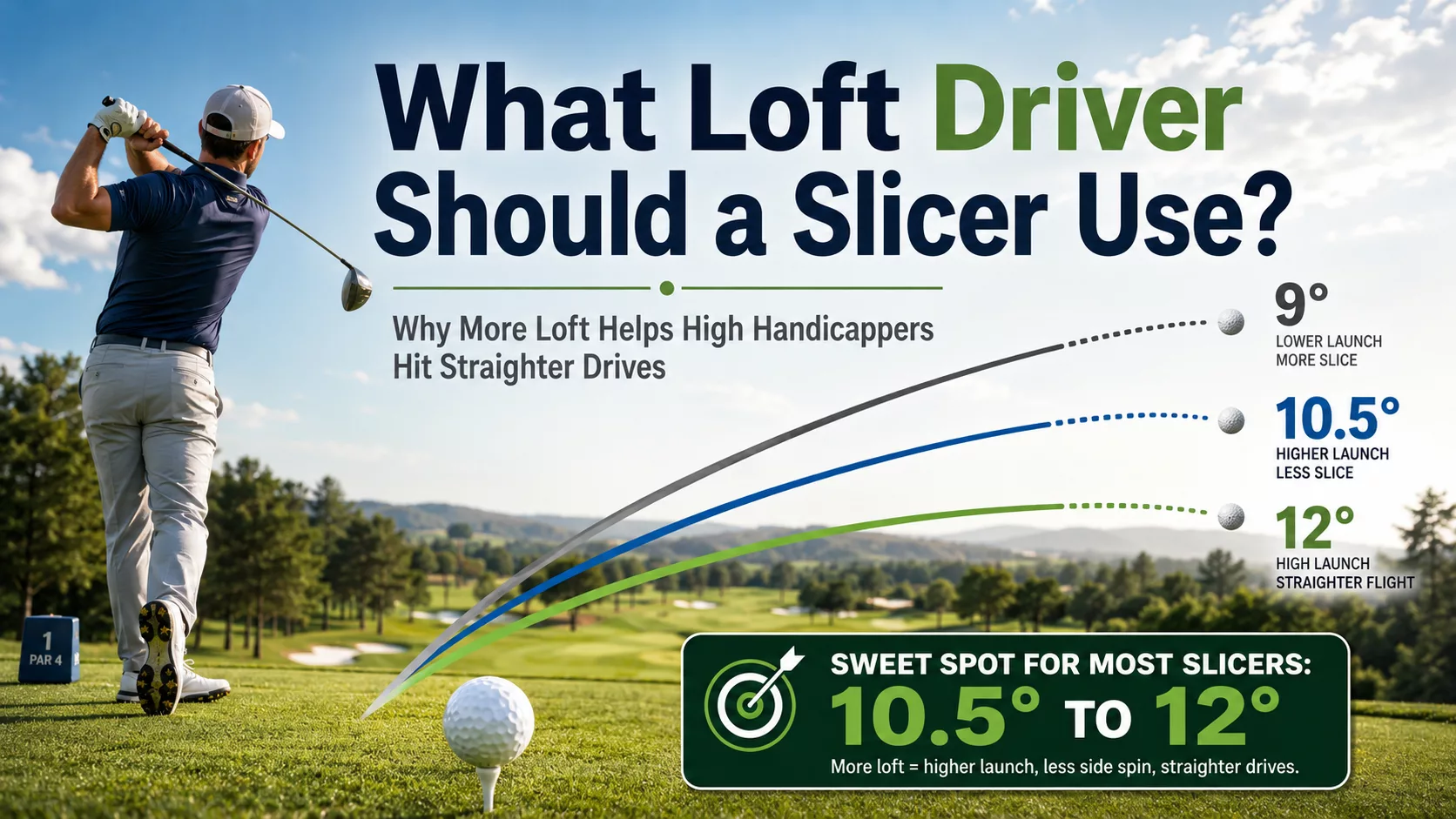
Quick answer: Most golfers who slice should use more loft than they currently have — typically 10.5° to 12°, and in some cases 13°+ for slower swing speeds. Higher loft reduces the sidespin that causes a slice to curve, produces a higher launch angle that increases carry distance for slower swingers, and is more forgiving on off-center hits.
The single most common loft mistake among recreational slicers is playing a 9° or 9.5° driver because it sounds more powerful — when in fact it is actively making their slice worse and costing them distance. This guide explains the mechanics behind loft selection and gives you a clear framework for finding the right loft for your swing.
Why Loft Is the Most Underappreciated Slice Variable
When recreational golfers research how to fix a slice, most of the conversation is about swing mechanics, face angle, and draw-bias equipment. Loft rarely comes up — and that’s a significant gap, because loft selection has a direct, measurable effect on how much a slice curves.
Here’s the physics: a driver with lower loft (say 9°) launches the ball on a flatter trajectory with more sidespin relative to backspin. Sidespin is the rotational component that makes a slice curve to the right.
Higher loft (say 12°) launches the ball on a steeper trajectory with more backspin relative to sidespin. Backspin dominates over sidespin — more backspin means less curve, even with the same open face at impact.
This means that two golfers with identical swings — identical out-to-in path, identical open face — will see meaningfully different amounts of slice curvature depending purely on the loft of their driver. The higher-loft golfer’s ball will fly straighter, because the backspin-to-sidespin ratio is working in their favor.
Loft doesn’t fix a slice the way draw-bias weighting and a closed face do — it doesn’t change what the club is doing at impact. But it does reduce the penalty for an open face at impact, which is why it belongs in every slicer’s equipment conversation.
The Loft Myth That’s Costing Slicers Distance
The most persistent myth in recreational golf equipment is that lower loft equals more distance. It’s understandable — tour players hit 9° and 9.5° drivers, and recreational golfers often assume that what works for a tour pro works for them.
It doesn’t. Here’s why.
A tour player swings at 110-125 MPH. At that speed, a 9° driver produces plenty of launch angle because the sheer energy of the strike deflects the ball upward even from a low loft. The ball launches high, carries far, and the high spin rate from a powerful swing controls the ball’s flight.
A recreational slicer swings at 75-90 MPH. At that speed, a 9° driver doesn’t have enough loft to launch the ball at an optimal angle — the ball launches too low, runs out of carry height too soon, and the sidespin ratio is working against them at the same time. The result: less distance and more curve than the same golfer would achieve with a 10.5° or 12° driver.
For recreational slicers, higher loft means more distance — not less. This is counterintuitive but well-supported by launch monitor data across every major golf equipment manufacturer’s fitting research.
The Optimal Loft Range for Slicers at Different Swing Speeds
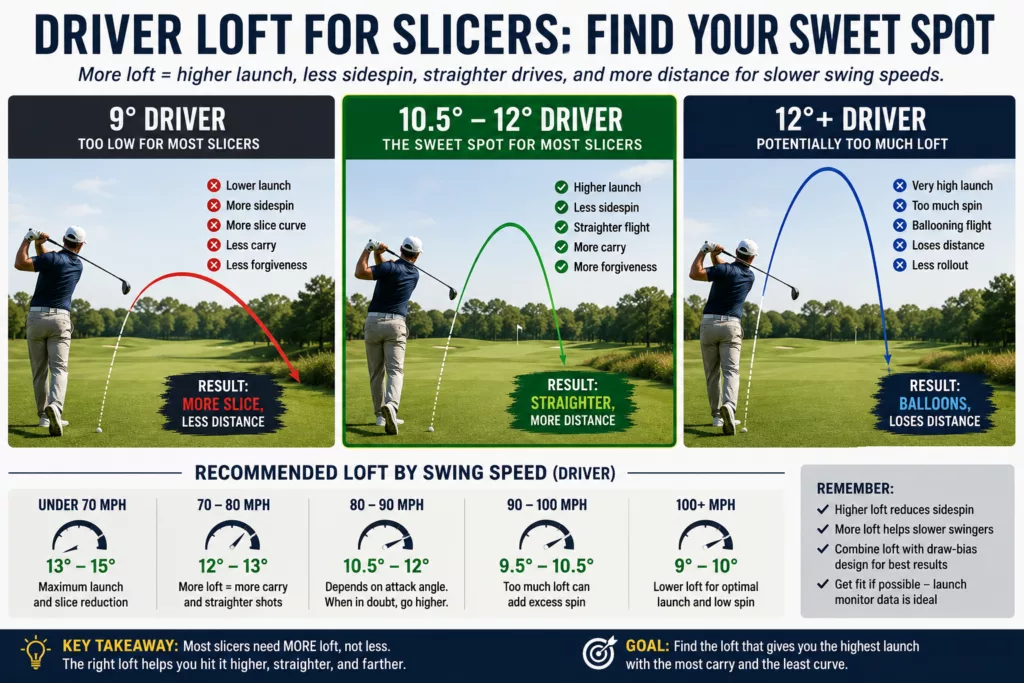
The right loft for a slicer depends on two variables working together: swing speed and attack angle. Here is the practical breakdown:
Under 70 MPH Swing Speed
Recommended loft: 13°-15°
At swing speeds under 70 MPH, the ball needs maximum loft assistance to achieve optimal launch. A 12° driver is the minimum — many golfers in this speed range benefit from 13° or higher, which is why some brands offer high-loft “senior” or “super game improvement” configurations.
The additional loft also reduces sidespin dramatically, producing significantly straighter ball flights even without any draw-bias engineering in the head.
70-80 MPH Swing Speed
Recommended loft: 12°-13°
The classic senior/soft flex speed range. Most golfers in this bracket are leaving significant distance on the table by playing 10.5° drivers because they feel 12° “looks like a beginner club.” A 12° driver at this speed range typically adds 10-20 yards of carry over a 10.5° driver, and the reduced sidespin produces visibly straighter ball flight on the same swing.
80-90 MPH Swing Speed
Recommended loft: 10.5°-12°
This is the regular flex speed range and the widest loft spread of any group, because attack angle variation matters most here. A golfer with a steep, downward attack angle (common among slicers who come over the top) should lean toward 12°.
A golfer with a more neutral or slightly upward attack angle can consider 10.5°. When in doubt, 10.5° is the safer starting point for this speed range.
90-100 MPH Swing Speed
Recommended loft: 9.5°-10.5°
At this speed range, excessive loft starts to introduce too much backspin for optimal distance, and the sidespin reduction benefit of additional loft becomes less dramatic. Most stiff flex swingers in the 90-100 MPH range are well-served by 10.5°, with 9.5° appropriate for those with higher natural launch angles or more upward attack angles.
100+ MPH Swing Speed
Recommended loft: 9°-10°
At tour-caliber swing speeds, lower loft is genuinely appropriate. The energy of the swing creates adequate launch, and higher loft would produce excessive spin that costs distance. However, even at this speed range, a slicer may benefit from 10° over 9° for the sidespin reduction effect.
Attack Angle: The Second Variable That Modifies Loft Selection
Attack angle is the angle at which the clubhead approaches the ball at impact — either downward (negative attack angle), level, or upward (positive attack angle).
Most recreational slicers swing with a steep, downward attack angle because their over-the-top swing path creates a steep descent into the ball. This downward attack angle effectively reduces the loft presented to the ball at impact — a 10.5° driver with a -3° attack angle presents approximately 7.5° of effective loft at impact, which is too low for most recreational swing speeds.
This means slicers with steep attack angles need more stated loft to achieve the same effective loft as a neutral-attack-angle golfer. A slicer at 85 MPH with a -4° attack angle should be looking at 12° rather than 10.5° to get the same effective loft as a neutral-angle golfer using 10.5°.
Conversely, golfers who have worked on sweeping the ball or who naturally have a slight upward attack angle (hitting slightly up on the ball) can tolerate slightly lower loft because the upward attack angle adds effective loft at impact.
Without a launch monitor that measures attack angle specifically, the practical rule for slicers is: assume your attack angle is steeper than average and select loft accordingly — meaning err toward more loft rather than less.
How Loft Interacts With Draw-Bias Driver Design
If you’re considering the Performance Golf SF2 or any other draw-bias driver, loft selection interacts with the draw-bias correction in specific ways worth understanding.
More loft reduces sidespin independently of the draw-bias mechanism. This means a draw-bias driver in a higher loft configuration delivers two independent slice-correction effects: the draw-bias weighting and face angle working on path and face angle at impact, and the higher loft reducing how much the open face translates into sidespin curvature.
These effects are additive — higher loft plus draw bias produces straighter flight than either alone.
The SF2’s effective loft: The SF2 is designed around an approximately 10.5°-12° effective loft configuration in its standard offering. For most recreational slicers in the 80-90 MPH regular flex range, this aligns well with the recommended loft range.
Golfers in the 70-80 MPH senior flex range should verify whether the SF2 is available in a higher loft configuration or whether a different draw-bias driver with adjustable loft (like the Ping G430 SFT’s OptiFit hosel) gives them more flexibility.
The adjustable hosel advantage: Drivers with adjustable hosels — the Ping G430 SFT, Callaway Paradym Draw, and most current premium OEM drivers — allow you to change loft by 1-2° after purchase as you refine your understanding of your optimal launch conditions.
Fixed-loft drivers like the SF2 commit you to one loft configuration, which is why getting the loft right at the point of selection is especially important when buying a fixed-configuration club.
The Ball Flight Test: How to Know if Your Current Loft Is Wrong
If you want to evaluate whether your current driver loft is contributing to your slice before buying anything new, use this simple observational test on the range or course:
Signs your loft is too low:
- Ball flight is low and piercing off the tee rather than high and arcing
- Slice curve is dramatic and early — the ball starts heading right almost immediately off the face rather than starting straight and curving right later in flight
- You lose significant distance on slices — they don’t carry far before landing and running offline
Signs your loft is too high:
- Ball flight is very high and balloon-like, losing forward momentum near the peak of flight
- Drives that do go straight still don’t carry particularly far despite feeling solidly struck
- Ball climbs high and drops steeply with minimal roll
Signs your loft is approximately right:
- Ball launches at a moderate-to-high angle and carries its distance before landing
- Straight shots (when you hit them) have a penetrating but not flat trajectory
- Mishits still carry reasonable distance rather than dropping immediately
Most recreational slicers will recognize the “too low” profile in their current ball flight, which confirms that adding loft is the right adjustment.
Loft vs Draw Bias: Which Matters More for Fixing a Slice?
This is the most commonly asked question once golfers understand both variables, and the honest answer is that they address different aspects of the same problem.
Loft reduces how much sidespin translates into curvature — it doesn’t change the face angle or path that creates the sidespin. Higher loft means the same open face produces less curve, but the ball still starts right if the face is open.
Draw bias (closed face angle, heel weighting) changes what the face and path are doing at impact — it directly attacks the cause of the slice rather than just reducing its effect. But draw bias works within the context of whatever loft the club is presenting, which affects how much the corrected face angle actually improves ball flight.
The combined approach is significantly more effective than either alone. A draw-bias driver in the correct higher loft configuration is the most complete non-swing-change approach to fixing a slice that recreational equipment engineering currently offers.
This is why verifying the SF2’s loft configuration — and confirming it matches your swing speed’s optimal launch conditions — matters as much as verifying the shaft flex.
See our full draw-bias driver roundup for how loft configurations compare across the top options.
Frequently Asked Questions
Should a slicer use 10.5 or 12 degree driver? For most recreational slicers swinging between 75-88 MPH, 12° is the stronger choice. It produces higher launch, more carry distance, and less sidespin curvature on the same swing than 10.5°. Golfers at the upper end of this range (85-90 MPH) with a more neutral attack angle can consider 10.5°.
Does higher loft fix a slice? Higher loft reduces how much a slice curves by improving the backspin-to-sidespin ratio at impact, but it doesn’t eliminate the open face or out-to-in path that causes the slice. It is a meaningful performance improvement that reduces the severity of the miss without correcting the root mechanical cause.
What loft does the Performance Golf SF2 come in? The SF2’s standard configuration is built around an approximately 10.5°-12° effective loft. Verify the specific loft options directly with Performance Golf before purchasing, as configurations can vary.
Why do tour players use 9 degree drivers if higher loft is better for slicers? Tour players swing at 110-125 MPH with a highly trained neutral-to-upward attack angle and consistent center-face contact.
At those speeds and skill levels, lower loft produces optimal launch conditions. Recreational slicers have the opposite profile — lower speed, steeper attack angle, off-center contact — which reverses the optimal loft prescription entirely.
Can I add loft to my existing driver without buying a new one? If your current driver has an adjustable hosel, yes — most adjustable hosels allow 1-2° of loft adjustment. If your driver has a fixed hosel, loft cannot be changed without replacing the shaft and reshafting at a specific tip-trim length, which is a complex modification not worth pursuing on an older club.
What is attack angle and how do I know mine? Attack angle is the downward or upward angle of the clubhead at impact. It is measured by a launch monitor — a Trackman or similar device at a fitting center will display your attack angle automatically.
Without measurement, most recreational slicers can assume a negative (downward) attack angle of -2° to -5° due to the steep swing path associated with over-the-top slice mechanics.
This guide reflects general golf equipment fitting principles and driver loft research as of 2026. Always verify specific product loft configurations directly with manufacturers before purchasing.
Related Post

What Time Does Twilight Golf Start? (And When It’s Actually a Deal)
Twilight golf typically starts between 1:00pm and 4:00pm, but there is no industry-standard time — [...]
Golf Equipment Checklist for Complete Beginners Under $300
Last Updated: Julyy 21, 2025 Starting your golf journey doesn’t have to break the bank. [...]