This website uses cookies to improve your experience. We\'ll assume you\'re ok with this, but you can opt-out if you wish. Read More
Do Golf Courses Pair You With Strangers? Playing as a Single Explained
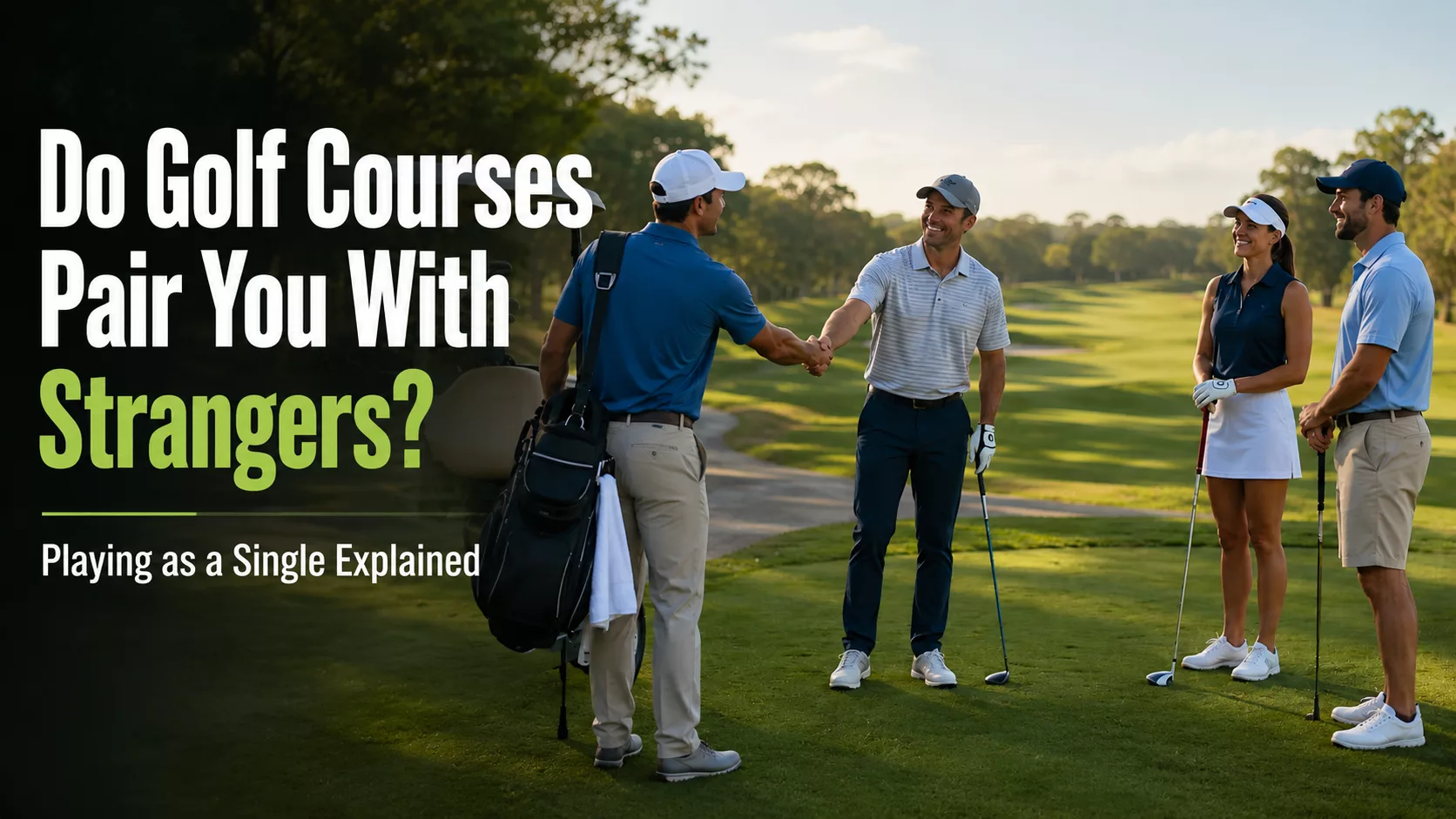
Yes — most courses pair single golfers into existing groups to fill out foursomes, and it’s completely routine. You book for one, you show up, and the starter puts you with two or three other people who have never met you either.
For a lot of new golfers this is the single most nerve-wracking part of the whole sport — more than the swing, more than the score. So here’s exactly how it works, what’s expected of you, what to say on the first tee, and how to book a round where it won’t happen at all if you’d rather ease in.
Why Singles Get Paired (It’s Not Personal)
A golf course sells tee times in slots, and each slot holds up to four players. A single occupying a slot alone costs the course three green fees and slows everyone behind — because one person plays faster than a foursome, they catch the group ahead and stack up.
So pairing isn’t the course being pushy. It’s the economics of the tee sheet, and it’s why municipal and busy public courses pair most aggressively, especially on weekends. Quieter courses at quieter times often won’t bother.
Worth knowing: you pay the same rate either way. Being paired doesn’t cost or save you anything — it’s purely about how the course fills its sheet. (If you’re still mapping out what a round actually costs, our real-numbers guide to starting golf breaks down green fees, carts, and the rest.)
How Pairing Actually Works, Step by Step
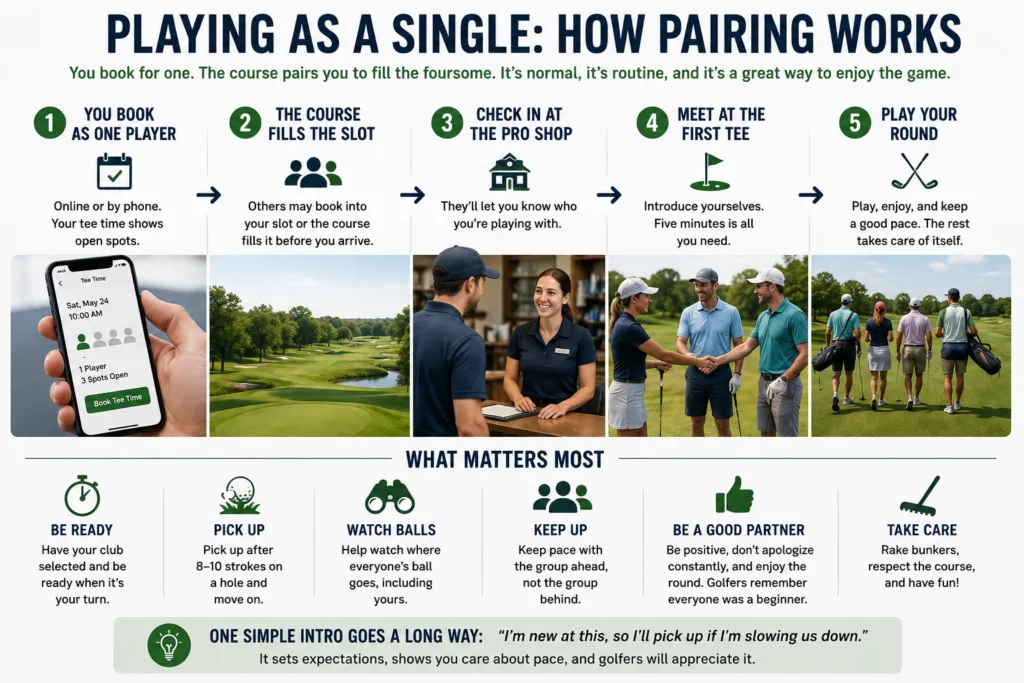
- You book online or by phone as one player. Most booking systems show your slot as having three open spots.
- Others may book into your slot before you arrive — or the course fills it the morning of.
- You check in at the pro shop and they’ll tell you: “You’re with a twosome” or “we’ll pair you at the tee.”
- You meet at the first tee, five minutes before your time. Names, handshakes, done.
- You play. Somebody offers a fist bump on the third hole and the awkwardness is over.
If you’re riding, you’ll usually share a cart with one of them. If that’s uncomfortable, ask the pro shop for your own cart or plan to walk — nobody will question it.
What to Say on the First Tee
This is the whole thing, really. One sentence defuses nearly all beginner anxiety:
“Morning — I’m Nicole. Fair warning, I’m pretty new at this, so I’ll pick up if I’m slowing us down.”
That sentence does three jobs at once: it introduces you, it sets expectations so nobody’s confused when you hit a bad one, and — most importantly — it signals that you understand pace of play matters. Experienced golfers do not care what you shoot. They care whether the round takes four hours or five and a half.
Say that, and in my experience you’ll typically find the group softens immediately. Many will start offering encouragement, some will offer a tip or two, and a fair number will be openly rooting for you by the back nine. Golfers were all beginners once, and most remember it clearly.
The Handful of Things That Actually Matter
You don’t need to memorize a rulebook. As a paired single, this is the real list:
- Be ready when it’s your turn. Glove on, club chosen, ball and tee in hand. This matters more than any swing thought.
- Pick up after 8–10 strokes on a hole. Nobody expects you to hole out a disaster. Pocket the ball, walk on, no explanation needed.
- Watch where everyone’s ball goes, including yours. Four sets of eyes finds balls faster.
- Keep up with the group ahead, not the group behind. If there’s an open hole in front of you, you’re behind regardless of who’s pressuring you.
- Don’t apologize constantly. One acknowledgment is fine; a running commentary of apologies is more awkward for everyone than the bad shots.
That’s it. Rake your bunker, don’t walk through someone’s putting line, and you’re a good playing partner.
When Being Paired Is Actually Great
A few reasons golfers eventually start requesting it:
- You learn faster. Watching better players choose clubs and manage trouble teaches things the range can’t.
- It’s how people find regular groups. A great many weekly foursomes started as a random Tuesday pairing.
- Local course knowledge comes free. Regulars will tell you where the green slopes, which side to miss on, and which other courses in the area are worth playing.
- The pressure is lower than you think. These people will never see you again unless you both want them to.
How to Avoid Being Paired (If You’d Rather)
Completely legitimate — plenty of golfers prefer solitude, and beginners sometimes want a low-stakes first round. Your options:
Book weekday twilight. The most reliable method. Late-afternoon weekday tee sheets are thin, and courses rarely bother pairing. Our guide to when twilight rates start also covers how to make sure you finish before dark — and these times are 30–50% cheaper besides.
Play a quieter municipal or 9-hole course on a weekday. Volume drives pairing; low-volume courses at low-volume times leave you alone. Our guide to judging municipal courses covers how to find good ones near you.
Just ask. Call the pro shop: “Is it possible to go out as a single without being paired?” Some will say yes if the sheet is open; some will say no on weekends. Either way you’ll know before you drive over.
Book the first or last tee time of the day. Early birds and last-out golfers frequently go solo.
Book two slots. Some courses let a single pay for two spots to guarantee privacy. Expensive, but it exists.
One caution: showing up as a single on a Saturday morning at a busy course and asking not to be paired won’t go well. Match the request to the conditions.
Will Playing Alone Even Count?
A practical footnote: if you’re keeping a handicap, rounds played entirely alone generally aren’t acceptable for handicap posting, because scores need to be peer-reviewed. Rounds played in a paired group count fine. For most casual golfers this is irrelevant — but if you’re working toward an official handicap, being paired is a feature, not a bug.
The Bottom Line
Courses pair singles because tee sheets work better full, not because they’re pushing you into anything. It’s normal, you pay the same, and one honest sentence on the first tee — “I’m new, I’ll pick up if I’m slowing us down” — handles the entire social side of it.
If you’d rather go it alone while you find your feet, book weekday twilight at a quieter course, call ahead, and you’ll usually have the fairway to yourself. Then try a pairing once you’ve got a few rounds under you. Most golfers who dreaded it end up liking it.
Frequently Asked Questions
Do golf courses pair you with strangers if you book alone? Yes, most courses pair single golfers into groups to fill foursomes, especially at busy public and municipal courses on weekends. It’s routine and you pay the same rate either way. Quieter courses at off-peak times often let singles play alone.
Is it weird to play golf by yourself? Not at all — plenty of golfers play solo regularly, and courses accommodate it when the tee sheet allows. The main constraint is course volume rather than etiquette: busy times mean pairing, quiet times usually don’t. Note that rounds played entirely alone generally can’t be posted for an official handicap, since scores require peer review.
What do you say when you’re paired with strangers in golf? Introduce yourself and set expectations in one sentence, such as: “I’m new at this, so I’ll pick up if I’m slowing us down.” Experienced golfers care about pace of play, not your score, and that sentence signals you understand it. Most groups become friendly and encouraging within a few holes.
How do you avoid being paired with strangers? Book weekday twilight times, choose quieter municipal or 9-hole courses on weekdays, take the first or last tee time of the day, or simply call the pro shop and ask whether you can go out as a single. Avoid making the request at busy weekend morning times, when courses need to fill every slot.
Do you have to share a cart when paired with strangers? Usually you’ll be offered a shared cart with one of the other players, but it’s not required. You can request your own cart from the pro shop or choose to walk — walking also saves $15 to $22 per round, so many golfers prefer it anyway.
Coming Soon:
- Golf Pace of Play for Beginners
- Golf Etiquette for Beginners
Related Post

Best Draw Bias Drivers 2026: Ranked and Reviewed for High Handicappers
Quick answer: The best draw bias drivers for high handicappers in 2026 are the Ping [...]
Golf Ball Compression Guide for Slow Swing Speeds
Bottom Line Up Front: If you swing your driver under 85 mph, choose golf balls [...]