This website uses cookies to improve your experience. We\'ll assume you\'re ok with this, but you can opt-out if you wish. Read More
What Is the Best Driver for a Charity Golf Scramble When You Only Play Twice a Year?
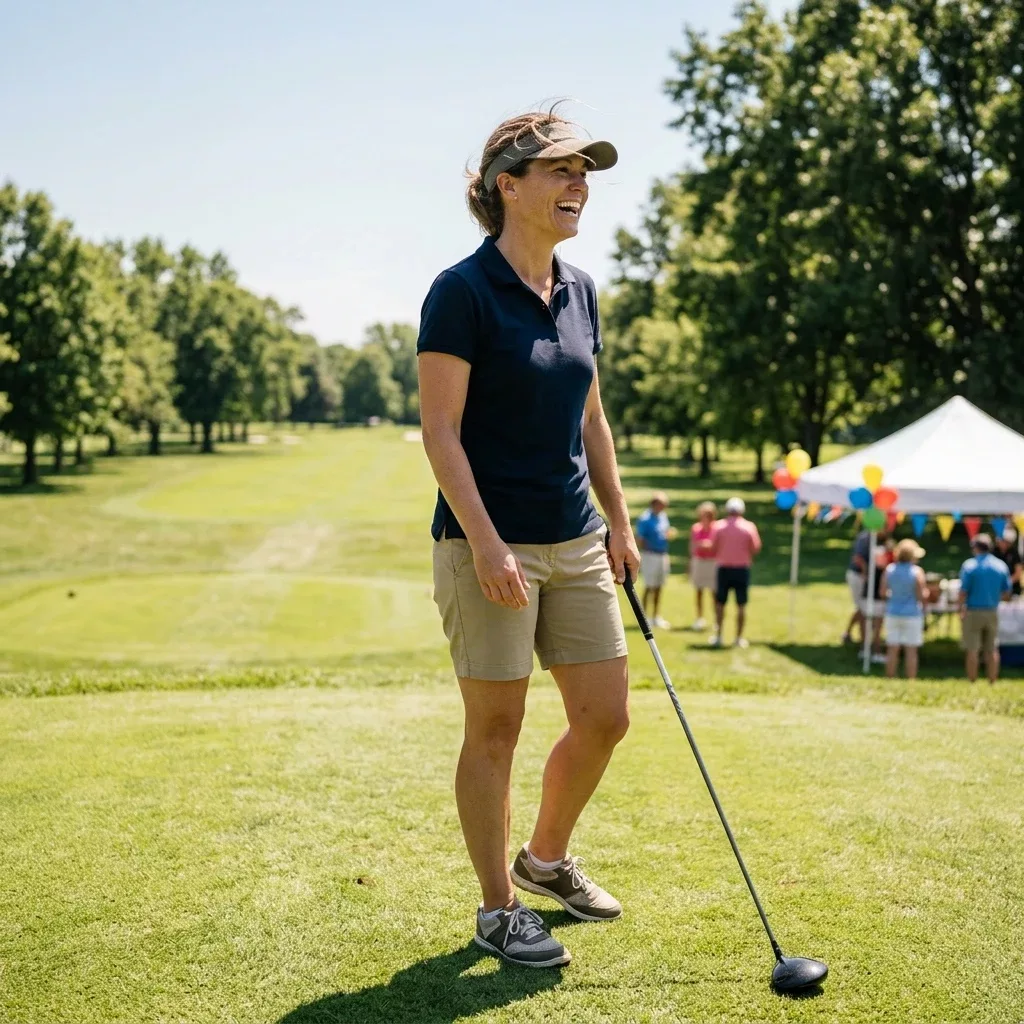
Quick answer: For a golfer who plays once or twice a year in charity scrambles and corporate events, the single most important driver spec is forgiving — meaning high MOI, draw bias to reduce a slice, and a shaft flex matched to your actual swing speed.
You don’t need to spend $400. A used Ping G430 SFT at $180-$250, the Performance Golf SF2 at its direct price, or even a used TaylorMade Burner SuperFast 2.0 Draw Edition at $70-$120 will all dramatically outperform whatever dusty neutral driver is sitting in your garage from 2009. This guide helps you pick the right option for exactly this situation.
The Charity Scramble Golfer: A Specific Profile With Specific Needs
The twice-a-year scramble golfer is one of the most underserved audiences in golf equipment content — almost everything written about drivers assumes you’re playing 18-36 rounds a year, posting a handicap, and actively trying to improve. That’s not you, and the advice that works for that golfer doesn’t always work for you.
Here’s what actually defines your situation:
You haven’t swung a club since the last event. Your swing is rusty at the start of every round and may not fully come back until the back nine. Equipment that is maximally forgiving on off-center contact matters more for you than for someone who plays weekly and has a grooved swing.
You’re playing a scramble format. In a scramble, the team uses the best shot from each player. This changes the math on driver strategy significantly — you’re not trying to put every drive in the fairway, you’re trying to put at least one drive from your group somewhere useful.
One good drive out of four attempts is all you need. That means you can swing a little harder and more aggressively than you would in stroke play, which slightly changes the shaft flex recommendation.
You want to not embarrass yourself. This is the real goal for most charity scramble golfers and it’s completely valid. A drive that goes straight — even if it only goes 175 yards — is infinitely better than one that rockets into the woods right on the first tee in front of your entire office.
You’re playing with colleagues, clients, or community members. The social stakes at a charity scramble are sometimes higher than the golf stakes. Equipment that gives you confidence at address and produces reasonable ball flight matters for your on-course enjoyment regardless of the score.
What Specs Actually Matter for a Scramble Golfer
1. Draw bias — your most important spec If you slice, a draw-bias driver is the single highest-impact equipment change you can make before a charity scramble. A club that fights your slice without requiring any swing changes will immediately improve your ball flight and reduce the OB shots that cost your team strokes.
2. High MOI forgiveness Since you play infrequently, your contact pattern across the face is likely inconsistent — sometimes center, sometimes toe, sometimes heel. A 460cc high-MOI head protects ball speed and direction on all of those off-center strikes. This is why a 460cc draw-bias driver is almost always the right call for the twice-a-year golfer over a more targeted 445cc option.
3. Correct shaft flex — lighter and softer than you think Most occasional golfers are playing a shaft that’s too stiff because it belonged to them when they played more regularly, or because they grabbed something off a rack without thinking about it. If you’re not playing regularly, your swing speed has likely declined from its peak.
When in doubt, go one flex softer than you think you need — a slightly softer shaft loads and releases more forgivingly on the inconsistent swing timing that comes with infrequent play.
4. Appropriate loft — higher than tour players use As covered in our driver loft guide, most recreational golfers benefit from 10.5°-12° of loft. For the occasional scramble golfer, 12° is almost always the better choice — more carry distance, less sidespin, straighter ball flight on the same swing. Don’t be talked into 9° or 9.5° because that’s what looks powerful on the rack.
5. Confidence at address This is underrated but real. A driver that looks clean and confidence-inspiring behind the ball produces better swings than one that looks complicated or intimidating. If you’re standing over the ball on the first tee thinking “I’m not sure about this club,” you’ve already lost before the swing starts.
The Best Driver Options for Charity Scramble Golfers
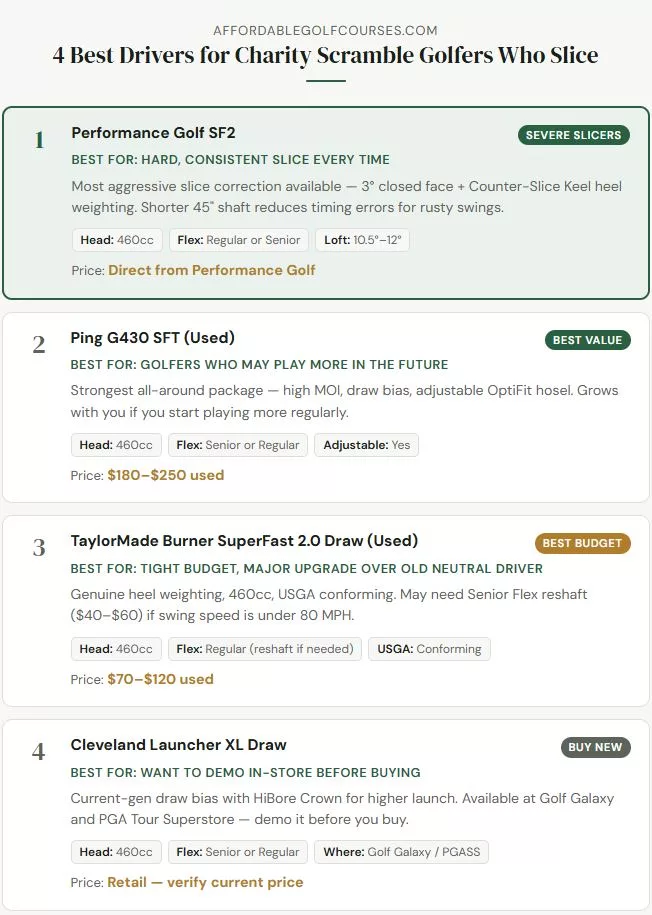
Option 1 — Performance Golf SF2 (Best for Severe Slicers)
Best for: Scramble golfers whose primary problem is a hard, consistent slice
If you know from previous scrambles that your driver tends to fly hard right on almost every swing, the SF2’s aggressive dual-mechanism correction — 3° closed face plus Counter-Slice Keel heel weighting — is the most direct solution available.
It’s specifically engineered for the recreational golfer who needs maximum slice correction built into the club rather than relying on swing mechanics that may be rusty from months off.
The SF2’s shorter 45-inch shaft also helps occasional golfers — less shaft length means less timing variability, which is exactly what an infrequent golfer needs when their swing isn’t fully groomed.
Best flex for scramble golfers: Regular or Senior depending on your estimated swing speed. When in doubt for a scramble, go Senior — the more forgiving timing window helps when your swing isn’t fully warmed up.
Price: Direct-to-consumer — verify current price at Performance Golf.
Considering the SF2 driver?
The full review covers whether the slice correction actually holds up for real golfers — not just what the marketing says — plus what the order page adds on at checkout that most buyers don’t see coming.
Read the full SF2 reviewOption 2 — Used Ping G430 SFT (Best Overall Value)
Best for: Scramble golfers who want the most complete package and may play more in the future
The Ping G430 SFT used at $180-$250 is the strongest overall recommendation for most charity scramble golfers because it delivers the highest combination of draw bias, MOI forgiveness, and overall driver quality at a price that makes sense for someone who plays twice a year.
If you ever decide to play more, this club grows with you — it’s not a specialist anti-slice tool, it’s a genuinely excellent driver that happens to fight your slice.
The adjustable OptiFit hosel also lets you dial in loft after purchase, which is useful if your first scramble with it reveals you need a touch more or less launch.
Best flex for scramble golfers: Senior Flex for swing speeds under 80 MPH, Regular for 80-90 MPH.
Price: $180-$250 used (2nd Swing, eBay, Golf Galaxy Pre-Owned)
Option 3 — TaylorMade Burner SuperFast 2.0 Draw Edition (Best Budget Option)
Best for: Scramble golfers on a tight budget who want a genuine upgrade over their current driver
At $70-$120 used, the TaylorMade Burner SuperFast 2.0 Draw Edition is the highest-value upgrade available for a charity scramble golfer who is currently playing an old neutral driver or hasn’t updated their equipment in years.
Confirmed USGA conforming, genuine heel weighting for draw bias, and a 460cc head for maximum forgiveness — it covers everything a scramble golfer needs at a price that’s easy to justify for twice-a-year play.
The one modification to make: if the stock shaft is Regular Flex and your swing speed is under 80 MPH, ask a local pro shop to reshaft it in Senior Flex before your event. This makes a meaningful difference for occasional golfers whose swing speed has declined.
Price: $70-$120 used plus optional $40-$60 reshaft if needed
Option 4 — Cleveland Launcher XL Draw (Best New Budget OEM Option)
Best for: Scramble golfers who want to buy new with a warranty and in-store support
If you prefer buying new from a recognized brand with warranty coverage and the ability to demo before purchasing, the Cleveland Launcher XL Draw delivers current-generation draw-bias technology at the most accessible new price on this list.
The HiBore Crown’s lower CG gives you higher launch — helpful for occasional golfers who tend to hit the ball slightly low — and draw bias tackles the slice simultaneously.
Available at Golf Galaxy and PGA Tour Superstore where you can actually swing it before buying, which is a meaningful advantage for a golfer who doesn’t play regularly and can’t easily self-assess their swing profile.
Price: Accessible retail pricing — verify current price at major golf retailers
The Scramble Strategy Question: Should You Swing Hard or Play Safe?
This is worth addressing directly because it affects which driver spec matters most for your situation.
In a scramble, you’re not the only one hitting — your team has three other drives to work with. This changes the optimal strategy from stroke play in one specific way: you can afford to be slightly more aggressive with your driver because a wild shot doesn’t cost your team a stroke if one of your partners hits a good one.
However — and this matters for equipment selection — “aggressive” in a scramble doesn’t mean swinging out of your shoes. It means swinging with confidence and a full turn rather than a tentative, steering motion.
Tentative swings at the tee in a scramble actually produce worse results than a committed full swing, because a steering motion creates more face angle variation and more off-center contact, not less.
The best equipment choice for a scramble golfer is a club that gives you enough confidence to make a committed, full swing — not a swing you’re trying to control or guide. A draw-bias driver that you trust to fight your slice gives you that confidence to commit, which produces better results than a neutral driver you’re steering.
Should You Take a Lesson Before the Scramble?
If your event is more than three weeks away, one lesson with a local PGA Professional focused specifically on driver basics is worth considering alongside the equipment upgrade. Not to rebuild your swing — just to get a single thought or feel to take to the tee that gives your swing a consistent anchor point.
The combination of draw-bias equipment plus one driver-specific tip from a pro produces better results than either alone for the occasional scramble golfer.
If the event is less than two weeks away, skip the lesson and focus on the equipment — there isn’t enough time to ingrain a swing change before the event, and a half-learned tip can actually introduce more inconsistency than playing without one.
Frequently Asked Questions
What is the best driver for someone who barely plays golf? For a golfer who plays once or twice a year, the priority is maximum forgiveness and draw bias to fight a slice — a 460cc high-MOI draw-bias driver in the correct shaft flex for your swing speed.
The used Ping G430 SFT at $180-$250 or the Performance Golf SF2 are both strong choices depending on your budget and slice severity.
Should I buy a new driver just for a charity scramble? If you’re currently playing a driver from before 2015 with no draw bias, yes — the improvement in ball flight from a modern draw-bias driver is significant enough to justify the cost even for twice-a-year play. If you’re playing a recent draw-bias driver that fits your swing speed, a new purchase probably isn’t necessary.
What loft driver should I use for a charity scramble? For most occasional golfers, 12° is the right choice. Higher loft produces more carry distance and reduces sidespin curvature at the moderate swing speeds typical of occasional golfers — both of which directly improve your scramble performance.
Do I need a driver fitting before a charity scramble? A full fitting isn’t necessary for a scramble golfer, but a free 15-minute swing speed measurement at Golf Galaxy or PGA Tour Superstore is worth doing before purchasing — it confirms your correct shaft flex and takes the guesswork out of the most important spec decision.
Is a draw bias driver legal for charity scramble events? Charity scrambles almost never enforce USGA equipment rules — they’re social events, not sanctioned competitions.
Bring whatever driver gives you the best results. If for some reason your event does enforce equipment rules, the Ping G430 SFT and Cleveland Launcher XL Draw are confirmed conforming; verify the SF2 independently at usga.org if needed.
Let us know what you think.
Scramble golfers — what driver are you currently playing at charity events, and what’s your biggest problem off the tee? Drop it in the comments and I’ll give you a straight answer on whether an equipment upgrade would help your scramble game.
Related Post
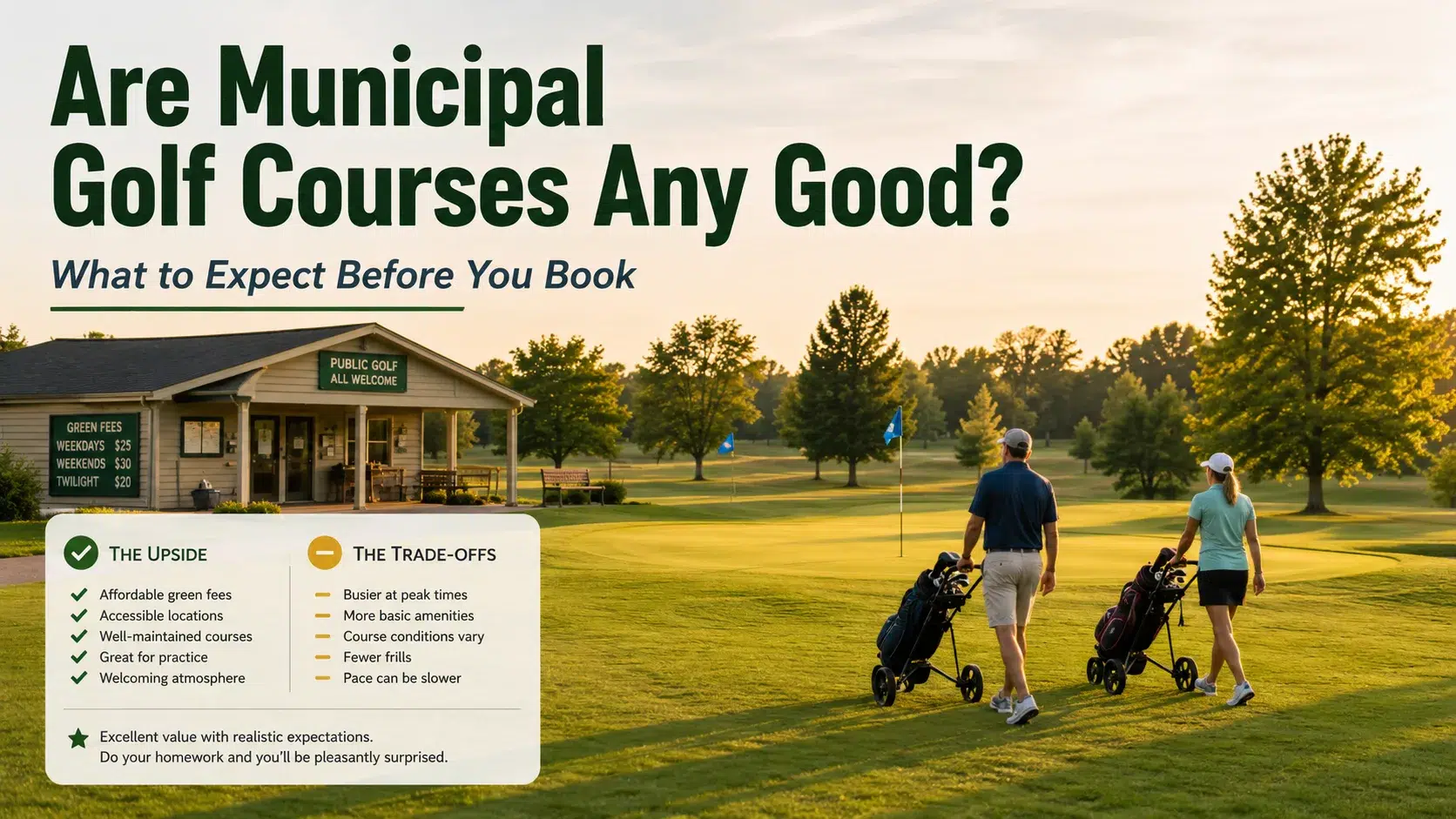
Are Municipal Golf Courses Any Good? What to Expect in 2026
Are Municipal Golf Courses Any Good? What to Expect Before You Book Municipal golf courses [...]
Senior Golf Discounts: Most Courses Start Between 50 and 62 — Here’s How to Find Yours
There’s no standard senior age in golf. Most courses set the threshold somewhere between 50 [...]