This website uses cookies to improve your experience. We\'ll assume you\'re ok with this, but you can opt-out if you wish. Read More
Best Public Golf Courses Under $50

Categories :
Article At A Glance: Best Affordable Public Golf Courses
- Public golf courses across the U.S. offer green fees as low as $35, with many top-rated layouts coming in well under $60 for 18 holes.
- Municipal courses and daily-fee public courses are not the same thing — and knowing the difference can save you serious money on your next round.
- Twilight rates, weekday tee times, and resident discounts can cut your green fee by 40% or more at most public courses.
- Some of the best-designed courses in America — including Donald Ross layouts — are open to the public for under $60.
- Keep reading to find out which discount strategies most golfers never think to ask about, and how to spot a genuinely great value course before you book.
Great golf doesn’t have to drain your wallet — and if you know where to look, some of the most rewarding rounds you’ll ever play cost less than a dinner out.
Green fees have been climbing steadily, and for everyday golfers, that stings. The average cost of a round at a private club can easily exceed $100–$200, putting it out of reach for most players who just want to get out on the course regularly.
But here’s what the golf media doesn’t always highlight: there are hundreds of outstanding public courses across the country charging $35 to $57 for 18 holes — courses with real pedigree, well-maintained fairways, and layouts that will genuinely test your game.
At GolfersRx, finding ways to help golfers play more for less is something they take seriously, because more time on the course means a better game for everyone.
This guide cuts through the noise and gets straight to the best affordable public golf courses worth your time and money, plus the strategies that make them even cheaper.
Great Golf Does Not Have to Cost a Fortune
The idea that quality and affordability can’t coexist on the golf course is simply outdated. Some of the most celebrated course designers in history — Donald Ross, A.W. Tillinghast, Robert Trent Jones Sr. — built courses that ended up in public hands, and today you can play them for a fraction of what a private club charges.
What makes a public course worth playing isn’t the price tag — it’s the combination of thoughtful design, decent conditioning, and an experience that leaves you thinking about specific holes on the drive home.
The courses in this guide do exactly that. Several of them consistently earn four and five-star reviews from real golfers who note things like course variety, staff friendliness, and overall conditioning as standout qualities.
1. George Wright Golf Course – Hyde Park, Massachusetts
George Wright Golf Course sits in the Hyde Park neighborhood of Boston and is one of the most underrated public golf values on the entire East Coast. Operated by the City of Boston, it’s the kind of course that regulars guard like a local secret.
What Makes This Donald Ross Layout Worth Playing
The layout was designed by Donald Ross, the same architect behind Pinehurst No. 2 and Oakland Hills — courses that have hosted major championships. At George Wright, his trademark undulating greens and natural use of the terrain create a round that is genuinely challenging without ever feeling gimmicky.
The course is hilly, demanding, and rewards smart course management over raw power. It does not have a driving range, which is a minor drawback, but the layout itself more than compensates.
Rates and Discount Options to Know Before You Go
Green fees at George Wright run $50–$57 for 18 holes, depending on the day and whether you’re a Boston resident. City residents qualify for reduced rates, and junior and senior discounts are also available. For a Donald Ross design in this condition, that pricing is genuinely exceptional — courses of comparable design pedigree in the private sector routinely charge five to ten times more.
Course Location Green Fee Range Designer George Wright Golf Course Hyde Park, MA $50–$57 Donald Ross Rustic Canyon Golf Course Moorpark, CA $35–$52 Gil Hanse Village Green Golf Course Varies $47–$55 N/A
2. Rustic Canyon Golf Course – Moorpark, California
Rustic Canyon Golf Course in Moorpark, California, is one of those rare public courses that golfers travel specifically to play. Designed by Gil Hanse — the same architect behind the 2016 Olympic Golf Course in Rio de Janeiro — it plays as a walking-friendly, minimalist design routed through natural California terrain.
Green fees come in at $35–$52, which is almost absurdly low for the quality of design on offer.
Golfer reviews consistently highlight the variety of hole layouts and the excellent course conditions, though like George Wright, it does not offer a driving range.
One verified review on GolfPass notes: “Great course and layout. Not super long but still challenging with variety of hole layouts. Course was in great shape.” That captures it well — this is a course built for golfers who care more about strategy than yardage.
Why Golf Insiders Rate This Course Above Its Price Tag
What separates Rustic Canyon from other budget options is the intentionality of the design. Hanse built the course to play naturally with the land, which means you’re reading terrain and wind rather than just targeting flat, manicured targets. That makes every round feel different, and it’s the kind of experience you’d normally associate with high-end resort golf.
Best Times to Book for the Lowest Green Fees
Like most public courses, Rustic Canyon’s rates vary by time and day. Weekday morning tee times tend to carry the highest fees, while twilight rounds — typically starting after 2:00 or 3:00 PM — can drop the price significantly. If flexibility is part of your game plan, a late weekday afternoon round here is one of the best green fee values in Southern California.
3. How Public Golf Courses Keep Costs Low Without Cutting Corners
Public courses operate under a fundamentally different financial model than private clubs. Without the overhead of membership infrastructure, exclusive amenities, or the expectation of exclusivity, daily-fee and municipal courses can pass genuine savings to the golfer.
Many are also subsidized at the local government level, which is why some of the best bargains exist at city- and county-run facilities.
Municipal vs. Public: What the Difference Means for Your Wallet
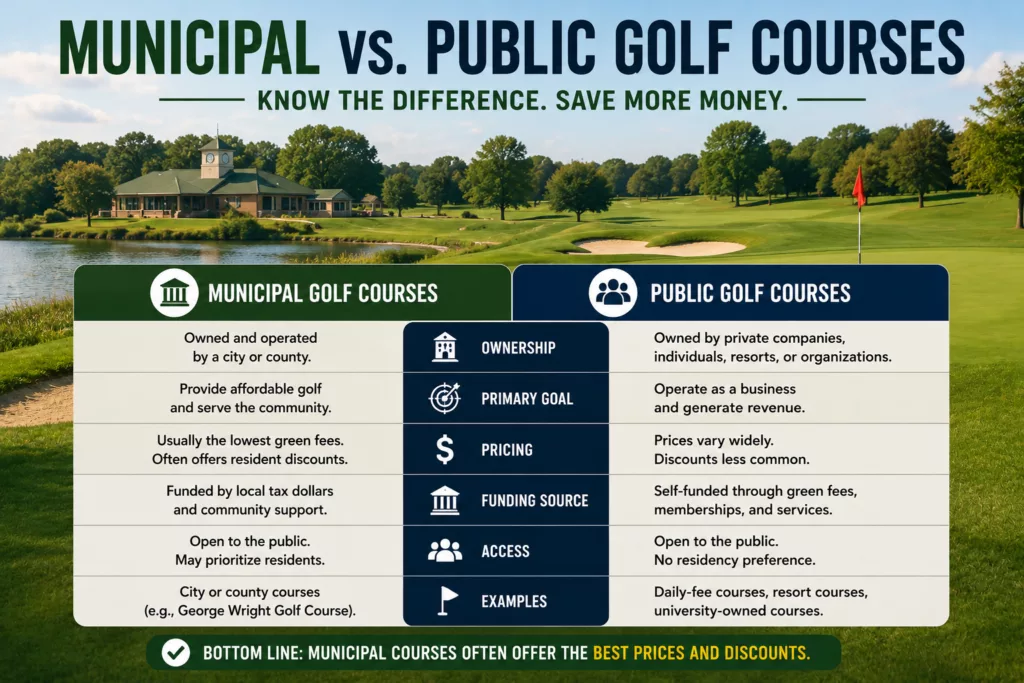
These two terms get used interchangeably, but they mean different things — and the distinction matters when you’re hunting for the best rates. A municipal golf course is owned and operated by a local government body, like a city or county parks department.
A public golf course is simply any course open to the public without a membership requirement, regardless of who owns it. That includes daily-fee courses run by private operators, resort courses open to walk-ins, and university-owned facilities.
Municipal courses almost always offer the lowest base rates because they’re funded in part by local tax revenue and are designed to serve the community. Many also offer resident discount cards that bring rates down even further.
If you live near a city-run course, calling the pro shop to ask about resident pricing is one of the fastest ways to cut your annual golf spending without sacrificing a single round.
How Twilight Rates and Weekday Tee Times Can Save You 40%+
Timing is everything when it comes to green fees. Most public courses use dynamic pricing, meaning the same 18 holes can cost wildly different amounts depending on when you tee off. Weekend mornings command the highest rates — peak demand, peak price.
Shift your round to a weekday, or book a twilight tee time after 2:00 or 3:00 PM, and the savings are immediate and substantial. On many courses, that same round that costs $55 on a Saturday morning drops to $30–$35 as a weekday twilight. That’s a 40% reduction without changing a single thing about the course you’re playing.

4. Discounts Most Golfers Never Think to Ask About
Most golfers assume the rate on the website is the rate they’ll pay — but that’s rarely the full picture. Public and municipal courses offer a surprising range of discounts that never get prominently advertised. Here are four worth knowing about before your next booking. Check out the Top 25 Value Golf Courses to explore more affordable options.
1. Senior and Junior Rates
Almost every public course offers reduced rates for seniors — typically players 60 or 65 and older — and juniors, usually under 17 or 18. These discounts are often significant, sometimes 20–30% off the standard adult rate. At municipal courses especially, junior rates are kept intentionally low as part of community outreach programs designed to grow the game.
If you’re booking a round with a mixed group that includes players in either category, always ask specifically about tiered pricing when you call. Websites don’t always list every discount tier, and a 60-second phone call to the pro shop can save your group real money.
2. Resident Discounts at Municipal Courses
City- and county-operated courses routinely offer reduced rates to local residents as part of their public service mandate. At George Wright Golf Course in Boston, for example, Boston residents pay a lower rate than out-of-town guests.
Some municipalities offer discount cards or annual passes for residents that bring the per-round cost down dramatically. If there’s a municipal course within your zip code, it’s worth a call to ask what residency-based pricing looks like — you may be leaving money on the table every time you play.
3. Loyalty Cards and Season Passes
Many public courses offer punch cards, loyalty programs, or seasonal passes that significantly reduce the effective cost per round. A season pass at a well-maintained municipal course can sometimes break down to as little as $15–$20 per round when you factor in the number of times you’ll play from April through October.
These programs don’t always get promoted aggressively, so it pays to ask the pro shop directly. Some courses also partner with local golf associations to offer member discounts across multiple facilities — a particularly good deal for golfers who like to rotate between a few different layouts rather than playing the same course every week.
4. Last-Minute Tee Time Apps Like GolfNow
Apps like GolfNow and TeeOff have changed the way budget-conscious golfers book rounds. Courses list unfilled tee times — often within 24 to 48 hours of the round — at heavily discounted rates simply to fill empty slots. It’s the golf equivalent of last-minute flight deals, and the savings can be dramatic.
GolfNow in particular has a feature called Hot Deals that surfaces the steepest last-minute discounts in your area. If your schedule has any flexibility at all, checking these apps the evening before you want to play can routinely land you rounds at quality public courses for $20–$30 less than the standard rate.
Combine that with a twilight tee time and you’re looking at genuinely exceptional value.
5. What Separates a Truly Great Value Course From a Cheap One
Price alone doesn’t tell the whole story. There are $25 courses that feel like a waste of four hours, and there are $55 courses that leave you already planning your return trip before you’ve reached your car. The difference comes down to a handful of factors that experienced golfers learn to identify before they ever set foot on the first tee.
Course Conditions Matter More Than the Clubhouse
A gleaming clubhouse with a full restaurant and pro shop means nothing if the fairways are patchy and the greens are slow and uneven. When evaluating whether a public course represents genuine value, conditions are the first thing to assess.
Look for recent golfer reviews — not just star ratings, but written comments that specifically mention green speed, fairway turf quality, and bunker maintenance. A course where reviewers consistently say things like “greens were in great shape” or “fairways were well-maintained” is a far better bet than one with a flashier facility and mediocre playing surfaces.
Design Pedigree: Why a Ross or Tillinghast Layout Changes Everything
When a course was designed by Donald Ross, A.W. Tillinghast, or another golden-age architect, the bones of the layout carry an inherent quality that no amount of modern renovation can replicate.
Ross in particular was a genius at using natural terrain — he rarely moved earth unnecessarily, which means his courses flow with the land in a way that feels organic and logical from the first tee to the eighteenth green. His greens are famous for their subtle crowns and false edges, rewarding precise approach play over raw distance.
What this means for the budget golfer is significant. Many Ross and Tillinghast designs ended up in municipal or daily-fee public hands over the decades, preserved by city parks departments rather than sold to private developers.
George Wright in Boston is a prime example — a genuine Ross design you can walk for under $60. That is an extraordinary value by any measure, and it is the kind of thing that makes hunting for well-designed affordable public courses one of the most rewarding pursuits in the game.
The Best Affordable Public Golf Is Out There — You Just Have to Look
The best affordable public golf doesn’t announce itself with billboard advertising or a massive online presence. It lives in city parks departments, on county-managed fairways, and at daily-fee courses run by operators who care more about the golf than the profit margin.
Between twilight rates, resident discounts, last-minute booking apps, and the sheer number of quality public layouts across the country, there has never been a better time to play great golf on a real budget. You just have to know where to look — and now you do.
Frequently Asked Questions
Here are the most common questions golfers ask when searching for affordable public courses, answered directly and honestly.
What is considered a good green fee for a public golf course?
A good green fee at a public golf course is generally anything under $60 for 18 holes, with truly exceptional value found in the $35–$55 range. At that price point, you can access well-maintained layouts — including some with genuine design pedigree — without feeling like you compromised on the experience.
Anything under $40 for a quality course with decent conditions is considered an outstanding deal by most golfers’ standards.
Are municipal golf courses the same as public golf courses?
Not exactly. A municipal golf course is a specific type of public course — one that is owned and operated by a local government body such as a city or county parks department. All municipal courses are public, but not all public courses are municipal.
Daily-fee courses, resort courses open to walk-ins, and university-owned facilities are all technically public because anyone can pay to play — but they operate under private or institutional management rather than government oversight.
The practical difference is that municipal courses almost always offer the lowest base rates and the most robust discount structures, including resident pricing that can cut green fees by 20–30% for locals.
Do public golf courses require a membership to play?
No. By definition, a public golf course does not require a membership to play. You can walk up, pay the green fee, and tee off — no application, no initiation fee, no annual dues. That open-access model is precisely what makes public courses the backbone of recreational golf in the United States.
That said, many public and municipal courses do offer optional memberships, season passes, or loyalty programs that reduce the per-round cost for frequent players.
These are entirely voluntary and never a requirement for access. If you play the same course more than 15–20 times a year, it is usually worth asking the pro shop whether a season pass or punch card would save you money over paying individual green fees each time.
What is the cheapest time to play golf at a public course?
The cheapest time to play at most public courses is during a weekday twilight round — typically a tee time booked after 2:00 or 3:00 PM on a Monday through Friday. Demand is at its lowest during these windows, and most courses price accordingly. On many public layouts, a twilight weekday rate can run 30–40% lower than the same course on a weekend morning.
Booking through last-minute tee time platforms like GolfNow or TeeOff within 24–48 hours of your round can push those savings even further. Courses list unfilled slots at steep discounts rather than let them go empty, and the golfer with a flexible schedule is the one who benefits most.
Combining a weekday twilight tee time with a last-minute app booking is the single most effective way to minimize your green fee at a quality public course.
Are affordable public golf courses worth playing, or is the quality too low?
Affordable public golf courses are absolutely worth playing — and the assumption that low price equals low quality is one of the most persistent myths in the game. Courses like George Wright Golf Course in Boston and Rustic Canyon Golf Course in Moorpark, California, are legitimate proof that outstanding golf design and accessible pricing are not mutually exclusive.
The key is knowing what to look for. Focus on courses with strong recent reviews that specifically mention conditions, not just star ratings. Look for layouts with design pedigree — a Ross, Tillinghast, or Hanse design at a public rate is always worth investigating.
And don’t equate the absence of a luxury clubhouse with a lesser experience on the course itself. The golf is what matters, and at the right public course, it can be every bit as memorable as a round that costs three times as much.
At the end of the day, the golfers who play the most — and improve the fastest — are the ones who find great public courses they can return to again and again without breaking the bank.
That is what affordable public golf makes possible, and it is why knowing these courses and strategies is worth every bit of the research. Visit GolfersRx to explore more expert tips, course recommendations, and gear advice built specifically for golfers who want to play better and spend smarter.
Related Post

Performance Golf SF2 vs Callaway Paradym Draw: Is the Price Difference Justified?
Quick answer: The Callaway Paradym Draw is a premium, confirmed USGA-conforming draw-bias driver built on [...]
Will a Slice-Correcting Driver Fix My Slice, or Do I Need Lessons?
A slice-correcting driver will reduce your slice, but it will not fix it. The club [...]