This website uses cookies to improve your experience. We\'ll assume you\'re ok with this, but you can opt-out if you wish. Read More
What Is the Best Driver for a 20 Handicapper Who Slices?
Affiliate disclosure: AffordableGolfCourses.com may earn a commission if you buy through links on this page, at no extra cost to you. Prices below were checked in October 2026 and change often, especially on prior-year models. Confirm the price before you buy.
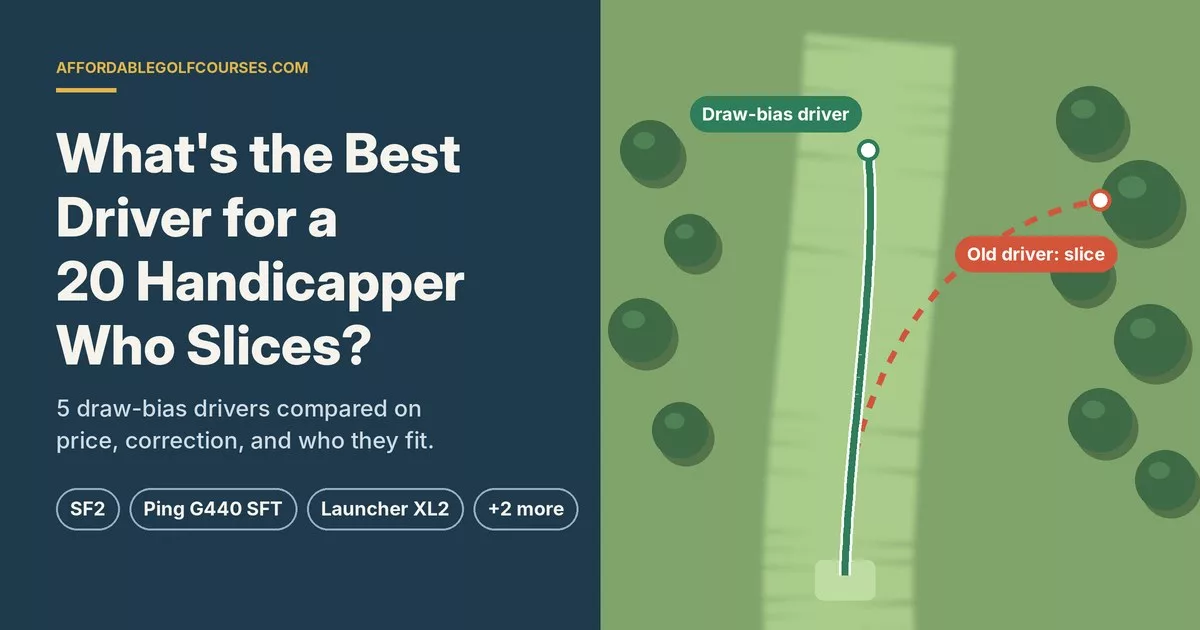
Quick answer: For most 20 handicappers who slice, the best driver is one with real draw bias, 10.5° to 12° of loft, and a shaft flex matched to your actual swing speed.
The Performance Golf SF2 ($299) is the strongest correction for a consistent, big slice.
The Ping G440 SFT is the best premium choice if you want a conforming club with resale value.
The Cobra DS-Adapt Max-D is the best pick if your slice comes and goes and you want adjustability.
The Cleveland Launcher XL2 Draw is the best value, often on sale around $200.
The TaylorMade Qi35 Max fits the 20 handicapper whose misses go both ways. Which one is right depends on how big your slice is and how consistent it is.
What Makes a 20 Handicapper Different From Other Slicers?
A 20 handicapper is different because the swing is repeatable enough to have a pattern, but not repeatable enough to fix that pattern on its own. You’re not a beginner. You can break 95 on a good day, you know what your miss looks like, and you’ve probably watched more slice-fix videos than you’d care to admit.
That matters for driver choice in three ways:
Your miss is predictable. Most 20 handicappers who slice have a slice that shows up most of the time, not every time. That means a driver can be tuned to it. A beginner’s misses go everywhere, so equipment can only do so much.
You swing faster than you think. Many 20 handicappers swing somewhere in the mid-80s to mid-90s MPH with a driver. That often puts you in a Regular flex, not the Senior flex a lot of slicers default to.
A shaft that’s too soft can make an open face worse, not better. If you haven’t measured yours, our guide on how to measure your swing speed without a launch monitor takes about ten minutes.
You’re close to a real scoring jump. The gap between a 20 and a 15 handicap is mostly penalty strokes and recovery shots. Taking one or two drives per round out of the trees is often worth three to five strokes on its own. That’s why driver choice matters more at this level than almost anywhere else.
What Should a 20 Handicapper Look for in an Anti-Slice Driver?
A 20 handicapper should look for four things: the right amount of draw bias, enough loft, a matched shaft, and forgiveness on off-center hits.
1. Draw bias that matches your slice. Draw bias comes from heel weighting, a closed face, offset, or some mix of the three. A mild fade needs mild correction. A slice that starts left and curves 30 yards right needs aggressive correction. Too much draw bias on a mild slicer turns the slice into a hook.
We cover that trade-off in does a draw bias driver actually fix a slice or just move the miss.
2. Loft of 10.5° to 12°. More loft means less sidespin, which means a smaller curve. Most 20 handicappers who slice are playing too little loft. If you’re between options, go higher. Our driver loft guide for slicers breaks down the numbers by swing speed.
3. The right shaft flex. Match the flex to your measured swing speed, not your age or your ego. See SF2 shaft flex guide for the speed bands.
4. High forgiveness (MOI). Even a good 20 handicapper hits the heel and toe a lot. A high-MOI head keeps those mishits closer to the fairway.
What Are the 5 Best Drivers for a 20 Handicapper Who Slices?
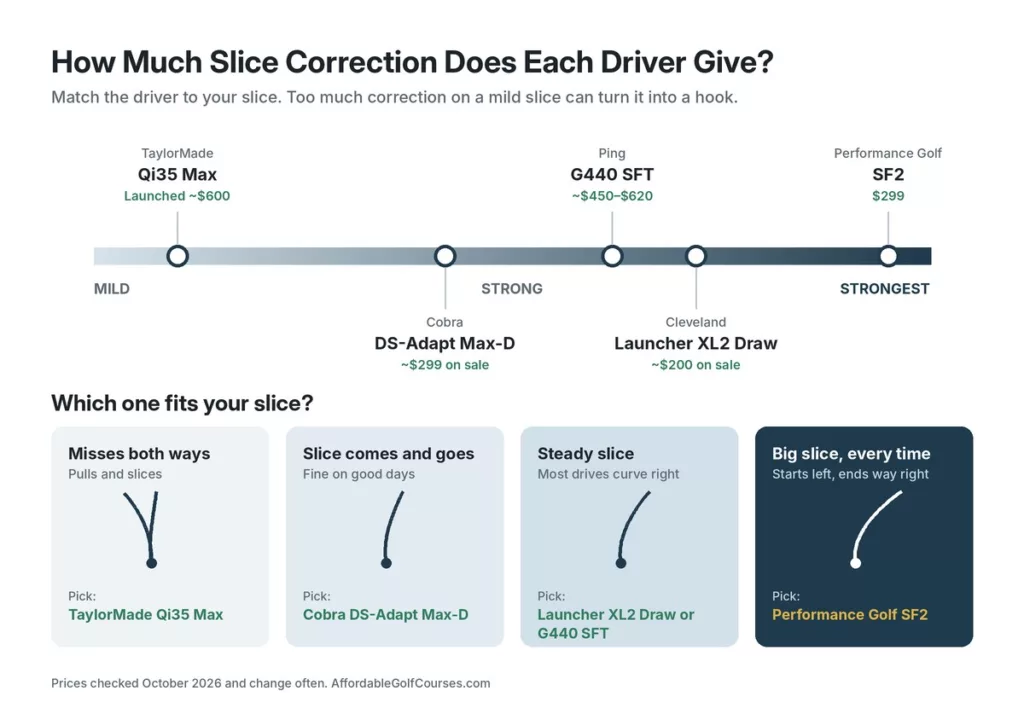
Here are the five worth considering, ranked by how strongly they correct a slice.
| Driver | Price (Oct 2026) | Draw Correction | Adjustable? | Best For |
|---|---|---|---|---|
| Performance Golf SF2 | $299 | Strongest | No | Big, consistent slice |
| Cleveland Launcher XL2 Draw | ~$200 on sale (list ~$450) | Strong | No | Best value |
| Ping G440 SFT | ~$450–$620 new | Strong | Weight + hosel | Premium, conforming, resale value |
| Cobra DS-Adapt Max-D | ~$299 on sale (list ~$549) | Moderate to strong | Yes, hosel | Slice that comes and goes |
| TaylorMade Qi35 Max | Launched ~$600, often discounted | Mild | Yes | Misses both ways |
1. Performance Golf SF2: Best for a Big, Consistent Slice
The SF2 is the most aggressive slice correction on this list. It has a 3° closed face, heel weighting, and 15° of loft at square that works out to about 12° at address. None of it is adjustable, which is the point. It’s built for one golfer: the one who slices nearly every drive.
Why it fits a 20 handicapper: If your slice is your single biggest scoring problem, the SF2 attacks it harder than anything else here. It also comes in Senior, Regular, Stiff, and Ladies builds, so you can match the flex properly.
The trade-offs: It’s 445cc, a bit smaller than the 460cc heads on the other four. There’s no adjustability, so if your swing improves and the slice shrinks, you can’t dial the correction back. It’s sold direct, so you can’t hit one at a store first.
Performance Golf backs it with a 365-day money-back guarantee, which takes most of the risk out of that. Our full Performance Golf SF2 review covers it in detail.
Skip it if: your miss is sometimes a hook, or you play in sanctioned events and want zero doubt about conformance. Read is the SF2 USGA conforming first.
Considering the SF2 driver?
The full review covers whether the slice correction actually holds up for real golfers — not just what the marketing says — plus what the order page adds on at checkout that most buyers don’t see coming.
Read the full SF2 review2. Cleveland Launcher XL2 Draw: Best Value
The Launcher XL2 Draw is the best-value draw driver on this list. Its list price was about $450, but it’s widely discounted, and it was on sale for around $200 at golfdiscount.com when we checked in October 2026. Cleveland built it with internal heel weighting and a lightweight build, aimed at golfers with moderate swing speeds.
Why it fits a 20 handicapper: You get real draw bias, a full 460cc head, and current technology for less than most used premium drivers. If you want to fix a steady slice without spending much, this is the one.
The trade-offs: Today’s Golfer’s testers found it launched lower with a less flighted ball than some rivals, so faster swingers may want the 12° head. It isn’t adjustable.
3. Ping G440 SFT: Best Premium, Conforming Option
Ping’s SFT (“Straight Flight Technology”) line has been the default premium anti-slice driver for years. The G440 SFT adds a moveable weight and an adjustable hosel, and it comes in 9°, 10.5°, and 12.5°. It was listed at $447 on sale against a $617 list price when we checked.
Why it fits a 20 handicapper: It’s confirmed conforming, holds resale value well, and you can get it custom fit at most golf shops. If you’re the 20 handicapper who’s serious about getting to 15 and wants a driver you won’t outgrow, this is it.
The trade-offs: It’s the most expensive option here. In Today’s Golfer’s testing, it also had the widest left-to-right dispersion of the drivers on their shortlist, so it’s a strong slice fixer but not the tightest-grouping club. Testers also found it louder at impact.
Budget version: The previous-generation Ping G430 SFT often sells used for $180–$250 and gives you most of the same correction. We compared it head to head in SF2 vs Ping G430 SFT.
4. Cobra DS-Adapt Max-D: Best for a Slice That Comes and Goes
The DS-Adapt Max-D is a draw-biased head with Cobra’s FutureFit33 hosel, which offers a wide range of loft and lie settings. It was on sale for about $299 against a $549 list price when we checked.
Why it fits a 20 handicapper: Plenty of 20 handicappers have a slice on bad days and a straight ball on good ones. Adjustability lets you start with more correction and dial it back as your swing improves. That’s the main thing it does better than the SF2.
The trade-offs: The draw bias is moderate. If you have a big slice on every drive, the SF2 or the Ping will correct it more. Adjustability also only helps if you actually use it. Many golfers set it once and never touch it again.
5. TaylorMade Qi35 Max: Best When Your Misses Go Both Ways
The Qi35 Max isn’t a dedicated draw driver. It’s one of the most forgiving drivers TaylorMade has made, with a 10,000 MOI headline number, and in Today’s Golfer’s testing it had the tightest left-to-right dispersion of the clubs on their shortlist.
Why it fits a 20 handicapper: If your slice is real but you also hit the occasional pull or hook, a strong draw driver will make those worse. A very forgiving, mostly neutral head shrinks both misses instead of pushing everything left.
The trade-offs: It won’t straighten a big slice on its own. It launched at around $600, though last year’s TaylorMade models are often discounted. If your miss is always right, pick one of the four above.
Which Driver Should You Pick?
Pick based on your slice, not the brand name. Use this as your shortcut:
- Your slice shows up on almost every drive and it’s big: Performance Golf SF2
- You have a steady slice and a tight budget: Cleveland Launcher XL2 Draw
- You want a premium, conforming club you can get fitted for: Ping G440 SFT (or a used G430 SFT)
- Your slice comes and goes: Cobra DS-Adapt Max-D
- You miss both ways: TaylorMade Qi35 Max
If you’d like the full field ranked, including options for beginners and seniors, see our best draw bias drivers of 2026 ranked. If you’re over 60 and losing swing speed, our best drivers for seniors who slice is a better fit than this guide.
Will a New Driver Get a 20 Handicapper to 15?
A new driver alone usually won’t get you from 20 to 15, but it can get you a good part of the way. The right driver takes the worst slices out of play. That saves penalty strokes and punch-outs, which is where most 20 handicappers lose the most shots.
What it won’t do is fix the swing that causes the slice. If your clubface is open at impact because of your grip or your path, a draw driver reduces the damage but doesn’t remove the cause.
The golfers who improve fastest usually do both: get a driver that keeps them in play now, and work on the swing over the season. One lesson focused on grip and path is often enough to tell you which you need more.
Frequently Asked Questions
What is the best driver for a 20 handicapper who slices? For a big, consistent slice, the Performance Golf SF2 offers the strongest correction at $299. For a premium conforming option, the Ping G440 SFT is the standard choice. For value, the Cleveland Launcher XL2 Draw is often on sale around $200. The best one depends on how big and how consistent your slice is.
What loft driver should a 20 handicapper use? Most 20 handicappers who slice should use 10.5° to 12° of loft. Higher loft reduces sidespin, which shrinks the curve on a slice and usually adds carry for golfers with moderate swing speeds.
What shaft flex does a 20 handicapper need? It depends on swing speed, not handicap. Many 20 handicappers swing between the mid-80s and mid-90s MPH, which usually fits a Regular flex. Golfers under about 80 MPH generally do better with a Senior flex. Measure your speed before choosing.
Is a draw bias driver bad for a 20 handicapper? No. A draw bias driver is one of the most useful equipment changes a 20 handicapper who slices can make. The only risk is choosing too much correction for a mild slice, which can turn a fade into a hook.
Should a 20 handicapper buy a new driver or take lessons? Both help in different ways. A draw bias driver reduces the damage from a slice right away. Lessons address the grip or swing path that causes it. Many golfers get the best results by doing both.
Can a 20 handicapper use an adjustable driver? Yes. An adjustable driver like the Cobra DS-Adapt Max-D or Ping G440 SFT lets you increase draw settings now and dial them back as your swing improves. Adjustability only helps if you take the time to test the settings.
20 handicappers: how big is your slice, really? Tell me what driver you’re playing now, what loft it is, and how far right your average miss ends up. A few yards, the edge of the fairway, or the next hole over? Drop it in the comments and I’ll tell you which of these five I’d put in your bag.
Related Post
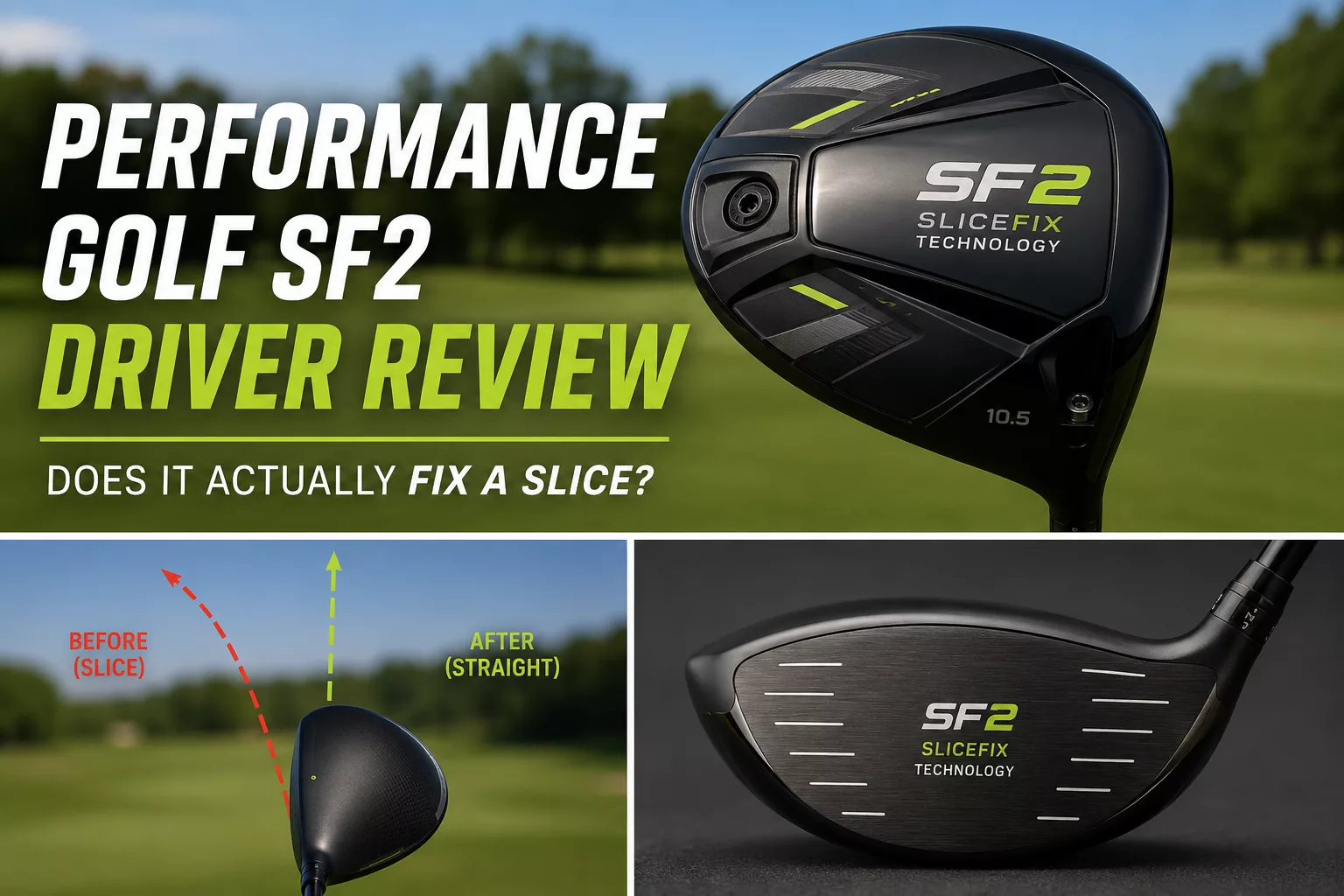
Performance Golf SF2 Driver Review: Does It Actually Fix a Slice?
Performance Golf SF2 Driver Review: Does It Actually Fix a Slice? The short answer: yes. [...]
What Time Does Twilight Golf Start? (And When It’s Actually a Deal)
Twilight golf typically starts between 1:00pm and 4:00pm, but there is no industry-standard time — [...]