This website uses cookies to improve your experience. We\'ll assume you\'re ok with this, but you can opt-out if you wish. Read More
Best Golf Courses in the $30-$75 Range in Wisconsin

Categories :
- Wisconsin has over 400 public golf courses, and some of the most architecturally interesting ones cost less than a tank of gas to play.
- Bull’s Eye Country Club in Wisconsin Rapids offers a Larry Packard-designed layout with a peak walking rate of just $55 — and it sits minutes from Sand Valley Resort.
- The Sandbox at Sand Valley is a 17-hole Coore & Crenshaw short course that plays for under $75, with green complexes that rival anything in the Midwest.
- Budget courses in Wisconsin often share common flaws — tree overgrowth, shrunken greens, and poor mowing lines — but knowing what to look for helps you avoid disappointment.
- Keep reading to find out which under-$30 Wisconsin courses are actually worth your time, and which tips will stretch your golf budget even further.
Wisconsin is quietly one of the best states in the country for budget golfers who actually care about course quality.
Most people think affordable golf means flat, boring layouts with patchy fairways and greens that haven’t seen a stimpmeter in years. That’s not Wisconsin. The state’s rolling terrain — glacially carved, dramatic in places — creates natural settings that even budget-priced courses can capitalize on. Wisconsin Golf Addict has been cataloguing these hidden gems for years, and their research backs up what savvy locals already know: you don’t need to spend $200 at Whistling Straits to have a memorable round here.
With more than 400 public courses spread across the state, the options can feel overwhelming. The trick isn’t finding cheap golf — it’s finding good cheap golf. That’s exactly what this guide is built for.
What Makes a Cheap Course Worth Your Time
Not every $20 green fee is created equal. Some budget courses are cheap for a reason — neglected infrastructure, cookie-cutter routing, and greens that roll like carpet samples. But others are underpriced simply because they’re not well-marketed, or because they’re tucked into communities that haven’t figured out what they have yet.
Architectural Interest Over Manicured Mediocrity
The single best predictor of whether a budget course is worth playing is the routing. A well-designed course uses its land. It moves with the terrain instead of fighting it, creates risk-reward decisions on multiple holes, and gives you something to think about beyond just “hit it straight.”
Wisconsin has a surprising number of courses designed by legitimate architects — names like Larry Packard, George Hanson, and the team of Coore & Crenshaw — that happen to be accessible at public rates. These are designers who built courses at private clubs across the country, and their public Wisconsin work is largely underappreciated. A common criticism across the state is tree overgrowth that narrows corridors and kills strategic variety, but the bones of these designs are still there.
When evaluating a course, look past the conditioning. Ask whether the hole gives you options, whether the green complexes reward precise approach play, and whether the land itself is interesting. Those are the things you can’t fix with a bigger maintenance budget — and they’re the things that make a round memorable at any price point.
Walking Access and Public Tee Times
Walking a course instead of riding is the single easiest way to cut your costs in half without losing anything. Many of Wisconsin’s best budget tracks are walkable by design — especially the older parkland layouts where terrain was a key part of the original vision. If a course restricts walking during peak hours, that’s worth factoring into your overall value calculation.
1. Bull’s Eye Country Club – Wisconsin Rapids, WI
Bull’s Eye Country Club sits in Wisconsin Rapids and plays as one of the most compelling value rounds in the entire state. Designed by Larry Packard — a prolific architect whose work includes dozens of courses across the Midwest — the layout takes full advantage of its rolling central Wisconsin terrain. The peak walking rate sits at $55, which sounds like it falls outside the “under $30” category, but off-peak and twilight rates bring it into range regularly. More importantly, it sets the benchmark for what architectural quality at a budget price actually looks like.
Why Larry Packard’s Design Punches Above Its Price Tag
Packard was a workhorse designer in an era when golf architecture prioritized strategy over spectacle. His courses ask real questions — especially off the tee, where angles matter and blind aggression gets punished. Bull’s Eye is a textbook example of his philosophy: understated from the parking lot, genuinely engaging once you’re on the course. The greens complexes are varied, the fairways move with the land, and the overall experience feels a tier above the green fee.
The Double Dogleg Par 5 You Need to See
The standout hole at Bull’s Eye is a double dogleg par 5 that forces layup decisions at two separate points in the hole. It’s the kind of design feature you’d expect at a course charging three times the price. The views from the back nine — particularly from the 10th green and 11th tee box — have been described as some of the best in Wisconsin, offering the kind of panoramic elevation change that most budget courses simply don’t have.
How Close It Is to Sand Valley
Wisconsin Rapids is the gateway city to Sand Valley Resort, which means a trip to Bull’s Eye pairs naturally with a round at The Sandbox or one of the Sand Valley resort courses. If you’re building a Wisconsin golf trip on a budget, anchoring it in this region gives you access to multiple tiers of course quality without driving hours between stops.
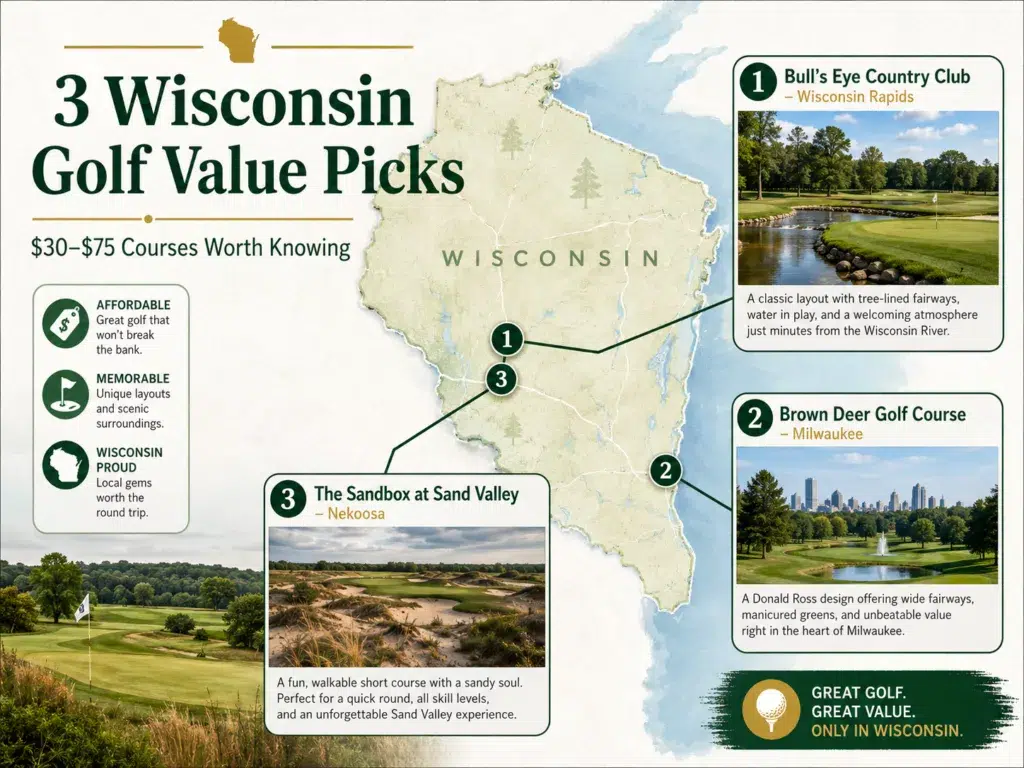
2. Brown Deer Golf Course – Milwaukee, WI
Brown Deer Golf Course is a Milwaukee County-operated track with serious pedigree. Designed by George Hanson, the course has historically hosted PGA Tour events — most notably the Greater Milwaukee Open — and its layout reflects that competitive heritage. The peak walking rate of $79 puts it at the higher end of the budget spectrum, but the course’s history, conditioning, and design quality make it one of the strongest value propositions in southeastern Wisconsin. For golfers in the Milwaukee metro who want a course with real tournament DNA without paying private club rates, Brown Deer delivers consistently.
George Hanson’s Legacy Track in the Heart of Milwaukee
Brown Deer isn’t just a municipal course that happens to be affordable — it’s a course that has genuinely tested PGA Tour professionals. The layout features tree-lined fairways, firm and fast greens when properly maintained, and enough length to challenge low handicappers while remaining accessible for recreational players. The George Hanson design uses elevation changes throughout the property to create visual interest and strategic variety that most county-run courses simply don’t bother with.
3. The Sandbox at Sand Valley – Nekoosa, WI
The Sandbox is the short course at Sand Valley Resort, designed by the legendary team of Bill Coore and Ben Crenshaw. It plays 17 holes across a sandy, tumbling landscape that looks and feels nothing like a traditional Wisconsin golf course. At a peak walking rate of $75, it’s the most premium entry on this list — but it earns its place because of what it offers architecturally at that price point.
Coore & Crenshaw are responsible for some of the most celebrated courses in American golf, including Sand Hills in Nebraska and Friars Head in New York. The Sandbox reflects the same design sensibility at a fraction of the scale — and a fraction of the price. It’s a masterclass in using natural terrain creatively, and it’s genuinely unlike anything else you can play in the Midwest for under $100.
17 Holes of Pure Short-Game Creativity
The Sandbox plays as a 17-hole layout, which is an intentional design choice rather than an oversight. Each hole is compact, precise, and demands creative shot-making around and onto the greens. The sandy subsoil creates firm, fast conditions that reward bump-and-run approaches and punish golfers who insist on flying the ball all the way to the pin.
Because the holes are short — most well under 150 yards — the emphasis shifts entirely to trajectory, spin control, and reading complex green surfaces. It’s the kind of course where a scratch golfer and a 20-handicapper can both have an equally engaging time, just for completely different reasons.
The 17-hole format also means rounds move quickly. Most players finish in under two hours walking, which leads to one of the smartest strategies for getting maximum value out of the green fee.
- Holes play across natural sandy ridges and hollows — no artificial shaping
- Every green complex offers at least two or three distinct pin positions with different strategic demands
- The turf plays firm and fast, rewarding ground game over aerial approaches
- Wind becomes a genuine factor, even on short holes, because of the open sandy landscape
- Walking the full 17 takes most players between 90 minutes and two hours
Best Green Complexes in the State for Under $75
The greens at The Sandbox are what set it apart from every other budget course in Wisconsin. Coore & Crenshaw are known for building green complexes that integrate seamlessly with the surrounding landscape — no abrupt edges, no artificial-looking false fronts. The surfaces roll with natural movement, and the collection areas around each green create genuinely interesting up-and-down challenges. For golfers who want to sharpen their short game, this is as good a training ground as you’ll find in the state at any price.
Why Playing It Multiple Times in One Day Makes Sense
Because rounds move so quickly and the fee covers a single session rather than a set number of holes, many players loop through The Sandbox twice in a single visit. The 17-hole format means you almost never play the same combination of pin positions twice, and the low-stakes environment makes it ideal for working on specific shots without the pressure of a full 18-hole scorecard.
Common Flaws to Watch for at Budget Wisconsin Courses
Wisconsin’s budget golf scene isn’t without its problems. The same characteristics that keep green fees low — modest maintenance budgets, aging infrastructure, limited staffing — also produce some recurring issues that can take the shine off an otherwise promising round. Knowing what to watch for before you book saves you from disappointment.
The most commonly cited issues across budget courses in the state fall into two categories: design compromises made over time, and maintenance shortcuts that compound those compromises. Neither is a dealbreaker on its own, but together they can turn a great-bones course into a frustrating experience.
Tree Overgrowth and Narrow Corridors
Tree overgrowth is the single most widespread problem at Wisconsin’s older budget courses. Many layouts were designed in an era when trees were planted as aesthetic features or windbreaks, with little consideration for how they’d affect strategic play decades later. What was once an open, strategic fairway becomes a narrow chute where the only correct shot is straight. This kills variety, punishes mishits disproportionately, and removes the risk-reward decisions that make good golf interesting. It’s worth checking recent reviews or aerial views of a course before you visit to gauge how severe the tree issue has become.
Shrunken Greens and Poor Mowing Lines
The second major issue is green size. Decades of topdressing, re-edging, and deferred renovation have left many Wisconsin greens significantly smaller than their original design intent. A green that was built at 6,000 square feet may now play closer to 3,500, which eliminates pin positions, speeds up surfaces artificially, and reduces the variety that makes approach play engaging.
Poor mowing lines compound this problem by creating visual confusion between fairway, rough, and surrounds. When the transitions aren’t clean, it’s harder to read lies, harder to select the right club, and — frankly — harder to enjoy the round. These are fixable problems, but they require investment that many budget operations haven’t prioritized.
- Check Google Earth or satellite views to assess tree density before booking
- Look for courses that have undergone recent renovation or tree removal programs
- Read recent player reviews specifically mentioning green size and mowing quality
- Morning tee times often mean better green conditions before foot traffic builds
- Courses operated by county or municipal systems often have more consistent maintenance funding than privately owned budget tracks
None of these issues mean a course isn’t worth playing — Bull’s Eye and Brown Deer both carry some of these characteristics in places — but going in with eyes open means you evaluate the round on its actual merits rather than against an expectation it was never going to meet. For more insights, you can explore affordable golf courses in Wisconsin.

Tips for Getting the Most Out of Cheap Wisconsin Golf
Finding a good budget course is only half the equation. The other half is knowing how to play the system — tee time strategy, walking vs. riding decisions, and how to sequence your rounds across a multi-day trip to get the best combination of value and quality.
These strategies work across virtually every budget course in the state, and a few of them can meaningfully reduce your out-of-pocket cost without sacrificing anything on the experience side.
1. Walk Instead of Riding to Save Money
Walking is almost always cheaper than riding, and at Wisconsin’s budget courses the savings can be significant — sometimes $15 to $20 per round. Beyond the cost, walking gives you a better feel for the course’s terrain, keeps you more engaged between shots, and turns a round of golf into genuine exercise. Most of the courses worth playing in this state are walkable by design, especially the older parkland layouts. If a course actively discourages walking during prime hours, that’s a red flag about both the culture of the operation and the walkability of the layout itself.
2. Book Tee Times Early in the Week for Lower Rates
Monday through Thursday tee times are almost universally cheaper than weekend rates at Wisconsin public courses, sometimes by $10 to $20 per round. Many courses also offer twilight rates starting anywhere from 2pm to 4pm depending on the season, which can bring an otherwise out-of-reach course into the under-$30 window. If your schedule has any flexibility at all, shifting your rounds to weekday mornings or late afternoon slots is the fastest way to stretch your golf budget without compromising on course quality.
3. Prioritize Courses With Architectural Character
Green fees are temporary. The memory of a brilliantly routed hole stays with you. When you’re working with a tight budget, the instinct is to simply find the cheapest option available — but that approach often leads to rounds on forgettable, flat layouts that leave you wondering why you bothered.
The better strategy is to treat architectural interest as a non-negotiable filter. Look for courses designed by named architects, courses with documented renovation histories, or courses that show real terrain movement in aerial views. In Wisconsin specifically, the glacial geology creates natural drama that good designers exploit. When that design intent survives the decades intact, the result is a budget round that feels anything but cheap. For more insight into the top public courses in the state, check out this ranking of Wisconsin’s top public golf courses.
The practical test is simple: after nine holes, are you still thinking about shot strategy, or are you just going through the motions? If it’s the latter, the course failed you regardless of what you paid.
- Search for courses designed by architects like Larry Packard, George Hanson, or Edward Lawrence Packard
- Check if the course has hosted any regional or state-level competitive events
- Look for courses built before 1980 — older designs often have more strategic variety than modern budget builds
- Aerial views on Google Maps reveal terrain movement, tree density, and green size before you commit
- Player reviews that mention specific holes by number are a good sign the course is architecturally memorable
4. Pair Budget Rounds With Nearby Premium Courses
If you’re making a dedicated golf trip to Wisconsin, the smartest itinerary mixes budget rounds with one or two premium experiences. The Sand Valley corridor in central Wisconsin is the perfect example — you can play The Sandbox and Bull’s Eye Country Club on the affordable end, then allocate your splurge budget toward one of the Sand Valley resort courses. The contrast actually makes both experiences better: the budget rounds sharpen your appreciation for what great design costs, and the premium round reminds you what you’re working toward as a golfer.
These Wisconsin Courses Just Miss the $30 Mark But Are Worth Knowing
Not every strong value course in Wisconsin hits the under-$30 threshold, but a handful come close enough to deserve attention — especially when you factor in twilight rates, weekday discounts, or junior and senior pricing that can pull them below the line.
Naga-Waukee War Memorial Golf Course in Pewaukee, designed by Larry Packard, carries a peak walking rate of $45 but regularly offers discounted rates through Waukesha County’s golf system. It’s a full 18-hole layout with the same design DNA as Bull’s Eye, and it’s one of the most consistently underrated public courses in the Milwaukee metro area. The War Memorial designation reflects the course’s history as a tribute to veterans — a detail that adds meaning to a round that already delivers solid architectural value.
Eagle Springs Golf Resort in Eagle offers nine holes at a peak walking rate of just $13, or $20 for a full 18. That puts it firmly in budget territory and makes it one of the most accessible options in southeastern Wisconsin for golfers who want to squeeze in a quick round without committing to a half-day outing. It won’t challenge a low handicapper for long, but for recreational golfers or anyone looking to work on a specific part of their game in a low-pressure setting, Eagle Springs punches well above its price point.
Frequently Asked Questions
Here are the most common questions budget golfers ask when planning a Wisconsin golf trip.
Are there any public golf courses in Wisconsin you can walk for under $30?
Yes — Wisconsin has multiple public courses where walking rates fall at or below the $30 mark, particularly on weekdays and during twilight windows. Eagle Springs Golf Resort in Eagle offers 9-hole walking rates at $13, making it one of the most accessible options in the state. Many county-operated courses in the Milwaukee and Madison metro areas also dip into this range during off-peak hours.
The key is timing. A course with a $45 peak walking rate might drop to $25 or $28 during a weekday twilight window — which means the $30 threshold is more achievable than it first appears if you’re willing to adjust your schedule. Most course websites post their full rate cards, and calling ahead to ask about current promotions often surfaces deals that aren’t publicly advertised.
Courses operated through county or municipal park systems — like the Waukesha County Golf system that includes Naga-Waukee War Memorial — tend to have the most consistent budget-friendly pricing because they’re structured to serve local residents rather than maximize per-round revenue.
What is the cheapest time to play golf in Wisconsin?
Twilight rates on weekdays are the cheapest recurring window at most Wisconsin public courses. Depending on the course and the time of year, twilight pricing can kick in as early as 2pm and often drops green fees by 30% to 50% off the peak rate. Early spring and late fall — when the season is just opening or winding down — also bring reduced rates at courses trying to fill tee sheets before and after peak summer demand.
Is Bull’s Eye Country Club open to the public every day?
Bull’s Eye Country Club operates as a semi-private facility, which means public tee times are available but may be subject to member priority windows — particularly on weekend mornings. Calling ahead or booking through their tee sheet system is the safest way to confirm availability. Weekday access is generally more open, and that’s also when you’re most likely to find rates closer to the budget range.
How does Wisconsin compare to other states for affordable public golf?
Wisconsin compares favorably to most Midwestern states when it comes to the combination of course quality and price. The state has been noted for producing more strong new and renovated public golf tracks than most comparable markets, and the presence of Sand Valley Resort has elevated the overall profile of Wisconsin golf significantly. Where states like Illinois struggle with overcrowded municipal systems and poor course conditioning at budget price points, Wisconsin’s lower population density means less wear on public courses and more tee time availability — both of which contribute to a better overall experience at the budget end of the market.
Is The Sandbox at Sand Valley worth it for beginners?
The Sandbox is genuinely one of the best courses in Wisconsin for beginners — not despite its complexity, but because of how that complexity is packaged. The holes are short, there’s no out-of-bounds pressure on most of the layout, and the sandy surrounds are forgiving in a way that rough and water hazards simply aren’t. A beginner can pick up and drop without penalty, focus on making contact, and still experience what genuinely great golf design feels like.
The fast, firm conditions do create some frustration for players who are used to hitting high, soft approach shots — but that frustration is productive. It pushes beginners toward ground-game creativity and club selection discipline faster than any traditional beginner course would.
The 90-minute round time also means beginners don’t face the mental fatigue of a full 18-hole round before they’re ready for it. Two loops of The Sandbox in an afternoon is a realistic option that gives newer players extended time on a world-class design without overwhelming them.
Related Post

Affordable Public Golf Courses in Portage County, Wisconsin: Best Budget-Friendly Places to Play
Golf’s a big deal for a lot of folks in Portage County, Wisconsin, whether you [...]
Most Affordable Public Golf Courses in Forest County, Wisconsin: Top Budget-Friendly Options for Golfers
Golf is a favorite way to get outside and relax in Wisconsin. People love the [...]