What Should I Expect My First Time at a Golf Course?
Updated November 21, 2026 · By Ron Johnson
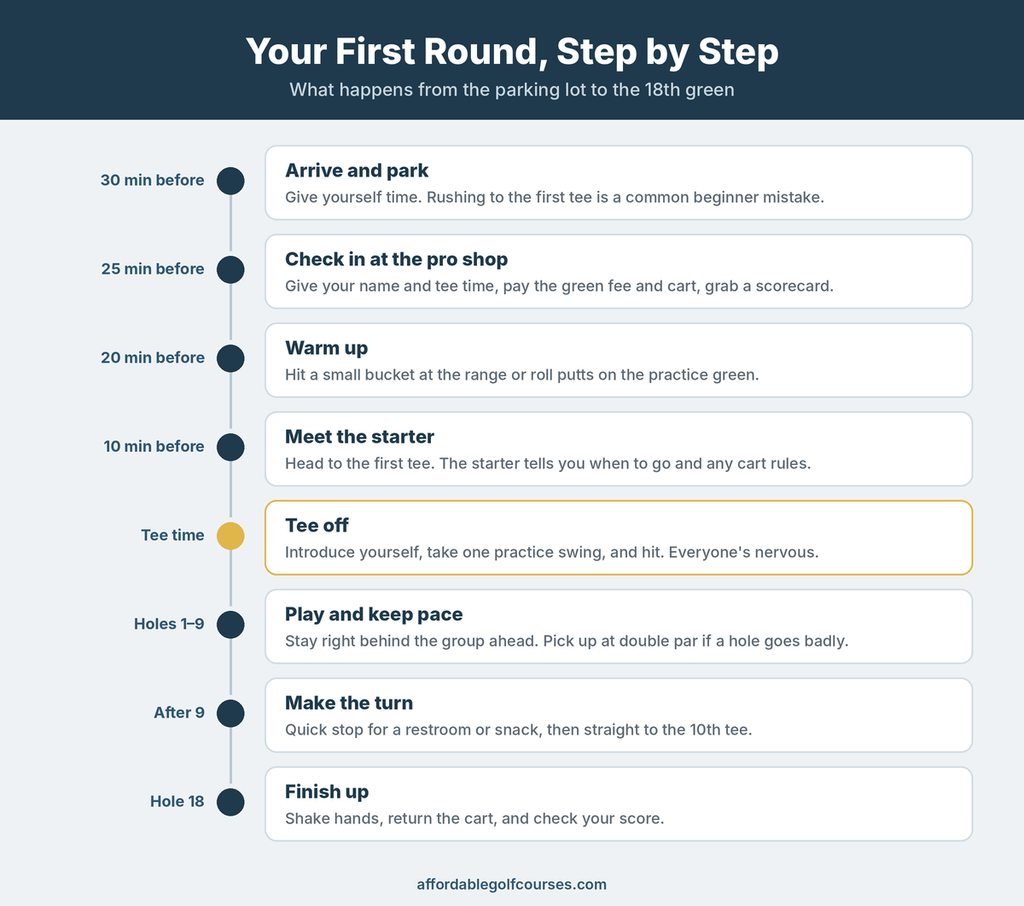
Quick answer: Arrive about 30 minutes before your tee time. Check in at the pro shop, pay your green fee, and warm up on the range or putting green. About 10 minutes before your time, head to the first tee, where the starter sends you off. On the course, the main rule is simple: keep up with the group ahead of you.
Your first round on a real golf course can feel like walking into a party where everyone knows the rules but you. The good news is that the routine is the same at almost every public course, and once you’ve done it once, it’s easy. Here’s exactly what happens, in order.
How Early Should I Get to the Golf Course?
Plan to arrive about 30 minutes before your tee time. That gives you time to park, check in, use the restroom, and hit a few warm-up shots without rushing.
Rushing to the first tee is one of the most common beginner mistakes. You show up flustered, skip the warm-up, and your first few holes go badly before you’ve settled in. An extra 15 minutes fixes that.
If you’re booking your first round, a quieter time helps too. A weekday afternoon or a twilight tee time usually means fewer golfers behind you and a cheaper rate.
What Happens When I Check In at the Pro Shop?
Walk into the pro shop (sometimes called the clubhouse) and tell the person at the counter your name and tee time. They’ll:
- Take payment for your green fee, plus a cart if you’re riding. Some courses charge when you book online, so you may only need to show your confirmation.
- Give you a receipt or cart tag. Keep it. A ranger may ask to see it.
- Hand you a scorecard and pencil if you ask. The scorecard also shows the course layout and local rules.
- Tell you where to go, like which cart is yours and where the first tee is.
This is a great time to ask questions. Say it’s your first time and ask if there’s anything you should know, like whether carts must stay on the paths today. Pro shop staff field beginner questions every day.
Do I Need to Warm Up Before My First Round?
You don’t have to, but a short warm-up helps your nerves more than your swing. Two easy options:
- The driving range. A small bucket of balls is usually cheap. Hit a few with a wedge, a mid iron, and whatever club you’ll use off the first tee.
- The putting green. It’s free at most courses. Roll a few long putts to get a feel for the speed of the greens. That alone can save you strokes.
Watch the clock. Leave the practice area about 10 minutes before your tee time.
What Does the Starter Do?
The starter is the person stationed near the first tee who keeps tee times running on schedule. They’ll check that your group is paid, tell you when it’s your turn to tee off, and mention any rules for the day, like “carts on paths only” after rain.
If you’re a single or a twosome, the starter may pair you with other golfers to fill a group. That’s normal, and it’s usually more fun than you’d expect. Here’s what to know about being paired with strangers.
What Happens on the First Tee?
Introduce yourself to your group, and it’s fine to say it’s your first time. Most golfers remember their own first round and will be friendly about it.
Then:
- Pick your tee box. Courses have several sets of tees, usually marked by color. As a beginner, play the forward tees. Shorter holes keep the round fun and moving.
- Decide who hits first. On the first tee, it’s often whoever’s ready. Most casual groups play “ready golf,” meaning whoever is ready hits, as long as it’s safe.
- Take one practice swing, then hit. Nobody expects a perfect shot. If it dribbles 20 yards, laugh it off and keep going.
What Are the Rules for Driving a Golf Cart?
Every course posts its cart rules, usually at the first tee or on the cart itself. The most common ones:
- Cart paths only: keep all four wheels on the paved path. This is common after rain.
- The 90-degree rule: drive on the path until you’re even with your ball, turn straight across the fairway to it, then go straight back to the path.
- Never drive near the greens or tee boxes. Look for signs or ropes that keep carts away.
When in doubt, stay on the path. Nobody gets in trouble for that.
How Do I Keep From Holding Up the Group Behind Me?
Pace matters more than your score. Nobody minds a beginner who takes a lot of strokes. People mind a group that falls far behind.
The main habits:
- Keep up with the group ahead, not just ahead of the group behind.
- Pick up your ball at double par. If you’ve hit twice the hole’s par (say, 8 on a par 4), pick up and move on. Write down the 8.
- Be ready when it’s your turn. Pick your club while others are hitting.
- Let faster groups play through if you fall behind.
Here are nine habits that keep a beginner on pace. And if you’re still wondering whether you’re ready at all, see how good you need to be to play a golf course.
What Are the Basic Manners on the Course?
You don’t need to know 50 rules. These few cover most situations:
- Stay quiet and still while someone is swinging.
- Don’t walk in someone’s putting line, the path between their ball and the hole.
- Repair your ball mark on the green, and rake the sand after you hit out of a bunker.
- Yell “Fore!” loudly if your ball is heading toward other people.
- Leave the green as soon as everyone has putted out, and write down scores at the next tee, not on the green.
What Happens at the Turn After 9 Holes?
“The turn” is the break between the 9th and 10th holes, usually right by the clubhouse. It’s a chance to use the restroom and grab a drink or snack.
Keep it short, about 5 minutes. The group behind you is coming, and the starter may be sending groups off the 10th tee too. Order something you can take with you.
What Do I Do After the Round?
On the 18th green, take your hat off and shake hands with your group. It’s a small tradition that golfers of every level follow.
Then return your cart to where the pro shop told you, and add up your score. Don’t worry about the number. Your first round is about learning the routine, not the scorecard.
What Should I Wear and Bring?
Most public courses ask for a collared shirt and no denim, but rules vary. Check the course’s website or call. If you’re wondering about specific clothes, here’s whether you can wear leggings golfing.
Bring at least 6 balls, a few tees, a ball marker (a coin works), water, and sunscreen. Want a full list with prices? See how much it costs to start golfing.
Choosing the right course helps too. Municipal courses are often the friendliest place for a first round. Here’s what to expect at a municipal golf course.
Frequently Asked Questions
How early should I arrive for my first tee time?
About 30 minutes early. That gives you time to check in, pay, use the restroom, and warm up without rushing.
Do I have to tell the course it’s my first time?
No, but it helps. Pro shop staff and the starter can tell you the cart rules and anything unusual about the course, and most playing partners will be patient.
What if I’m too slow?
Keep up with the group ahead, pick up at double par on a bad hole, and let faster groups play through. Courses care about pace much more than score.
Do I need my own clubs for my first round?
Many courses rent clubs. Call ahead to check. Renting is a cheap way to play your first round before you buy anything.
What is “the turn” in golf?
The turn is the break between the 9th and 10th holes. It’s a short stop for the restroom or a snack, usually about 5 minutes.
How Did Your First Round Go?
Remember your first time on a golf course? Tell us in the comments what surprised you most, or what you wish someone had told you. Your answer could help a new golfer feel a lot less nervous.
Related Post

Golf Season Pass vs. Pay Per Round: The Break-Even Math
Season Pass vs. Paying Per Round: The Break-Even Math Nobody Shows You A public course [...]
Are Municipal Golf Courses Any Good? What to Expect in 2026
Are Municipal Golf Courses Any Good? What to Expect Before You Book Municipal golf courses [...]