This website uses cookies to improve your experience. We\'ll assume you\'re ok with this, but you can opt-out if you wish. Read More
How Do Beginner Golfers Keep From Holding Up the Group Behind Them?
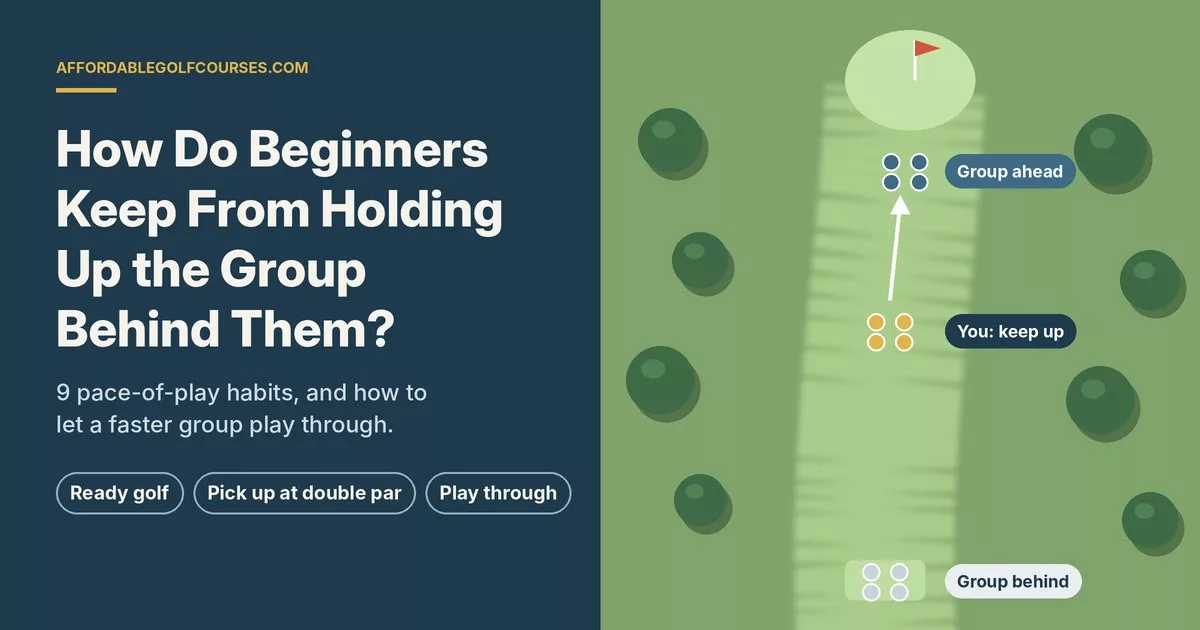
Beginners don’t hold up golf courses by hitting bad shots. They hold them up by losing time between shots: waiting their turn when nobody needs them to, searching too long for a ball, reading a putt from four angles, or walking back to the cart for a different club.
Fix the time between shots and you can shoot 120 without anyone behind you noticing. This guide covers the nine habits that keep a beginner on pace, how to tell whether you’re actually slow, and exactly what to do when a faster group catches up.
How Long Should 18 Holes Take?
Most public courses aim for a round of about 4 to 4.5 hours for 18 holes, or a little over 2 hours for 9. That works out to roughly 13 to 15 minutes per hole. Busy weekend mornings often run longer, and quiet weekday afternoons often run shorter.
The number itself matters less than the rule behind it: your job is to keep up with the group in front of you, not to stay ahead of the group behind you. If there’s an open hole in front of you and a group waiting behind you, you’re slow, whatever the clock says. If the group in front is right there and you’re waiting on every shot, you’re fine.
Do You Need to Be Good to Play at a Normal Pace?
No. Pace has almost nothing to do with skill. A 25 handicapper who plays ready golf moves faster than a 10 handicapper who takes three practice swings and lines up every putt from both sides.
That’s the whole point of our guide on how good you need to be to play a real course: there’s no skill requirement, only a pace requirement. This article is the “how.”
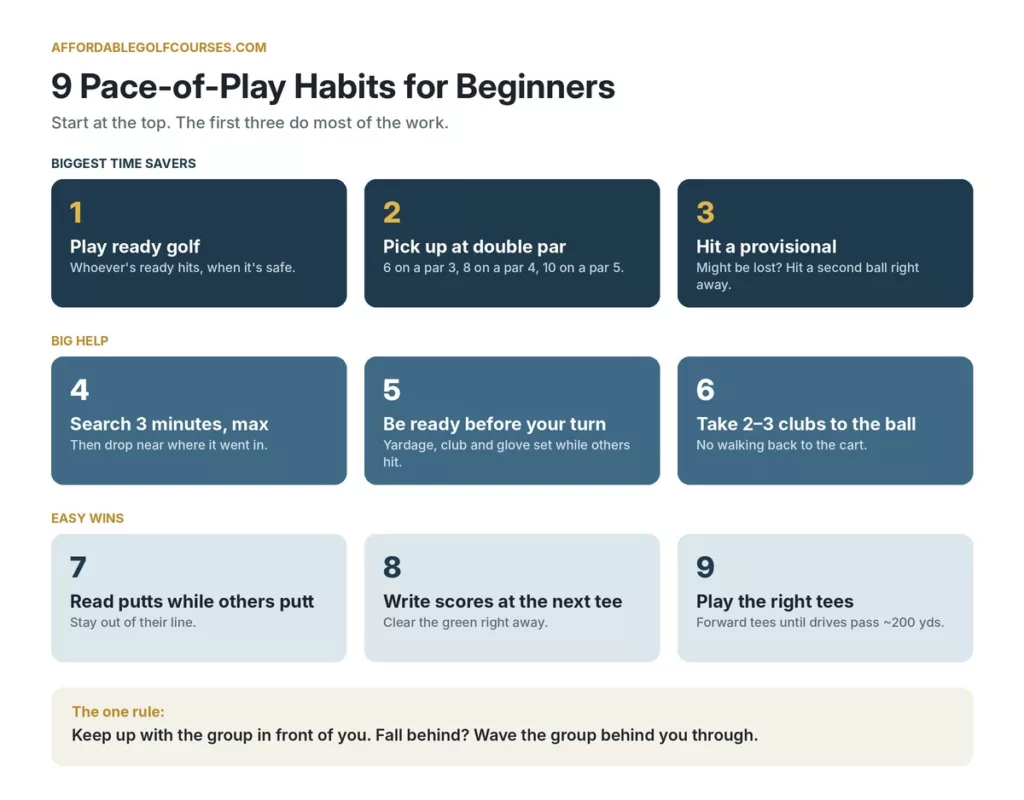
What Are the 9 Habits That Keep a Beginner on Pace?
These nine habits save more time than any swing improvement. Start with the first three. They do most of the work.
1. Play “ready golf”
Ready golf means whoever is ready hits, instead of waiting for the player farthest from the hole. In casual rounds, nearly every course prefers it. Just say “I’m ready, mind if I go?” and hit when it’s safe. The only exception is someone else’s line of play or safety, so never hit while someone is ahead of you within range.
2. Pick up after double par
When a hole is getting away from you, pick up your ball once you reach double par: 6 on a par 3, 8 on a par 4, 10 on a par 5. Write that number down and move on. For handicap purposes, the most you can post on a hole is net double bogey anyway, so those extra strokes don’t count for anything.
This is the single biggest time-saver for beginners, and nobody will think less of you for it. Experienced golfers do it constantly.
3. Hit a provisional ball when you might have lost one
If your shot might be lost or out of bounds, announce “provisional” and hit a second ball right away from the same spot. If you find the first one, play it and pick up the provisional. If you don’t, you play the provisional, and you’ve saved a long walk back to the tee.
4. Limit ball searches to 3 minutes
The Rules of Golf allow three minutes to search. In a casual round, many golfers spend less. If it’s not turning up quickly, drop a ball near where it went in, add a penalty stroke or two, and keep playing. Many courses use a local rule allowing exactly this, and in a casual round nobody will object.
5. Be ready before it’s your turn
While others are hitting, figure out your yardage, pick your club, and put your glove on. When it’s your turn, you should need one practice swing at most, then hit.
6. Take extra clubs to the ball
If you’re riding and the cart has to stay on the path, take two or three clubs with you, not one. Walking back to the cart because you guessed wrong is one of the most common time-wasters for beginners. The same goes for walkers: leave your bag on the side of the green closest to the next tee, never in front of it.
7. Read your putt while others putt
You can read your line while your playing partners are putting, as long as you’re not standing in their line or their view. Then when it’s your turn, step up and putt. On short putts, just finish.
8. Write scores at the next tee, not on the green
Walk off the green as soon as the last putt drops, then write down scores at the next tee. Standing on the green adding up numbers holds the group behind you on their approach shots.
9. Play the right tees
Play from the forward tees until your typical drive goes past about 200 yards. Longer tees mean more shots, more walking, and more searching. Playing the right tees isn’t a statement about your ability. It’s just math.
How Do You Know If You’re Playing Too Slowly?
Check these three signs on every hole:
- The group behind you is waiting on the tee while you’re still in the fairway, more than once.
- There’s a full open hole in front of you. If you can’t see the group ahead, you’ve fallen behind.
- A course marshal or ranger drives up to you. Marshals usually come out only when a group has fallen behind.
If any of those happen, speed up first using the habits above. If you’re still falling behind, it’s time to let the group behind you play through.
How Do You Let a Faster Group Play Through?
Letting a group play through means stepping aside so they can play the hole ahead of you. Here’s how to do it without awkwardness:
- Pick the right spot. The best place is a par 3 tee, or after you’ve hit your tee shots on any hole and are walking down the fairway.
- Wave them up. A wave from the green or the side of the fairway is the universal signal. You can also just say, “Want to play through?”
- Step completely out of range. Move to the side of the fairway or behind the green, well out of the way.
- Wait until they’ve hit and moved on, then continue.
It takes about five minutes and buys you an entire round with nobody waiting behind you. Most golfers appreciate it and will thank you on the way by.
Does Walking or Riding Change Your Pace?
Riding is usually faster for beginners, but not always. A cart gets you between shots quickly, but cart-path-only days and two players heading to opposite sides of the fairway can make it slower than walking. A walker with a push cart who heads straight to their ball often keeps up fine.
If you’re deciding between the two on cost, our cart fee vs. walking rate breakdown runs the season math.
When Is the Best Time for a Beginner to Play?
The easiest time is late afternoon on a weekday. Courses are quieter, there’s less pressure from the group behind you, and green fees are lower. See our guide on when twilight golf starts.
The hardest time is a Saturday or Sunday morning, when tee times are packed every 8 to 10 minutes and serious golfers are trying to finish before lunch. Save those for later in your first season.
What If You Get Paired With Faster Players?
Tell them on the first tee. Something like, “Heads up, I’m pretty new, so I’ll pick up if I’m holding us up.” That one sentence takes all the pressure off. Experienced golfers almost always respond well to it, and many will offer tips.
If you’re nervous about being paired at all, here’s what to expect when a course pairs you with strangers.
Where Should a Beginner Play Their First Rounds?
Start on a 9-hole course, an executive course, or a municipal course on a quiet afternoon. These courses expect newer golfers, and the people around you are more patient. Our guide to what to expect at a municipal course covers why munis are the best place to learn, and our full cost to start golfing guide shows how to keep those first rounds cheap.
The Bottom Line
Pace of play is the one part of golf a beginner can get right on day one. Play ready golf, pick up at double par, hit a provisional when in doubt, and keep up with the group ahead. If someone faster catches you anyway, wave them through. Do those things and nobody on the course will care what you shot.
What’s the most helpful thing an experienced golfer ever told you about pace when you were starting out? Or if you’re new, what’s the part of keeping up that makes you most nervous? Drop it in the comments and I’ll answer every one.
Related Post

Golf Ball Compression Guide for Slow Swing Speeds
Bottom Line Up Front: If you swing your driver under 85 mph, choose golf balls [...]
Golf Season Pass vs. Pay Per Round: The Break-Even Math
Season Pass vs. Paying Per Round: The Break-Even Math Nobody Shows You A public course [...]